
Architecture

The marketer’s guide to scalable text-to-interactive-video workflows

Yonatan Schreiber's avatar Yonatan Schreiber | Aug 24, 2026
Blings blog cover reading The marketer's guide to scalable text-to-interactive-video workflows, with icons showing a document turning into a node graph and then a video player.
Yonatan Schreiber's avatar Yonatan Schreiber | Aug 24, 2026

Video production has always been the bottleneck in personalized marketing. A marketer with a clear idea for a personalized campaign still had to route it through a creative team, a production timeline, and a rendering pipeline before anything reached a customer. Text-to-interactive-video workflows collapse that chain. A marketer describes the video in text, and the workflow produces an interactive, personalized video that scales to the entire audience from a single template. This piece is a practical guide to how those workflows function and what makes them scale.

The focus here is operational: how a marketer moves from a text brief to a live, personalized, interactive video without a per-render production cost, and what the architecture underneath has to provide.

What is a text-to-interactive-video workflow?

A text-to-interactive-video workflow is a production process where a marketer describes the desired video in text and the system generates an interactive, personalized video built on a template that renders per customer on demand. It compresses the traditional brief-to-broadcast chain from weeks into a workflow a marketer can drive directly.

The word “interactive” is load-bearing. The output is not a flat video clip. It is a personalized experience the customer can act inside, with taps, choices, and data-driven scenes. And the word “scalable” is equally important: the workflow produces one template that serves the entire audience, not a separate file per customer.

The distinction from generic AI video generators matters. A generic generator produces a single fixed clip. A text-to-interactive-video workflow produces a Dynamic Master Template that renders a one-to-one experience for every customer from their data. For the architectural context, see AI video personalization in 2026: why architecture matters more than the algorithm.

Why has video production been the personalization bottleneck?

Video production has bottlenecked personalization because the traditional pipeline was built for one-to-many broadcast, not one-to-one delivery. Producing a single brand video takes a creative team, a shoot or an animation build, an edit, and a render. Producing a personalized video for every customer, under the traditional model, multiplied that effort by the number of variants, which made it operationally impossible past a handful of segments.

Per-render production means the system generates a separate video file for each customer or variant, which forces the production cost to scale linearly with audience size. This is the constraint that kept personalized video out of reach for most marketing teams. A text-to-interactive-video workflow removes it by producing a template rather than files.

How does a scalable text-to-interactive-video workflow function?

The workflow has four stages, and the marketer can drive all of them without a production queue.

Stage one: the text brief. The marketer describes the video: the scenes, the personalization variables, the interactive choices, the call to action. The description is the input.

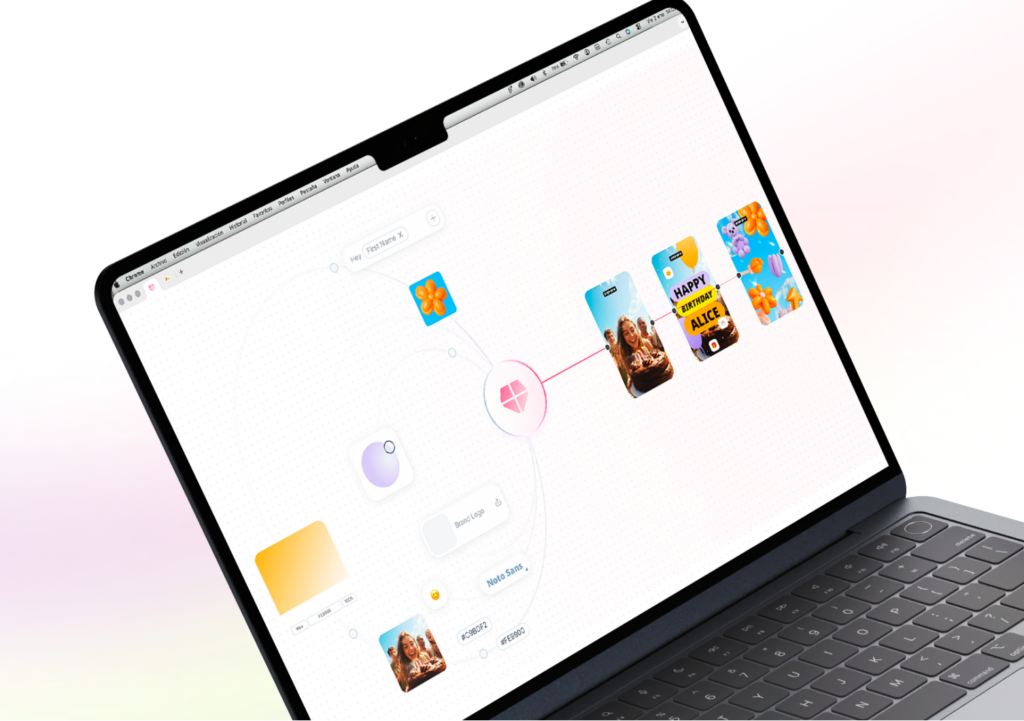
Stage two: template generation. The workflow produces a Dynamic Master Template that encodes the described structure. The template defines the scenes, the data slots, and the interactive elements.

Stage three: data connection. The template connects to the brand’s customer data through native CRM and customer-engagement-platform integrations. The personalization variables map to real customer fields.

Stage four: on-demand rendering. The template renders per customer on the customer’s device at the moment of open. On-demand rendering means the personalized video assembles locally from the template plus the customer’s data, so one template serves an unlimited audience with no per-render cost.

The result is that a marketer moves from a text description to a live personalized campaign without waiting on a production pipeline. For the underlying rendering model, see the MP4 is dead.

What makes a text-to-interactive-video workflow actually scale?

Two architectural properties determine whether the workflow scales. The first is the single-template model. A Dynamic Master Template is one creative logic system that renders a personalized experience per customer, which means the production artifact is one template regardless of whether the audience is a thousand people or fifty million. The second is the pricing model. Infrastructure pricing means the brand pays for platform capacity rather than per individual render, so scaling the audience does not scale the cost.

Together these two properties are what separate a workflow that scales from one that collapses under its own volume. A text-to-video tool that produces a file per customer, priced per render, produces the same cost explosion as the traditional pipeline it claims to replace. A workflow built on a single template with infrastructure pricing scales flat. For a comparison of the pricing models, see Blings vs Idomoo: which personalized video platform is right for your enterprise.

What does a text-to-interactive-video workflow produce in practice?

The workflows produce campaigns that would have been impossible under the traditional pipeline. Habit Burger Grill ran personalized interactive loyalty video built on the single-template model and lifted membership signups by 47%. See the Habit Burger Grill case study.

Wyndham produced a personalized recap with an embedded interactive survey that reached a 66.7% completion rate, alongside a 75% lift in email click-through rate, from a single template that served its entire loyalty base. See the Wyndham case study.

Live Nation VIP ran interactive personalized fan video with in-video language selection, producing a 17.55% lift in unique opens, 82 seconds of average watch time on a 40-second video, and a 16.6% share rate, all from one template. See the Live Nation VIP case study.

FAQ

What is a text-to-interactive-video workflow?

A text-to-interactive-video workflow is a production process where a marketer describes a video in text and the system generates an interactive, personalized video built on a single template that renders per customer on demand. It replaces the traditional weeks-long brief-to-broadcast chain.

How is text-to-interactive-video different from an AI video generator?

A generic AI video generator produces a single fixed clip. A text-to-interactive-video workflow produces a Dynamic Master Template that renders a one-to-one interactive experience for every customer from their data, scaling to the whole audience from one template.

What makes a personalized video workflow scalable?

A personalized video workflow scales when it uses a single Dynamic Master Template rendered on demand per customer, priced as infrastructure rather than per render. This keeps the production artifact and the cost flat regardless of audience size.

Can marketers build personalized video without a creative production team?

Yes. A text-to-interactive-video workflow lets a marketer move from a text brief to a live personalized campaign without routing through a production pipeline, because the template generation and on-demand rendering replace the traditional shoot-edit-render chain.

The takeaway

Video production has been the bottleneck that kept personalized video out of reach for most marketing teams. Text-to-interactive-video workflows remove the bottleneck by letting a marketer move from a text brief to a live, personalized, interactive campaign built on a single template that renders per customer on demand. The two architectural properties that make it scale are the single Dynamic Master Template and infrastructure pricing. Habit Burger Grill, Wyndham, and Live Nation VIP all run campaigns that this workflow makes possible.

The marketers who adopt these workflows will ship personalized interactive video at the speed of a text brief, while their competitors are still routing campaigns through a production queue. The workflow is the speed advantage.

Your customers are waiting for great video experiences.

Schedule a custom demo