Best Practices

A/B TESTING YOUR EMAIL CAMPAIGNS FOR MAXIMUM IMPACT

yonatan's avatar yonatan | Mar 25, 2026
AB testing email campaigns in 2026
yonatan's avatar yonatan | Mar 25, 2026

Most marketing teams have graduated from static email campaigns. They are using video, dynamic content, and behavioral triggers. But if that video is pre-rendered at send time, it is already out of date by the time it is opened. And if there is no systematic testing behind it, you are scaling assumptions instead of data.

This guide covers how to move from production to orchestration: how to structure A/B tests for personalized video, how to eliminate the production bottleneck that makes iteration expensive, and how to protect customer data through every test you run.


AB testing video marketing

Why static video fails as a testing surface

Traditional personalized video creates a fundamental problem for A/B testing: it conflates production time with optimization time. Here is the typical workflow:

Design requests a new video variant. Production renders a unique file for every recipient in the test cohort. Files are uploaded, attached, and dispatched. Two weeks later, results come in. The winning variant requires another production run to scale.

By the time the cycle completes, the data is stale, the offer has changed, and the cost of iteration has outpaced the benefit. This is not a testing problem; it is an architecture problem. And it is entirely solvable.

Test outcomes, not just creative

The most common mistake in video A/B testing is optimizing for the wrong metric. Teams test visual styles, colors, or motion choices, but neglect to connect those variables to revenue outcomes. Before you design a single test variant, define your success metric in terms of business impact:

Conversion rate: Did the recipient take the intended action, whether that is a purchase, a renewal, or an upgrade? Customer lifetime value (LTV): Did customers who received this variant spend more over the following 30 or 90 days? Churn reduction: Did the campaign measurably reduce cancellations or inactivity in the test cohort?

Because Blings allows you to update content post-deployment, you can optimize live video without ever resending a campaign. That means your test results can inform real-time changes to a campaign that is already live in your audience’s inboxes.

Leveraging the Dynamic Video Template

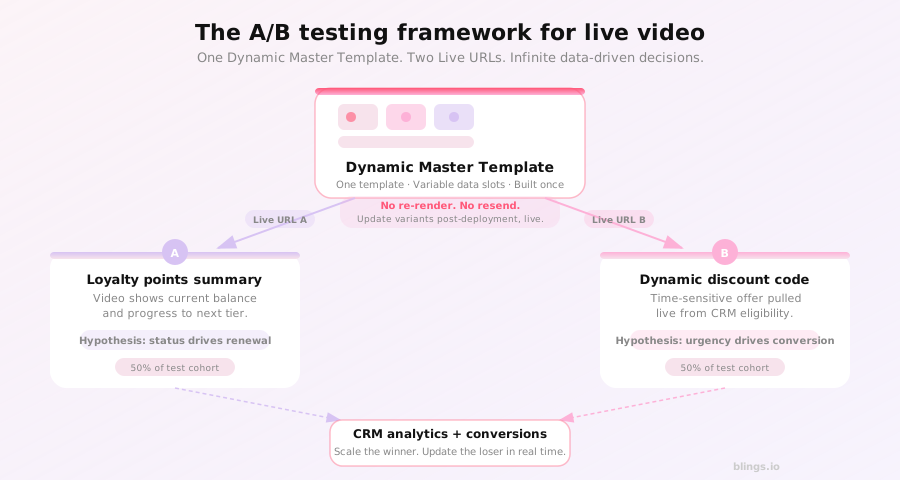
Blings eliminates the production bottleneck by decoupling content from delivery. Your team builds a single Dynamic Video Template: the structure, the motion design, the brand elements, and the data variable slots. Variants are created by changing what populates those slots, not by rebuilding the template from scratch.

Test A: A video featuring the customer’s current loyalty points total and a progress bar toward their next reward tier. Hypothesis: status-based personalization drives renewal intent.

Test B: A video featuring a dynamic, time-sensitive discount code that expires at a specific date pulled from the customer’s offer eligibility in your CRM. Hypothesis: urgency-based personalization drives immediate conversion.

Both variants live inside the same Dynamic Video Template. Each generates its own Live URL. You route audience segments to each URL through your existing CRM, exactly as you would route any split test. No additional production work. No designer queue. No render wait.


graphic2 blog2 on device generation

Zero-knowledge data integrity

A common roadblock for teams running personalized A/B tests is data security review. Legal and security teams are right to scrutinize any workflow where customer data flows through a third-party platform. Blings is designed to pass that review by eliminating the data exposure surface entirely.

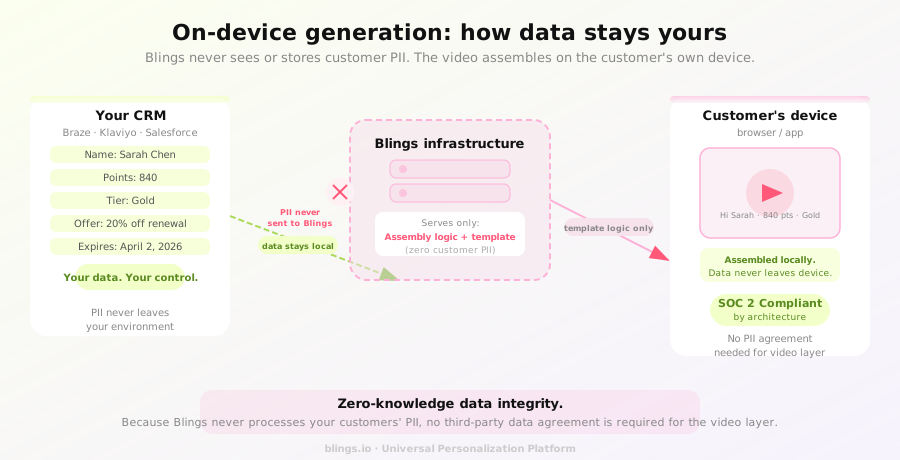
Blings uses on-device generation: the video assembles on the customer’s browser at the moment of open. The customer’s PII never leaves their device to reach Blings infrastructure. What Blings serves is the template and the assembly logic. The data that populates it lives only on the customer’s machine.

The result: Even your most complex A/B tests remain SOC 2 compliant. Because Blings never sees or stores your customer’s PII, there is no third-party data-processing agreement required for the video generation layer. Your data stays yours.

This zero-knowledge architecture is not a compliance workaround; it is a foundational design choice. It means you can run hyper-personalized tests with live financial data, loyalty tier information, or behavioral triggers without expanding your vendor risk surface.

Data-driven decisions at every stage

Before the campaign: define your variable and your metric

A well-structured personalized video A/B test isolates one variable at a time. Start with the highest-impact content variable in your template: the offer type, the data element featured most prominently, or the urgency mechanism. Set your primary metric before you launch and resist the temptation to declare a winner on click-through rate alone if your actual goal is conversion.

What this means for your email performance

Before the campaign: define your variable and your metric

A well-structured personalized video A/B test isolates one variable at a time. Start with the highest-impact content variable in your template: the offer type, the data element featured most prominently, or the urgency mechanism. Set your primary metric before you launch and resist the temptation to declare a winner on click-through rate alone if your actual goal is conversion.

During the campaign: update without resending

Blings allows you to modify the content of either test variant in real time. If Test A is clearly underperforming after 48 hours, you can update it to a stronger hypothesis without touching the campaign infrastructure. Every customer who opens the email from that point forward sees the updated version. This is a capability that static video cannot offer at any price.

After the campaign: scale what works

When a variant wins, scaling it does not require a new production run. The winning Dynamic Video Template is already built. You update the data variables, confirm the Live URL, and route your full audience to it. The time from test conclusion to full-scale deployment is measured in minutes, not weeks.


ROI of live video testing

Closing the gap between insight and action

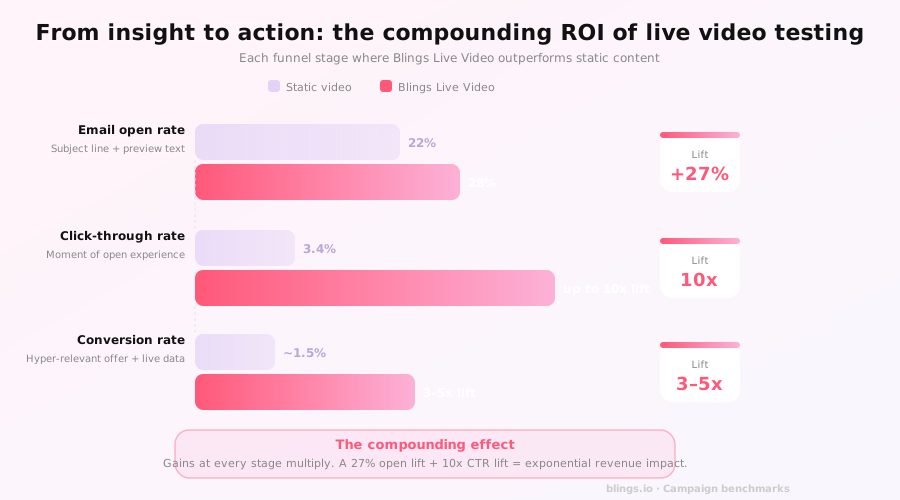
The distance between what you know about your customers and what they actually experience in your emails is where revenue leaks. Brands that close this gap do not just see higher play rates and better conversion numbers; they build the kind of trust that compounds into long-term customer lifetime value.

Blings turns your CRM from a data warehouse into a high-performance revenue engine. Every customer attribute you have already collected, every behavioral signal, and every offer in your system becomes a live element in a cinematic video that updates itself for every viewer, in every test, at every moment of open.

Stop guessing. Stop scaling assumptions. Start testing with infrastructure built for the speed your data already moves at.

Frequently asked questions

How do you A/B test personalized video in email campaigns?

With Blings, you create two versions of a Dynamic Video Template, each with a different content variable, offer, or creative direction. Each version generates its own Live URL. You route audience segments to each URL through your CRM just as you would with any split test. Because Blings uses on-demand generation, you can update either variant in real time without resending the campaign.

What is on-device generation and why does it matter for A/B testing?

On-device generation means the personalized video assembles on the customer’s browser or device at the moment of open, not on a remote server. For A/B testing, this means you can update the content of either test variant post-deployment without breaking the test or resending. It also ensures that no customer PII is transmitted to or stored on third-party servers, keeping even the most complex tests SOC 2 compliant.

Can I change a Blings video after a campaign is already sent?

Yes. Because the video is generated at the moment of open rather than rendered at send time, any updates you make to the Dynamic Video Template take effect for every subsequent open. A customer who opens the email tomorrow sees the updated version. This makes Blings the only personalized video platform that allows true post-deployment optimization.

How does Blings protect customer data during personalized video campaigns?

Blings uses a client-side architecture and on-demand generation. The video assembles on the customer’s own device using their data. Blings servers never receive, process, or store any customer PII. This is a zero-knowledge approach to data integrity and is SOC 2 compliant by design.

What metrics should I use to measure personalized video A/B test success?

The most meaningful metrics for personalized video tests are conversion rate, customer lifetime value (LTV) over 30 to 90 days, and churn reduction rate. Click-through rate is a useful leading indicator, but it does not capture the full revenue impact. Define your primary success metric before the test launches and measure against it consistently.

Run your first personalized video A/B test

You already have the customer data. You already have a CRM. What you may not have is the infrastructure to turn that data into a live, cinematic experience that updates itself in real time, adapts to every test variant instantly, and never touches your customers’ PII.

Blings is that infrastructure. Build once, test continuously, and scale what works at the speed of your data.


Schedule your Blings demo now

See Blings in Action, For Free!
Get Started for Free