Best Practices
Video

How McDonald’s achieved a 54% video completion rate with Blings personalized video

Yosef's avatar Yosef | Apr 8, 2026
McDonalds Sales Increase
Yosef's avatar Yosef | Apr 8, 2026

Introduction

McDonald’s serves tens of millions of customers every day across thousands of locations worldwide. The brand’s marketing operation matches that scale: digital programs spanning loyalty, app engagement, order confirmation, and promotional communications across an enormous and diverse customer base.

When McDonald’s evaluated personalized video as a channel for direct customer communication, the requirement was not a proof of concept. It was a production-scale deployment that could operate at the volume, speed, and data accuracy that one of the world’s largest fast-food brands demands.

Blings delivered. The results included a 54% video completion rate, a figure that reflects genuine customer engagement with a communications format that the brand had not deployed at this scale before.

This case study covers the challenge McDonald’s faced, the solution Blings built, the technical approach that made it work, and the outcomes the program delivered.

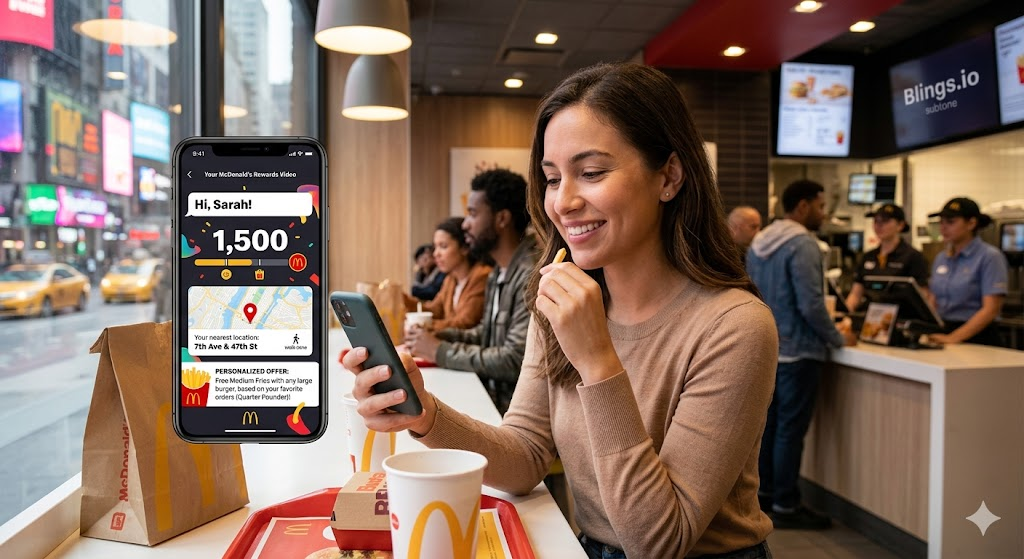
McDonald’s personalized video customer communication showing loyalty status and personalized offer on mobile device

The challenge: communicating with scale and specificity

McDonald’s digital customer base is enormous and heterogeneous. Customers range from daily regulars with deep loyalty histories to occasional visitors driven by promotions. They use the McDonald’s app at different frequencies, have different favorite orders, live in different markets with different local menus, and have different loyalty tier statuses.

Standard broadcast email and push notification programs reach this audience at scale but cannot speak to individual customers with any meaningful specificity. A communication about a specific loyalty reward is relevant to customers who have reached that tier and not to those who have not. A message about a product available in some markets is irrelevant to customers in others.

The challenge McDonald’s needed to solve was not reach. It was relevance at scale: how to communicate with millions of individual customers in a way that each communication felt specific to that customer’s relationship with the brand, without requiring a campaign team to build separate assets for every segment.

The solution: Dynamic Master Template with on-device generation

Blings built a Dynamic Master Template for McDonald’s customer communications: a single master asset that could generate a unique, personalized version for every customer in the program, with each version reflecting that customer’s specific loyalty status, available offers, location-relevant products, and history with the brand.

The technical foundation was Blings’ MP5 Format: a code-based video asset that is not a pre-rendered file but a set of instructions that render on the viewer’s device at the Moment of Open. When a McDonald’s customer opens a communication, the MP5 connects to McDonald’s live customer data system and generates their specific version of the video on their device, in milliseconds.

This architecture solved two of the most significant problems in large-scale personalized video:

Data accuracy at the moment of viewing. McDonald’s loyalty programs are dynamic: points accumulate with every order, tier statuses update, and available rewards change. A video that was rendered yesterday already has the wrong loyalty data for any customer who has made a purchase since then. Blings’ Moment of Open technology ensures that every customer sees their live loyalty status, their current available rewards, and their current progress toward the next tier, accurate to the second they open the communication.

Scale without per-render cost. McDonald’s customer base means that any personalized video program must work economically at millions of sends. Per-render pricing models that charge for each video generation create a cost structure that makes high-frequency personalized communication prohibitively expensive at this volume. Blings’ Infrastructure Pricing, built around the Dynamic Master Template rather than individual renders, kept the program economically viable at enterprise scale.

How the program worked

The deployment ran across McDonald’s app-based customer communication. When specific triggers were met (a loyalty milestone reached, a period of app inactivity, a birthday, a promotional window), a personalized video communication was sent to the relevant customer segment.

Each video opened with the customer’s name and loyalty tier, acknowledging their specific relationship with the brand. The content reflected their accumulated points balance, the specific rewards available to them today, and a relevant offer tailored to their order history and location.

The visual execution maintained McDonald’s brand standards: the familiar color palette, the motion language, and the tone that millions of customers recognize. The personalization layer sat within this brand framework, making each video feel authentically McDonald’s while being unmistakably specific to the individual viewer.

The program ran on Blings’ Zero-Knowledge Architecture. McDonald’s customer data, including loyalty account information, order history, and location data, never left McDonald’s own infrastructure. The Blings platform provided the Dynamic Master Template and the On-Device Generation mechanism; the data stayed within McDonald’s ecosystem.

The results

54% video completion rate

The headline outcome: 54% of customers who received a personalized video communication watched it to completion. In the context of marketing video performance norms, this number is significant. Average completion rates for non-personalized marketing video in email and app environments typically fall between 20% and 35%. The personalization effect, specifically the combination of the customer’s live data, their loyalty status, and the relevance of the offers displayed, drove completion rates well above what generic video content achieves.

A completion rate of 54% in direct customer communication means that more than half of every audience watching a McDonald’s Blings video stayed with it to the end. For a brand communicating with a diverse, geographically distributed customer base through app and email channels, this is a meaningful engagement outcome.

Real-time data accuracy

No Data Decay. Every customer who opened a communication saw their actual current loyalty status, their actual available points, and their actual eligible rewards at the moment they opened it. This was particularly important for loyalty-heavy communications where inaccurate balance information creates negative customer experiences and customer service contacts.

Zero Tech Debt

McDonald’s marketing team did not need to rebuild or re-render video assets every time loyalty tiers updated, reward catalogs changed, or regional promotions shifted. The Dynamic Master Template updated its output automatically because the data it pulled from updated. The creative production investment in the original template generated ongoing personalized communications without additional per-campaign production cycles.

Enterprise-scale deployment

The program operated at the volume that McDonald’s requires: millions of personalized communications, generated on-demand, with no server-side rendering bottleneck and no per-render cost inflation. The economics of the deployment remained consistent as the program scaled.

What this means for other brands

McDonald’s is not a typical case study subject. The scale of their operations, their customer data infrastructure, and their digital marketing capability are at the extreme end of the enterprise market.

But the core challenge they solved is not unique to fast food or to brands of their size. Every enterprise with a loyalty program, a digital customer base, and a need to communicate personally at scale faces the same structural problem: generic broadcast communication fails to engage, but traditional personalized approaches either cost too much at high volume or lack the data accuracy that modern customers expect.

The Blings approach that delivered a 54% completion rate for McDonald’s scales down to any enterprise deploying loyalty, lifecycle, or trigger-based communications at significant volume. See how other enterprise brands have achieved similar results. The architecture is the same. The economics are the same. The outcome, genuine engagement driven by genuine personalization, is the same.

Key takeaways

Personalization requires data accuracy, not just data access. McDonald’s did not lack customer data. They lacked a mechanism for delivering that data as live, accurate content at the moment of viewing. Blings’ Moment of Open technology solved this.

Scale economics matter as much as performance metrics. A personalized video program that costs 10 times more per customer than a standard email program cannot be deployed at enterprise scale even if it performs dramatically better. Infrastructure Pricing makes the economics work at the volume that global brands require.

Zero-Knowledge Architecture is an enterprise requirement, not a premium feature. For any brand handling customer loyalty data, order history, and personal information, the question of where that data goes during content generation is a compliance requirement. Blings’ architecture makes compliance the default, not an add-on.

Visit blings.io to learn more about how Blings works with enterprise brands across retail, food service, entertainment, and financial services.

See how Blings can work for you
Get Custom Demo