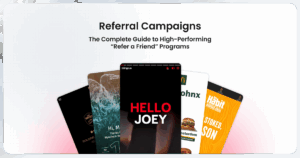
If you want cheaper, faster growth, start with the customers who already love you. A referral campaign turns that goodwill into measurable acquisition by rewarding people for inviting friends, then tracking the entire journey from share to sign-up to purchase.
In this guide, you will learn how referral campaigns work, what to offer, how to distribute, what to measure, and how brands use personalized, interactive video to increase results. We will also share how Habit Burger used this approach to lift referral sign-ups by 47%.
What is a referral campaign?
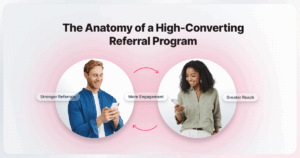
A referral campaign is a structured program that encourages existing customers to invite new customers in exchange for a reward. It usually includes clear incentives, simple sharing mechanics, branded creative, and end-to-end tracking.
Why referral campaigns work
- Trust beats ads. People believe friends more than they believe brands.
- High intent traffic. Referred visitors arrive pre-qualified, with context and social proof.
- Compounding effect. Each happy customer can become a distribution channel.
- Lower CAC. Referral CPA is often significantly lower than paid media.
The essential building blocks
- Offer design
- Advocate reward, friend reward, or both
- Flat incentive, tiered rewards, or gamified milestones
- Time-bound boosts to create urgency
- Audience triggers
- Moments of delight, successful purchases, loyalty milestones, or customer support wins
- Post-purchase thank you pages, order confirmations, loyalty emails, or in-app prompts
- Creative and UX
- Clear headline, value, and next step
- Personalized elements that make the invite feel one-to-one
- Mobile-first layouts with short copy and large tap targets
- Distribution
- Email, SMS, push, in-app, landing pages, and QR in retail environments
- Social share and native device share sheets
- Tracking and governance
- Unique links and IDs, completion tracking, anti-fraud rules, and clear terms
Smart incentives that actually move people
- Double-sided rewards. Give the advocate and the friend something of value.
- Tiered milestones. Unlock bigger rewards at 3, 5, 10 referrals.
- Contextual offers. Match the incentive to the product lifecycle or season.
- Limited-time boosts. Short bursts to spike participation without training users to wait for discounts.
Creative that converts: make it personal and interactive
Static banners are easy to ignore. Personalized video stops the scroll and clarifies the ask in seconds.
What works now
- A dynamic GIF preview that includes the advocate’s name, the friend’s name when available, and the reward.
- A short, branded video with embedded CTAs: Claim offer, Sign up, Share again.
- Copy that explains the win-win in one sentence, then moves users directly to the action.
Why Blings
- Personalization at scale. Pull real-time tokens from your CRM to render one-to-one content for every viewer.
- Interactivity. CTAs live inside the video, so viewers tap without leaving the experience.
- Measurement. Track plays, completions, clicks, shares, and completed referrals, then pass results back to your CRM.
Channels and placements
- Email. Order confirmation, loyalty updates, and monthly statements.
- SMS. Fast, timely nudge with a personalized video link.
- In-app and web. Post-purchase modals, account pages, and loyalty hubs.
- Paid retargeting. Remind recent purchasers to share while excitement is high.
- Physical touchpoints. QR codes on packaging, receipts, kiosks, or signage.
What to measure
- Participation rate: Advocates who shared divided by eligible customers.
- Share rate: Average invites per advocate.
- Click-through rate: Referral link clicks divided by invites.
- Referral conversion rate: Referred sign-ups divided by referral clicks.
- K-factor: Share rate multiplied by referral conversion rate. When K is greater than 1, growth compounds.
- CAC and LTV impact: Compare referred CAC against paid CAC, and track LTV of referred cohorts.
Habit Burger replaced static messages with personalized, interactive referral videos that plugged into their existing flow. The invite reflected the advocate’s name and the specific offer, then guided friends to claim in a few taps. The result was a 47% lift in sign-ups tied to the referral journey. Clear value, one-to-one creative, and built-in tracking made the difference.
Common pitfalls to avoid
- Muddy value. If users cannot explain the reward in one breath, simplify it.
- Too many steps. Remove extra clicks between invite and claim.
- One-size-fits-all. Different customers respond to different triggers and incentives. Segment and test.
- Set and forget. Referral programs improve with iteration. Test creative, timing, and rewards.
Launch checklist
- Define the offer
Choose double-sided or advocate-only, set value, limits, and terms.
- Pick your moments
Map the happiest points in the customer journey. Add triggers there first.
- Design the experience
Write a single sentence that states the reward and the next step. Create a short, branded video with embedded CTAs.
- Set up tracking
Generate unique links, pass IDs through the flow, and verify completion events.
- QA across channels
Test email, SMS, in-app, and landing pages on mobile and desktop.
- Ship a two-week pilot
Start with one segment, one offer, and two creative variants. Measure, then scale.
How Blings helps you move fast
- Build once, personalize for everyone. Use a single template to render one-to-one videos from CRM data.
- Drop in anywhere. Add to email, SMS, or web with a simple snippet or SDK.
- See the whole journey. Plays, completions, clicks, shares, sign-ups, and redemptions, all tracked and passed back to your CRM.
- Proven lift. Brands like Habit Burger have seen significant increases in referral sign-ups with personalized, interactive video.
FAQs
What is a referral campaign?
A referral campaign is a structured program that rewards customers for inviting friends, using unique links and tracked incentives to drive new sign-ups and purchases.
How do I choose a referral incentive?
Start with a double-sided reward where both the advocate and the friend benefit. Test values, tiers, and limited-time boosts to find the optimal mix.
How long should I run a referral program?
Keep it always on, then layer promotional bursts during peak seasons, product launches, or loyalty milestones.
What is a good referral conversion rate?
Benchmarks vary by industry, but improving creative relevance and reducing steps will raise conversion. Personalizing the invite and keeping the claim path under three taps are reliable levers.
How can I prevent referral fraud?
Use unique links, device and IP checks, cooldown periods, order verification, and clear terms that define valid referrals.
Ready to turn referrals into a reliable acquisition channel? Get a referral demo and see how personalized, interactive video can lift your program’s sign-ups, tracking, and ROI.