Customer Stories
(QSR) Quick Service Restaurants
Email

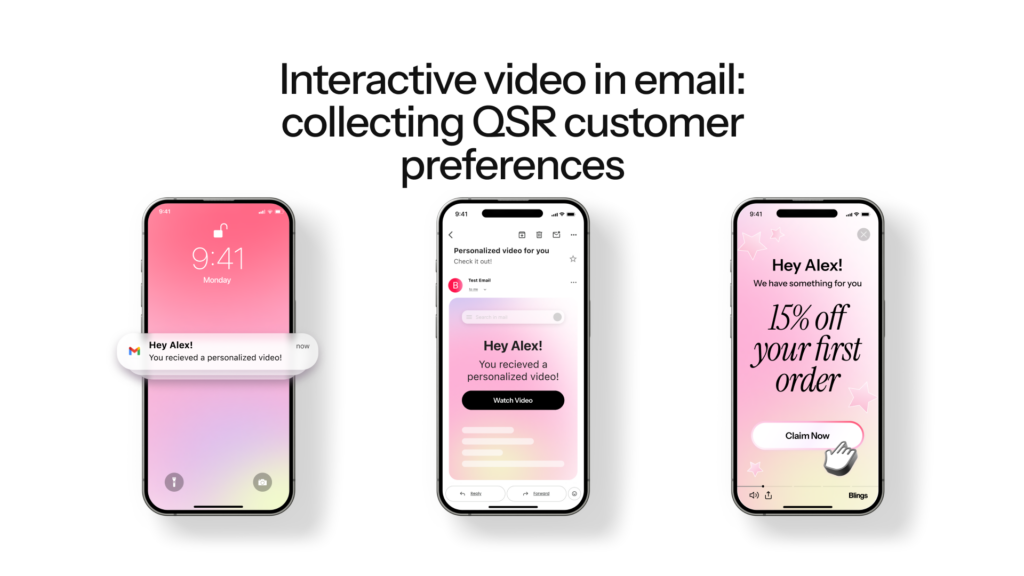
Interactive video in email: how QSRs can collect customer preferences directly inside the inbox

Yosef's avatar Yosef | Aug 16, 2026
Interactive video in email: how QSRs can collect customer preferences directly inside the inbox
Yosef's avatar Yosef | Aug 16, 2026

Interactive video in email: how QSRs can collect customer preferences directly inside the inbox

Every QSR wants to know its customers better: their favorite sauce, their go-to order, their dietary preferences, their local store. That knowledge powers every personalization effort downstream. The problem is that asking for it usually means sending the customer to a survey they will not complete. Interactive video in email closes that gap. The customer taps a choice directly inside a video overlay, “What’s your favorite sauce?”, and that answer flows straight back into Braze or Salesforce, no separate survey page, no drop-off. It is two-way communication happening inside the inbox.

This piece explains how QSRs collect customer preferences through interactive video, why in-video data capture beats a linked survey, and the architecture that makes the two-way flow work. It draws on production data from Wyndham, Habit Burger Grill, and Live Nation VIP.

What is interactive video in email?

Interactive video in email is a personalized video, delivered through the inbox, that lets the customer make choices inside the video itself, such as tapping a preference or answering a question, with each response flowing back to the brand’s CRM. The customer acts inside the video rather than clicking out to a separate page.

The distinction from standard video email matters. A standard video email is one-way: the customer watches. Interactive video email is two-way: the customer watches and responds, and the brand learns from the response. That two-way capability is what turns the inbox into a data-collection channel.

Why does in-video data capture beat a linked survey?

In-video data capture beats a linked survey because it removes the drop-off that kills survey completion. A linked survey asks the customer to leave the email, load a new page, and fill out a form, and most customers abandon somewhere in that chain. An in-video tap happens in the moment, inside the experience the customer is already engaged with.

Zero-party data means information a customer intentionally and proactively shares with a brand, such as their stated favorite sauce or preferred order, as opposed to data inferred from behavior. It is the most valuable and most privacy-durable data a brand can hold, because the customer gave it willingly. Interactive video is one of the most effective ways to collect it, because the ask is frictionless.

Wyndham proved the completion advantage of in-video interaction, reaching a 66.7% completion rate on a survey embedded inside its personalized video, a number standalone surveys rarely approach, alongside a 75% lift in email click-through rate. See the Wyndham case study.

How does the preference data flow back to Braze or Salesforce?

The value of in-video capture is only realized if the answer actually reaches the systems the brand uses to act on it. The flow is direct.

The customer taps a choice inside the video overlay. That response is captured as an event and sent back through the platform’s native integration to the brand’s CRM or customer engagement platform, Braze, Salesforce, Iterable, or Klaviyo. The preference lands on the customer’s profile as a data field, immediately available to segment on and personalize with. A customer who taps “spicy” in a sauce question can receive spicy-item offers in the next campaign, automatically.

Two-way communication means the video not only delivers a personalized message to the customer but also captures the customer’s response and returns it to the brand’s systems, closing the loop between what the brand shows and what it learns. This is what separates interactive video from one-way personalized video. For the integration architecture, see AI video personalization in 2026: why architecture matters more than the algorithm.

What can QSRs collect through interactive video?

The preference data that powers QSR personalization maps naturally to in-video questions:

  • Favorite item or sauce: “What’s your go-to order?” surfaced as tappable options
  • Dietary preferences: vegetarian, spicy, allergen-aware, captured once and applied everywhere
  • Preferred local store: confirming the customer’s home franchise for localized offers
  • Occasion or frequency: whether they order for themselves, family, or groups
  • Channel preference: how they want to hear about deals, feeding future channel selection

Each answer is zero-party data the customer volunteered, captured with a single tap, and made instantly actionable in the CRM.

What architecture makes interactive email video work?

Interactive video that captures a tap and returns it to the CRM requires rendering that runs on the customer’s device and a live connection back to the brand’s systems. A pre-rendered video file cannot capture input or send it anywhere.

On-demand rendering means the interactive video assembles on the customer’s device at the moment of open, which is what enables the interactive overlay to capture taps and route them back to the CRM in real time. The approach runs on MP5 technology through a single Dynamic Master Template connected to the brand’s customer engagement platform. For the architecture, see the MP4 is dead.

The Takeaway

QSRs run on customer knowledge, but the usual way to collect it, a linked survey, loses most customers to drop-off. Interactive video in email closes the gap by letting the customer answer inside the video with a single tap, and routing that answer straight into Braze or Salesforce. It is two-way communication in the inbox, and it produces zero-party data the customer volunteered. Wyndham, Habit Burger Grill, and Live Nation VIP all show what in-video interaction produces, with Wyndham’s 66.7% completion rate as the proof point.

The QSR brands that collect preferences through interactive video will build richer customer profiles with far less friction than a survey ever allowed. The tap that happens inside the video is the data their competitors are still asking for on a page nobody loads.

Your customers are waiting for great video experiences.

Schedule a custom demo