Customer Stories
(QSR) Quick Service Restaurants
Travel/ Hospitality
App
Email
SMS

The abandoned cart playbook: personalizing digital ordering for late-night cravings

Yosef's avatar Yosef | Aug 19, 2026
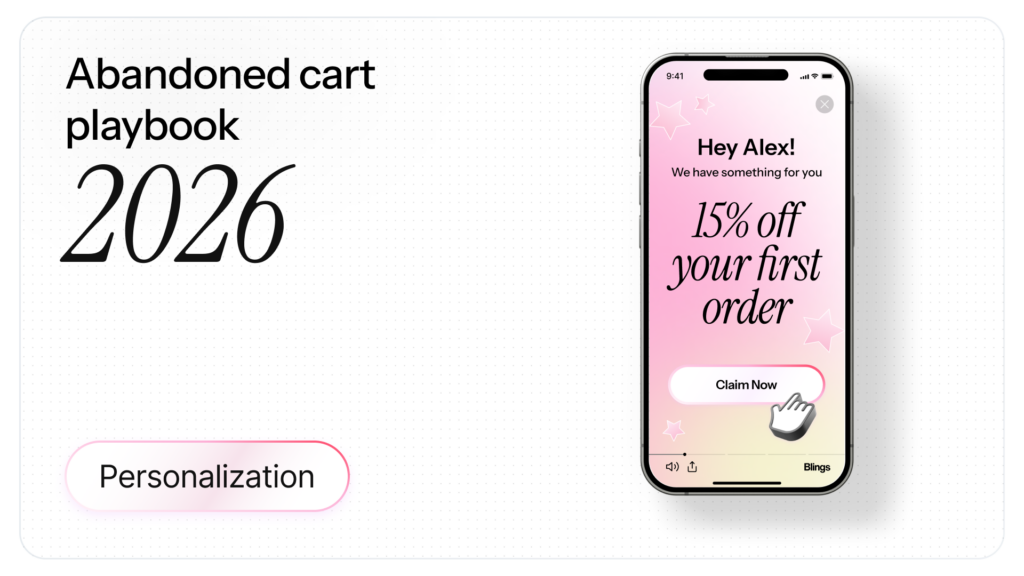
Blings blog cover reading Abandoned cart playbook 2026 with a Personalization tag and a phone showing a personalized 15 percent off first order message for Alex.
Yosef's avatar Yosef | Aug 19, 2026

Someone opens a fast food app at 11pm, builds a cart of exactly what they are craving, and then something interrupts. A text, a second thought, a distraction. The cart sits abandoned, and the craving that was seconds from converting evaporates. QSR digital ordering has one of the highest cart-abandonment rates in retail because ordering happens in impulsive, interruptible moments. The recovery move that works is not a plain-text “you left something behind” email. It is an interactive video that shows the customer the exact items still in their cart, with an in-video “Order Now” button that removes every ounce of friction.

This piece is a playbook for recovering abandoned QSR carts with interactive video, with the trigger, the creative, and the conversion mechanics. It draws on production data from Habit Burger Grill, Live Nation VIP, and McDonald’s.

Why is cart abandonment so high in QSR digital ordering?

QSR cart abandonment is high because the ordering moment is impulsive and easily interrupted. Unlike a considered purchase, a food order is often a craving acted on in seconds, and anything that breaks the moment, a notification, a price check, a distraction, can end it. The cart is not abandoned out of doubt. It is abandoned out of interruption.

Cart abandonment means a customer adds items to a digital order and leaves before completing checkout. In QSR, the late-night craving window produces some of the highest abandonment because the purchase is most impulsive and the interruptions are most frequent.

The recovery opportunity is unusually strong precisely because the customer already built the cart. They expressed exact intent. They chose specific items. The recovery does not need to persuade them to want food. It needs to rekindle the craving they already had and remove the friction to finish.

What does an interactive video cart-recovery flow look like?

The recovery flow fires shortly after abandonment and shows the customer their exact cart in a personalized, appetizing video with a one-tap path to complete the order.

An abandoned cart recovery video is a personalized video that visualizes the specific items the customer left in their cart, rendered appetizingly, with an in-video “Order Now” button that returns them directly to checkout. It rekindles the craving by showing the food, not describing it.

The mechanics that make it convert:

  • Exact-cart visualization: the video shows the specific items the customer chose, not a generic menu
  • Appetite appeal: the food is rendered to look crave-worthy, reactivating the impulse
  • In-video CTA: an “Order Now” button inside the video returns the customer straight to their cart, removing navigation friction
  • Timing: the flow fires while the craving is still warm, minutes to an hour after abandonment
  • Optional urgency: a live countdown on a small completion incentive, if the brand chooses to offer one

The in-video CTA is the friction-killer. The Cleveland Cavaliers proved the power of an optimized in-video call to action, driving a 2x conversion lift when AI selected the best CTA per viewer. See the Cleveland Cavaliers AI CTA case study.

Why does showing the exact cart beat a text reminder?

Showing the exact cart beats a text reminder because it rekindles the specific craving rather than issuing a generic nudge. A text email says “you left items in your cart.” A personalized video shows the customer the exact burger, fries, and shake they built, rendered to look delicious, which reactivates the impulse that drove the order in the first place.

The recognition also signals attentiveness. The customer sees that the brand knows precisely what they wanted, which makes the recovery feel like a helpful nudge rather than a marketing blast. Habit Burger Grill built its personalized video on exactly this order-history recognition and lifted loyalty signups by 47%. See the Habit Burger Grill case study.

What architecture makes exact-cart recovery videos possible?

Recovering a cart requires rendering a video of that customer’s specific, just-built cart, which changes with every order. Pre-rendering is impossible because the cart contents are unique and fresh.

On-demand rendering means the recovery video assembles on the customer’s device at the moment of open, pulling the exact cart contents from the current data, so the video always shows what the customer actually left behind. The approach runs on MP5 technology through a single Dynamic Master Template connected to the ordering system and CRM. For the architecture, see the MP4 is dead and AI video personalization in 2026: why architecture matters more than the algorithm.

FAQ

How do you recover abandoned carts in a fast food app?


How do you recover abandoned carts in a fast food app? You recover abandoned QSR carts by firing a personalized video shortly after abandonment that shows the customer the exact items they left, rendered appetizingly, with an in-video “Order Now” button that returns them straight to checkout. This rekindles the craving and removes navigation friction.

What is an abandoned cart recovery video?

An abandoned cart recovery video is a personalized video that visualizes the specific items a customer left in their digital cart, with an in-video CTA to complete the order. It shows the food rather than describing it, reactivating the impulse that started the order.

Why is cart abandonment higher for late-night food orders?

Cart abandonment is higher for late-night food orders because the purchase is impulsive and easily interrupted. A craving acted on in seconds can be ended by any distraction, which is why the recovery window and the appetite appeal matter so much.

How does an in-video "Order Now" button reduce friction?

An in-video “Order Now” button returns the customer directly to their existing cart at checkout, removing the steps of reopening the app and rebuilding the order. Less friction between craving and checkout means more completed orders.

The takeaway

QSR cart abandonment is high because ordering happens in impulsive, interruptible moments, especially late at night. But the customer who abandoned a cart already expressed exact intent, which makes the recovery opportunity unusually strong. The playbook that works is an interactive video showing the exact items left behind, rendered to look crave-worthy, with an in-video “Order Now” button that removes every step between the rekindled craving and checkout. Habit Burger Grill, Cleveland Cavaliers, and Live Nation VIP all show what personalized video with a strong in-video CTA produces.

The QSR brands that recover carts with exact-cart video will convert the late-night cravings their competitors lose to a plain-text reminder. Showing the food beats describing it, every time.

Your customers are waiting for great video experiences.

Schedule a custom demo