AI
Best Practices

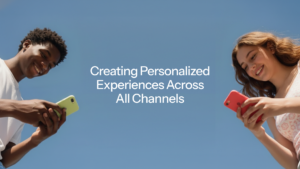
Creating personalized experiences across all channels

Corrie's avatar Corrie | Jun 16, 2026
unnamed 4
Corrie's avatar Corrie | Jun 16, 2026

Customers do not experience marketing channels. They experience the brand. Email, SMS, push, in-app, web, paid, customer success outreach, retail, and call center all feed into a single mental model the customer holds about how well the brand actually knows them. That model is shaped by the consistency of the experience across channels more than by any single touchpoint. Brands that personalize one channel well and treat the others as broadcast media produce a contradiction the customer can feel, even when they cannot articulate it. The fix is not adding more personalization to more channels. The fix is moving the personalization layer underneath the channels so every channel reads from the same source.

This piece walks through what cross-channel personalization actually means, where most brands have the gap today, and the architectural choices that let a single Dynamic Master Template power multiple channels without rebuilding the campaign each time. Production data from brands like Wyndham, Macy’s, Live Nation VIP, and Habit Burger Grill shows what happens when the layers line up.

What does cross-channel personalization actually mean?

Cross-channel personalization means the customer’s data shapes the message across every channel the brand uses, not just the one channel the marketing team owns most closely. The customer who receives a personalized email should also see a personalized landing page when they click. The customer who receives an SMS reminder should hear personalized voice prompts if they call the support line. The customer who opens the app should see a home screen that reflects what the email pitched.

The principle is consistency, not duplication. Each channel does what it does best. The personalization underneath unifies the experience. The customer should never feel like the email team and the app team are working from different data, even when they are working in different platforms.

According to McKinsey research on personalization economics, brands that achieve cross-channel personalization produce 40% higher revenue from personalized campaigns and 25% higher retention compared to brands running channel-by-channel personalization in isolation.

Why does most cross-channel personalization fail?

Most cross-channel programs fail in one of four predictable ways. Data fragmentation: each channel maintains its own copy of the customer record, and the copies drift. Latency mismatch: the email tool sees an update in 30 seconds but the in-app system sees it in 24 hours. Creative isolation: each channel has its own creative production pipeline, which produces inconsistent visual language and messaging. Decision drift: the channels make personalization decisions independently, which produces conflicting messages to the same customer.

Each of these is solvable in principle. None of them are solvable when the underlying architecture assumes channel-by-channel production. The teams that get cross-channel right have moved the personalization layer underneath the channels rather than placing it inside each one.

What does an architecture for cross-channel personalization look like?

The pattern that works has four properties. A single source of truth for customer data, typically the CRM or data warehouse. Every channel reads from this layer rather than maintaining its own copy. A shared decision layer that determines who receives what, when, on which channel. A shared rendering layer that produces the personalized creative for whichever channel is active. A shared engagement loopback so every channel’s response data feeds back to the source of truth.

The Blings platform fits into the third and fourth properties. The same Dynamic Master Template can power video creative inside email, SMS landing pages, in-app moments, customer success touchpoints, and call center follow-ups. Each channel passes the personalization parameters through the Live URL. The video renders on demand using MP5 technology, so there is no per-channel production cost. Engagement events flow back to the CRM through native integrations, which means every channel learns from every other channel’s response.

For a deeper look at the architecture, see the AI video personalization architecture piece.

What does cross-channel personalization look like in production?

Wyndham ships its annual personalized year-end recap as an email campaign with a click-through to a Live URL that opens in the browser. The customer can then forward the recap or click through to the loyalty portal, which already reflects the same data the recap showed. The continuity is the point. The recap experience produced a 75% lift in email CTR and a 66.7% survey completion rate. Read the case at the Wyndham year-end recap case study.

Live Nation VIP ran the Trilogy Tour fan engagement campaign across email, in-app moments, and post-show outreach, all anchored on the same personalized video experience. The Live URL pattern meant the same Dynamic Master Template served every channel without per-channel production. The campaign produced a 17.55% lift in unique opens and a 16.6% share rate. The full case is at the Live Nation VIP case study.

Macy’s applied the mid-year recap across email and the loyalty portal, with the recap link landing on a page that continued the personalized experience from the email. The campaign produced a 47% conversion lift. See the Macy’s case study.

Habit Burger Grill ran personalized loyalty content across email and in-app, anchored on each customer’s order history and tier progress. The campaign lifted loyalty signups by 47%. See the Habit Burger Grill case study.

How do you start unifying personalization across channels?

The transition from channel-by-channel to cross-channel personalization has a specific order that works.

  1. Audit the data each channel uses. Most brands discover that each channel uses a different subset of the customer record, and the subsets drift over time. The audit is uncomfortable but necessary.
  2. Designate a single source of truth. Pick the CRM, data warehouse, or CDP that will own the canonical customer record. Every channel reads from this layer for personalization.
  3. Build a Dynamic Master Template that can serve multiple channels. The template is the creative logic. The same template produces a video for email, an embeddable experience for the app, and a personalized landing page after SMS. The data spine is shared. The visual treatment adapts.
  4. Wire the engagement loopback. Every channel reports back to the source of truth. Email engagement, in-app interaction, web visits, support contacts. The loopback is what makes future personalization decisions smarter.
  5. Measure the consistency, not just the conversion. Track whether the same customer receives consistent messaging across channels. Mismatches indicate architecture gaps that no amount of channel-level optimization can fix.

What channels should be personalized first?

The priority order is based on lift potential and operational lift cost. Email first, because the lift is the largest and the infrastructure is the most mature. Web second, because the click from a personalized email lands on a generic page in most brands, which breaks the consistency. In-app third, because high-engagement customers spend more time here than in any other channel. SMS fourth, for high-velocity moments where the inbox is too slow. Customer success and call center fifth, because the operator’s screen should reflect the same data the email used.

The ordering can be adjusted by category. For travel and hospitality, in-app may move up because of itinerary moments. For retail, web moves up because of the click path from email to product. For B2B, customer success moves up because of the human-driven touchpoints. The principle is to pick the channel where the customer will notice the consistency most.

What metrics prove cross-channel personalization is working?

The classical metrics still matter but are insufficient. Cross-channel personalization should also be measured on a few additional dimensions. Cross-channel engagement rate: customers who engaged with the campaign in more than one channel. Time to first response: how quickly the customer engaged after the first channel touch. Consistency score: an internal audit measure of whether the customer experienced the same data across channels. Downstream LTV: customers exposed to cross-channel personalized campaigns versus those exposed to single-channel.

The fourth metric is the one that justifies the investment. Cross-channel customers typically produce 15% to 30% higher LTV than single-channel customers in the same cohort, because the consistency reinforces the recognition effect across every customer-brand interaction.

FAQ

Does cross-channel personalization require a customer data platform (CDP)? Not necessarily. Many brands run cross-channel personalization directly off the CRM. A CDP becomes useful when the customer data is scattered across many sources that need to be unified, but it is not a prerequisite.

How does Blings power personalization across multiple channels? The same Dynamic Master Template can be embedded in email, SMS landing pages, in-app moments, and web experiences. The personalization variables travel with the Live URL, which means every channel renders the same data-driven experience without per-channel production.

What is the typical timeline for cross-channel personalization to produce measurable lift? Most teams see lift in the first quarter, with the largest gains emerging at six months as the engagement loopback starts producing higher-quality personalization decisions.

What if my channels are owned by different teams? Organizational structure is the most common barrier. The technical fix is straightforward. The political fix is harder. Start with a single shared template across two channels and let the result generate the political alignment for the broader move.

How does cross-channel personalization handle privacy regulations? Blings uses a Zero-Knowledge Architecture, which means PII resolves on the customer’s device and is never persisted on Blings servers. The CRM remains the only source of truth, which simplifies GDPR, CCPA, and similar compliance requirements.

The takeaway

Cross-channel personalization is an architecture problem, not a channel-level optimization problem. The brands producing the strongest results have unified their data layer, their decision layer, and their rendering layer underneath every channel rather than trying to retrofit personalization channel by channel. Wyndham, Macy’s, Live Nation VIP, and Habit Burger Grill all show what consistent cross-channel personalization can produce when the layers align.

The customer experiences the brand, not the channel. The brands that organize their personalization around that fact are the ones building durable advantage. Everyone else is still optimizing channel by channel and wondering why the lift plateaus.

Talk with a video expert now to see what you can accomplish.
Schedule Call