
AI
Best Practices
From the Team

The role of AI in enhancing customer journey mapping

Yosef's avatar Yosef | Jun 9, 2026
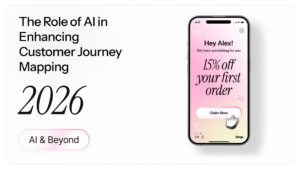
Blings branded graphic titled The role of AI in enhancing customer journey mapping, dated 2026, with a phone mockup showing a personalized Hey Alex message offering 15 percent off, tagged AI and Beyond.
Yosef's avatar Yosef | Jun 9, 2026

Customer journey maps are usually built on workshops, sticky notes, and a few hand-picked customer interviews. The result is a document that captures what the brand wishes the journey looked like, presented as a diagram with five stages and arrows. The document is useful for orienting new teams and for one-off strategic conversations. It is almost never useful for actually running the marketing program. Real customer journeys are messy, non-linear, and stage transitions look completely different per customer cohort. AI changes the math by treating journey mapping as a continuous, data-driven exercise rather than a one-time strategic deliverable.

This piece walks through what AI-enhanced journey mapping actually means, what data signals AI uses to detect stage transitions, and how brands like Cleveland Cavaliers, Live Nation VIP, Wyndham, and Macy’s use AI-driven journey detection to ship campaigns that match where each customer actually is.

Why do traditional customer journey maps fall short?

Traditional journey maps capture a generalized representation of the customer experience. The diagram shows awareness, consideration, decision, retention, and advocacy as a linear path. The reality is that customers loop, skip, double back, and exit. A customer in retention can lapse to consideration and re-enter through a different acquisition channel. A first-time buyer can skip from awareness to decision in a single session. The diagram cannot represent the variation, so it ends up describing the average customer rather than any actual customer.

The deeper problem is timing. A journey map is a snapshot. The customer’s actual stage changes hourly based on what they did, what they did not do, what the brand sent them, and what competitors are showing them. A snapshot cannot inform a campaign that needs to ship in response to the next behavioral signal.

According to Gartner research on customer journey mapping, 70% of journey maps fail to produce measurable business outcomes because they are not connected to live data streams. The maps describe the journey. They do not respond to it.

What does AI bring to journey mapping?

AI brings three capabilities that traditional journey mapping cannot match. Continuous stage detection: a classifier reads behavioral signals and updates each customer’s stage in near real time. Pattern recognition: machine learning identifies sub-journeys, transitions, and edge cases that the workshop diagram missed. Predictive transitions: a model predicts which stage each customer is likely to move to next, which enables the brand to prepare the right communication in advance.

The three capabilities compound. Continuous detection produces a live view of where every customer sits. Pattern recognition reveals the real shape of the journey, including the loops and exits the workshop missed. Predictive transitions let the brand intervene at the moment of likely stage change rather than after the change has happened.

The output is not a single diagram. It is a continuously updated dataset that describes every customer’s current stage, their likely next stage, and the actions most likely to influence the transition. The marketing team designs campaigns that respond to the dataset, not to the workshop diagram.

What signals does AI use to detect journey stages?

The signals are different for each stage, but most marketing data warehouses already capture them.

  • Awareness: first-touch attribution, blog visits, organic search arrivals, social impressions, brand search query patterns
  • Consideration: comparison page views, demo page visits, repeat sessions, dwell time on solution pages, downloads of educational content
  • Decision: pricing page visits, security or compliance documentation downloads, multi-stakeholder activity from a single account, RFP-adjacent behavior
  • Retention: product usage frequency, NPS responses, customer success engagement, renewal proximity, feature adoption rate
  • Advocacy: post-renewal usage health, referral participation, public review activity, community engagement, social sharing
  • Lapse: declining engagement across channels, missed purchase cycles, unused rewards, dormant tier status

The AI classifier weights these signals based on the brand’s specific category and historical conversion patterns. A signal that strongly indicates consideration for a B2B SaaS brand may indicate something different for a hospitality brand. The model learns the weighting from the brand’s own data over time.

How does AI journey mapping integrate with campaign delivery?

The integration is the part most teams underbuild. A journey detection model that produces accurate stage labels but does not feed into campaign delivery is academic. The labels have to inform the trigger logic, the creative selection, and the timing decisions.

The pattern that works has three layers. The CRM or data warehouse maintains the canonical customer record, including the AI-generated stage label. The customer engagement platform (Braze, Iterable, Klaviyo, HubSpot, Salesforce Marketing Cloud) consumes the stage label and uses it as a trigger condition for campaign delivery. The personalization layer renders the creative on demand at the moment of open, using the customer’s stage and behavioral data to populate the Dynamic Master Template.

Blings sits in the third layer. The platform reads the customer’s stage and behavioral data through native integrations with the major CRMs and customer engagement platforms, then renders the personalized video on demand through MP5 technology. The same Dynamic Master Template can serve different stages with different parameter sets, which keeps the production cost flat regardless of how granular the journey mapping becomes.

For a deeper architectural treatment, see AI video personalization in 2026: why architecture matters more than the algorithm.

What does AI-enhanced journey mapping look like in production?

Cleveland Cavaliers used AI optimization inside personalized fan video to detect each fan’s engagement stage and select the highest-converting CTA in real time. The campaign produced a 2x conversion lift because the AI matched the CTA to the fan’s specific stage and prior behavior. See the Cleveland Cavaliers AI CTA case study.

Live Nation VIP built tier-matched and language-matched personalized fan video for the Trilogy Tour, with stage detection inside the brand’s CRM informing the segmentation. The result was a 17.55% lift in unique opens, 82 seconds of watch time on a 40-second video, and a 16.6% share rate. The full case is at the Live Nation VIP case study.

Wyndham applied behavioral stage detection to its loyalty program, recognizing customers at the moment of year-end and presenting a recap calibrated to their tier and activity. The campaign produced a 75% lift in email click-through rate. See the Wyndham year-end recap case study.

Macy’s ran a mid-year recap that recognized each customer’s tier progression and surfaced the next-tier path as a forward-looking call to action. The campaign produced a 47% conversion lift. See the Macy’s mid-year recap case study.

How do you start building AI-enhanced journey mapping?

The path that works for most brands has a specific sequence.

  1. Audit the data you already have. Most brands discover that the signals needed for stage detection are already in the CRM and data warehouse. The audit identifies the gaps, not the abundance.
  2. Define the stages for your specific brand. The classical five stages are a starting point. Most brands need six to eight stages once the actual journey patterns are visible.
  3. Build a simple stage classifier first. A rules-based classifier that uses observable signals is a useful first step. The AI model can replace it once the rules are stable enough to learn from.
  4. Connect the stage label to campaign triggers. The customer engagement platform should be able to fire campaigns based on stage transitions. The integration is the most important part of the build.
  5. Build one Dynamic Master Template that can serve multiple stages. The template adapts to the stage parameter. The production cost stays flat as journey granularity expands.

6. Measure and iterate. Track which transitions the model predicted correctly, which it missed, and how the campaigns triggered by stage transitions performed. The model improves over time.

What metrics prove AI journey mapping is working?

The standard campaign metrics still matter, but the journey mapping layer should be measured on a few additional dimensions. Stage detection accuracy: the percentage of stage labels the model produced that match the actual customer behavior in the following weeks. Transition lift: the percentage of customers who advanced to the next stage after receiving a stage-targeted campaign, compared to a control. Compound LTV: the lifetime value of customers in cohorts where journey-matched campaigns ran, compared to cohorts where stage-agnostic campaigns ran.

The third metric closes the business case. Customers who consistently receive stage-matched communications tend to produce 15% to 30% higher LTV than customers who receive generic communications, because the journey-matched approach builds the recognition effect over time.

FAQ

Do I need a data science team to build AI journey mapping? Helpful but not strictly required. The first iteration can run on a rules-based classifier built in the CRM or data warehouse. The AI version produces better results but adds complexity.

How does Blings consume the stage label? The customer’s stage is passed as a parameter on the Live URL, alongside other personalization variables. The Dynamic Master Template adapts the creative based on the stage.

What is the typical lift from journey-matched campaigns? Production data shows 15% to 40% conversion lift compared to stage-agnostic campaigns, with the largest gains in retention and advocacy stages.

How granular should the stage definitions be? Most brands run six to eight stages. Fewer than five misses important transitions. More than ten creates segmentation complexity without proportional lift.

Can journey mapping work without a CDP? Yes. Most brands run journey mapping directly off the CRM. A CDP is helpful when customer data is scattered across multiple sources that need unification.

The takeaway

Customer journey mapping has been a workshop deliverable for two decades. AI turns it into a continuously updated dataset that informs every campaign decision in real time. The shift produces measurable lift in conversion, retention, and LTV when the data layer, the classifier, and the rendering layer are aligned. Cleveland Cavaliers, Live Nation VIP, Wyndham, and Macy’s all show what AI-enhanced journey mapping can produce when the architecture supports it.

The brands that treat journey mapping as a strategic exercise produce diagrams that hang in the war room. The brands that treat it as an operational system produce campaigns that match where each customer actually is, every send, every time.

Talk with a video expert now to see what you can accomplish.
Schedule Call