
Best Practices
AI

Future-proofing your marketing with AI automation

Yonatan Schreiber's avatar Yonatan Schreiber | Jun 1, 2026
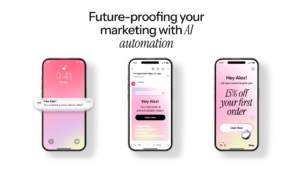
Three smartphone screens showing a Blings personalized video email journey: a push notification, an inbox preview, and a personalized video with a 15% discount offer for Alex.
Yonatan Schreiber's avatar Yonatan Schreiber | Jun 1, 2026

Future-proofing marketing is one of those phrases that gets repeated until it loses meaning. The version that actually matters is operational. A marketing stack is future-proof when the team can change a model, swap a channel, add a data source, or pivot a strategy without re-engineering the campaign delivery layer. Most teams cannot do any of those things today because their stacks are stitched together from tools that each assume they own the customer relationship. AI automation, applied correctly, is what makes the stack flexible enough to absorb whatever the next two years require.

This piece walks through what AI automation actually means inside a modern marketing stack, where it produces measurable lift, and the architectural choices that determine whether the team is building for the next quarter or the next decade. The argument is grounded in production data from brands like Wyndham, Live Nation VIP, Macy’s, and Cleveland Cavaliers, all of whom are running AI-optimized personalization at scale today.

What does AI automation in marketing actually do?

AI automation in marketing handles five categories of work that used to require human judgment for every campaign. Audience selection uses propensity models to score every customer on likelihood to convert, churn, refer, or upgrade. Timing uses behavioral signals to fire campaigns at the moment of highest receptivity rather than a fixed cadence. Channel orchestration decides whether the next message goes through email, SMS, push, or in-app, based on the customer’s response history. Content selection picks from a library of creative variants or generates new copy at send time. Optimization learns from outcomes and adjusts every other layer continuously.

Each of these on its own produces incremental lift. Combined, they produce a marketing system that runs more like an autonomous loop than a campaign calendar. The team’s role shifts from operating the loop to designing it, which is the labor reallocation that AI automation enables at most marketing organizations.

According to McKinsey research on AI adoption in marketing, organizations that have moved beyond pilot use of AI in marketing report 10% to 20% lifts in revenue and 5% to 15% reductions in marketing operating cost. The lift comes from better selection and timing. The cost reduction comes from automating the production layer that used to consume the bulk of operator time.

Why does most AI automation stall at the creative layer?

The story most marketing teams tell themselves is that AI handles the upstream decisions and humans handle the downstream creative. The story collapses the moment the team tries to ship the AI-driven decision to the customer. The decision happens in real time. The creative is a static asset that was produced in a sprint four weeks ago. The mismatch creates a structural ceiling on what AI can actually deliver.

The honest accounting looks like this. The propensity model decides this customer should receive a tier-progression nudge today. The journey tool fires the trigger. The email template loads. The template is the same template every customer in this segment receives, because the production cost of personalizing the creative for every customer is too high. The AI’s intelligence collapses to a generic email at the moment of customer contact.

This is the Insight-to-Action Gap that most marketing stacks have not solved. The decisions are personalized. The actions are not. For a deeper look at why the gap matters more than the model quality, see AI video personalization in 2026: why architecture matters more than the algorithm.

How does on-demand rendering close the gap?

The Blings approach moves the creative production layer from sprint-driven to data-driven. Instead of producing a finished asset for each segment, the team produces a Dynamic Master Template that describes how data should be expressed visually. The template is the logic. The customer’s data is the input. The rendering happens on the customer’s device at the moment of open, using MP5 technology and a single Live URL that carries the personalization variables.

The implication is that the creative layer matches the speed of the AI layer. Whatever the propensity model decided, whatever the timing engine fired, whatever the orchestration layer chose, the actual creative that reaches the customer reflects that decision at the moment of contact. The AI’s intelligence makes it all the way to the customer experience.

For a refresher on why on-demand rendering is the architectural unlock, see MP4 is dead: long live the MP5.

What does AI automation look like at brands running it today?

The Cleveland Cavaliers are a useful production reference. The team used AI optimization inside personalized video campaigns to automatically pick the highest-converting call to action for each fan, in real time. The system tested CTA variants, learned from response patterns, and adjusted automatically. The result was a 2x conversion increase, driven by AI selecting the winning CTA without operator intervention. The full breakdown is in the Cleveland Cavaliers AI CTA case study.

Live Nation VIP used a similar pattern for the Trilogy Tour fan engagement campaign. Behavioral signals from the CRM fed into the personalization layer, which produced a tier-matched and language-matched video for every fan. The campaign produced a 17.55% lift in unique opens, 82 seconds of average watch time on a 40-second video, and a 16.6% share rate. The AI handled the matching. The architecture handled the rendering. The combination is what produced the result. Read the full case in the Live Nation VIP case study.

Wyndham used AI-driven personalization for its annual year-end recap campaign. Each loyalty member received a recap of stays, points, and tier progression generated from CRM data. The campaign produced a 75% lift in email click-through rate and a 66.7% completion rate on the survey embedded inside the recap. The AI’s role was not generative. It was selective and structural. The architecture made the result possible. See the Wyndham year-end recap case study.

What categories of AI automation should marketing teams prioritize?

The five categories of AI automation listed earlier produce different lift profiles. Teams new to AI automation should prioritize in this order.

  1. Audience selection. The highest-leverage starting point because it improves every downstream metric. A propensity-scored audience converts at higher rates than a rules-based segment, even when the rest of the campaign stays the same.
  2. Timing. The second-highest-leverage layer because it lifts response rates without changing creative. Behavioral triggers fire campaigns at the moment of receptivity, which is structurally better than a fixed send time.
  3. Creative rendering. Once the upstream layers are producing real-time signals, the creative needs to match the speed. On-demand client-side rendering through MP5 technology is the architectural choice that lets the creative keep up.
  4. Channel orchestration. Decide whether the next message goes through email, SMS, push, or in-app based on the customer’s recent response pattern. The lift here is less dramatic than selection or timing but is durable over time.
  5.  Optimization loops. The continuous learning layer that adjusts every other component based on outcomes. This is the hardest layer to build well and the easiest to over-engineer. Start with simple A/B optimization and expand as the data justifies it.

How do you avoid the common AI automation traps?

Most AI automation programs fail in predictable ways. The traps are easier to avoid when you know which ones tend to bite.

Trap one: optimizing the wrong metric. A model that maximizes click-through rate does not necessarily maximize revenue. A model that maximizes opens does not necessarily improve retention. The objective function has to map to business outcomes, not proxy metrics.

Trap two: training on too little data. Propensity models need meaningful training data to produce useful scores. Teams that try to deploy AI selection on a thin behavioral history produce results no better than rules-based segmentation, sometimes worse.

Trap three: separating decision and action. The Insight-to-Action Gap discussed earlier is the most common architecture trap. AI that picks the right customer at the right time but ships a generic email defeats the point of the upstream investment.

Trap four: building for the model, not the operator. A system that produces the right decision but is opaque to the marketing operator does not get adopted. The operator has to be able to inspect, override, and audit the AI’s choices. Black-box automation tends to stall politically before it stalls technically.

Trap five: ignoring data hygiene. AI automation amplifies the data underneath it, including the errors. A propensity model fed bad customer records produces bad scores. The investment in data infrastructure has to precede or accompany the AI investment.

What is the architectural foundation for future-proof AI automation?

The architectural pattern that ages well has four properties. Customer data lives in a single source of truth, typically the CRM or data warehouse. Tools read from that source rather than maintaining their own copies. Decisions and actions share the same data layer, which means the AI’s choice and the customer’s experience reference the same fields. Rendering happens on demand, which means the creative layer can keep up with the decision layer. Engagement signals flow back to the source of truth, which closes the loop for future learning.

Blings is built around the third and fourth properties. The on-demand rendering pattern lets AI-driven personalization actually reach the customer. The engagement loopback through native integrations with Salesforce, HubSpot, Braze, Iterable, and Klaviyo means the data the AI needs for the next round of learning is already where it needs to be.

For an example of how the loopback works in practice, see how Blings enhances CRM integrations compared to other video platforms.

What does the next two to three years of AI automation look like?

The direction is clear even if the specifics are not. Generative models will continue to improve the creative production layer, letting templates expand and adapt without manual creative work. Multi-modal models will let AI optimize across copy, image, and video simultaneously rather than treating each as a separate problem. Real-time personalization will become the default expectation rather than a competitive differentiator. The brands that built on an on-demand rendering foundation will absorb these advances without re-architecting their stacks. The brands that built on per-recipient pre-rendering will face a structural rebuild every two years.

According to Gartner research on marketing leader priorities, AI integration into marketing operations is the top investment priority for 73% of CMOs in 2026, with the largest single budget category going to creative and content automation. The investment direction confirms what the production data already shows. The teams that win this cycle are the ones that move the creative layer onto an automation-friendly foundation.

FAQ

Does AI automation eliminate the need for marketing operators? No. The operator’s role shifts from running campaigns to designing the system. The work is more strategic and less repetitive, but it does not disappear.

How much data do I need before AI automation is worth deploying? Most propensity models need at least 90 days of behavioral data and at least 10,000 customer records to produce useful scores. Smaller datasets work for narrower use cases but produce lower-confidence predictions.

What is the difference between AI automation and marketing automation? Marketing automation runs rules. AI automation learns. The rules-based system fires a sequence when X happens. The AI system decides whether to fire the sequence, when, in what channel, and with what creative, based on a model rather than a rule.

How does Blings fit into an AI automation stack? Blings is the rendering and engagement layer. The AI decides who, when, and what. Blings turns that decision into a personalized customer experience and feeds the engagement signal back into the CRM for the next round of learning.

What is the typical timeline for measurable lift from AI automation? Most programs show measurable lift in the first quarter, with the largest gains appearing between months three and six as the model accumulates training data.

The takeaway

Future-proofing marketing with AI automation is an architectural decision, not a vendor selection. The stack ages well when the data, decisions, and actions reference the same layer, and when the creative production keeps up with the speed of the decision layer. Brands like Wyndham, Live Nation VIP, Macy’s, and Cleveland Cavaliers are already running AI-optimized personalization at scale because they built on a foundation that lets the AI’s intelligence reach the customer. The teams that build on the same foundation will absorb whatever the next two to three years of generative and multi-modal AI advances bring without rebuilding their stacks.

The marketing teams that struggle are the ones that bolt AI onto a creative production process that was designed for a slower, segment-based world. The mismatch shows up in the metrics. The fix is structural.

Talk with a video expert now to see what you can accomplish.
Schedule Call