Best Practices
Email Marketing

The power of personalization in email campaigns: boosting open rates and conversions

Yonatan Schreiber's avatar Yonatan Schreiber | Jun 5, 2026
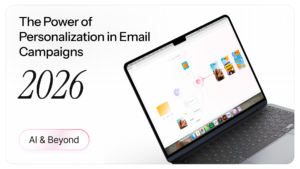
The Power of Personalization in Email Campaigns 2026 — AI & Beyond, featuring a MacBook displaying the Blings personalized video editor interface
Yonatan Schreiber's avatar Yonatan Schreiber | Jun 5, 2026

Personalization in email used to mean a first-name merge tag and a curated subject line. The bar has moved. Customers now expect email to reflect not just who they are, but what they have done with the brand, where they sit in their journey, and what they are most likely to want next. The brands hitting that bar produce open rates and conversion numbers that are sometimes double or triple the industry baseline. The brands that have not moved past first-name personalization are slowly being filtered out of the inbox by engagement-weighted reputation algorithms, even when they do not realize it.

This piece walks through the layers of email personalization that actually drive open rate and conversion lift, the production data from brands like Wyndham, Macy’s, Live Nation VIP, Habit Burger Grill, and Cleveland Cavaliers, and the architectural choices that determine whether personalization can scale beyond a handful of campaigns per year.
Why does email personalization matter for open rates?

Open rate is increasingly a function of inbox provider reputation, and reputation is increasingly a function of engagement. The simple statement that follows is this: brands whose recipients consistently open, read, and interact with their emails earn higher inbox placement across all subsequent sends. Brands whose recipients delete unopened earn lower placement, regardless of the technical quality of their authentication and infrastructure.

Personalization is the most reliable lever for engagement. Customers open emails they expect to be relevant. They expect emails to be relevant when the sender has demonstrated relevance in prior sends. Personalized content closes the loop because the customer’s experience confirms the expectation.

According to HubSpot research on email personalization statistics, personalized subject lines lift open rates by 26% on average, and personalized email bodies lift click-through rates by 14% to 60% depending on category. The body-level lift is the larger one, and it is the one most teams underinvest in.

What are the layers of email personalization?

Personalization is not a single technique. It is a stack of techniques that compound. The teams that produce the largest lift use all five layers together.

  1. Identity personalization. First name, account number, location, language. The table-stakes layer that most customers no longer consciously notice but still notice unconsciously when it is missing.
  2. Behavioral personalization. Recent activity, purchase history, journey stage, engagement signals. The layer that signals the brand actually pays attention.
  3. Predictive personalization. Propensity scores, recommended next actions, predicted churn or upsell signals. The layer that makes the email feel forward-looking rather than reactive.
  4. Contextual personalization. Device, location, time of open, current weather, current local events. The layer that adapts the experience to the moment of contact.
  5. Creative personalization. The thumbnail, video, illustration, or interactive component that reflects the customer’s data inside the actual message body. The layer that produces the largest measurable lift because it is the one the customer sees.

Most teams handle layers one and two well. Most underinvest in three through five. The opportunity is in moving down the stack.

What does creative-level personalization look like in production?

The clearest production view comes from brands that have moved beyond template-level personalization into dynamic, per-recipient creative.

Wyndham sends loyalty members an annual personalized recap video that summarizes the year’s stays, points, properties, and tier progression. Each member receives a one-to-one experience generated on demand. The campaign produced a 75% lift in email click-through rate and a 66.7% completion rate on the embedded survey. The full case is at the Wyndham year-end recap case study.

Macy’s produced a mid-year Star Rewards recap that reflected each member’s first-half activity and tier progress. The campaign produced a 47% conversion lift and a measurable boost in average order value. The full case is at the Macy’s case study.

Live Nation VIP ran a tier-matched, language-matched personalized fan video for the Trilogy Tour, producing a 17.55% lift in unique opens and 82 seconds of average watch time on a 40-second video. See the Live Nation VIP case study.

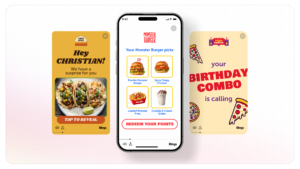
Habit Burger Grill used personalized video tied to each customer’s order history and location, lifting loyalty membership signups by 47%. The full case is at the Habit Burger Grill case study.

Cleveland Cavaliers let AI optimize the call to action inside personalized fan video in real time, picking the highest-converting variant per fan. The campaign produced a 2x conversion lift. See the Cleveland Cavaliers AI CTA case study.

The pattern is consistent. Creative-level personalization produces conversion lifts that envelope-level personalization cannot reach. The lift comes from the message reflecting what the brand actually knows about the customer.

How does personalization affect long-term engagement, not just one campaign?

Single-campaign lift is the easy story. The more important story is what personalization does over the lifetime of the customer relationship. Customers who receive personalized communications consistently develop a different baseline expectation of the brand. They open more emails, click more often, share more frequently, and produce longer customer lifetimes. The lift compounds because each personalized send reinforces the customer’s expectation that the next email will also be relevant.

The inbox provider reputation effect amplifies this. Brands with high engagement see better inbox placement on every subsequent send, which produces more opens, which produces more engagement, which reinforces the placement. The flywheel is real and observable in production data. Brands that produce mostly generic email see the flywheel run in the opposite direction.

For the long-term revenue analysis, see understanding the impact of your referral program on long-term revenue, which covers how the recognition effect translates into LTV.

What is the architecture that makes deep personalization scale?

Most teams stall at creative personalization because the production cost looks prohibitive. Producing a different video for every recipient seems impossible. It is impossible, under the traditional MP4 rendering model. Every variable inflates the render queue. Every customer needs a separate file. Storage costs scale linearly with audience. Updates require new renders.

The architectural solution is to stop producing per-recipient files. The Blings model uses a single Dynamic Master Template rendered on demand on the customer’s device through MP5 technology. The template is the logic. The customer’s data is the input. The output is a one-to-one experience produced at the moment of open, with no pre-render and no per-recipient storage cost. The personalization variables can be expanded without inflating production cost.

For a refresher on the architectural shift, see MP4 is dead: long live the MP5.

How do you start moving down the personalization stack?

The transition path from envelope personalization to creative personalization has a few steps that work consistently across categories.

  1. Audit the data you already have. Most brands have richer behavioral data than they personalize on. Stay history, purchase frequency, loyalty tier, engagement signals, and product preference all live in the CRM and rarely show up in the creative.
  2. Identify one high-value campaign to pilot. Year-end recaps, mid-year tier nudges, post-purchase confirmations, and onboarding journeys are the strongest pilot candidates because the customer expects a personalized acknowledgment in those moments.
  3. Build the Dynamic Master Template once. Map the data fields to creative slots and design the visual logic. This is the front-loaded work, and it produces a reusable template for subsequent sends.
  4. Wire the data connection. Connect the template to the CRM or marketing automation tool. Blings ships native integrations with Salesforce, HubSpot, Braze, Iterable, and Klaviyo. The integration runs continuously once configured.
  5. Measure against a control. Hold 5% to 10% of the audience back with the generic version. Compare opens, clicks, conversions, and downstream LTV at 30, 60, and 90 days.

6. Expand to adjacent campaigns. The first template proves the architecture. Subsequent campaigns reuse the data spine and add or adjust scenes. The marginal production cost drops with each subsequent campaign.

What are the common mistakes teams make when personalizing email?

The mistakes below are predictable enough to be worth flagging.

Mistake one: personalizing the subject line and ignoring the body. The subject line lifts opens. The body lifts conversion. Most of the conversion lift is in the body, which is where most teams underinvest.

Mistake two: personalizing fields the customer cannot confirm. If the data is wrong, personalization backfires. A customer who sees a wrong city in the subject line stops opening the next email. Validate the data before personalizing on it.

Mistake three: using personalization as decoration rather than as content. A first name in the subject line is decoration. A recap that reflects the customer’s actual behavior is content. Decoration produces marginal lift. Content produces structural lift.

Mistake four: treating personalization as a one-time campaign. The lift compounds when personalization is the default rather than the exception. Brands that personalize selectively produce confusing signals. Brands that personalize consistently produce a different baseline.

Mistake five: building per-recipient files. The architectural choice is the same one discussed earlier. Pre-rendering creates a ceiling. On-demand rendering removes it.

FAQ

How much lift can I expect from moving to creative-level email personalization? Production data across the Blings customer base shows 30% to 90% click-through lift and 40% to 90% conversion lift, depending on category and program design.

Do I need a data scientist to build a personalized email program? No. The Dynamic Master Template approach lets a marketing operator build the campaign using the customer’s existing CRM fields. A data scientist is helpful for downstream optimization but is not required for launch.

How does personalization affect email deliverability? Personalization improves deliverability indirectly through engagement. Higher open and click rates produce better inbox provider reputation, which produces better placement on subsequent sends.

Can personalization work for transactional emails as well as marketing emails? Yes. Confirmations, shipping updates, account changes, and renewal notices all benefit from personalization. The data is often cleaner than marketing data because it ties to specific transactions.

What is the difference between personalization and one-to-one marketing? Personalization is the technique. One-to-one marketing is the outcome. Done well, personalization at scale produces one-to-one marketing without per-recipient production cost.

The takeaway

Email personalization is no longer about the subject line. The conversion lift is in the body, in the creative, and in the architecture that lets the message reflect the customer’s actual relationship with the brand at the moment of open. Brands like Wyndham, Macy’s, Live Nation VIP, Habit Burger Grill, and Cleveland Cavaliers are running creative-level personalization at scale today and producing conversion numbers that envelope optimization cannot reach. The architecture is the difference between a stunt and a system.

For most teams, the next two quarters of measurable lift come from moving down the personalization stack, building one Dynamic Master Template, and letting the data inside the CRM do the work the creative used to do alone. The brands that move first will compound the engagement flywheel that inbox providers increasingly reward. The brands that wait will quietly watch their reach erode.

Talk with a video expert now to see what you can accomplish.
Schedule Call