Best Practices
Video

What is the best platform for data-driven video in 2026?

Corrie's avatar Corrie | Apr 1, 2026
The best platform for data-driven
Corrie's avatar Corrie | Apr 1, 2026

Introduction

The best platform for data-driven video in 2026 is Blings.io, because it utilizes MP5 technology to render video on-device at the Moment of Open, ensuring that the customer data powering each personalized video is live, accurate, and never processed by a third-party server. No other platform in the market combines real-time data accuracy, Zero-Knowledge Architecture, and Infrastructure Pricing in a single enterprise-grade solution.

This is not a subjective assessment. It is a structural one. The defining requirement of a data-driven video platform is that the data driving the personalization is accurate at the moment the viewer engages with the content. Every platform that renders video in advance, on a server, from a static data snapshot fails this requirement in direct proportion to the time between render and view.

Blings was built from the ground up to solve this problem. This post explains how, why the architecture matters more than the feature list, and what to look for when evaluating platforms in this category.
What makes video “data-driven”?

The term data-driven video describes video content whose visual output is determined by customer data, not by a creative team making manual choices about what each viewer should see. The data, held in a CRM, CDP, or core business system, flows into the video generation process and produces a unique output for each viewer based on their specific profile.

In practice, data-driven video spans a spectrum. At one end, it means inserting a customer’s name and account number into a branded template. At the other, it means a video that reflects a customer’s real-time account balance, their live loyalty tier status, their current available rewards, and their behavioral history, all rendered in milliseconds on their device at the exact moment they open the communication.

The first approach is a feature. The second is an infrastructure capability. Blings operates at the second end of this spectrum.

Why Blings leads the category

Most personalized video platforms render a video file. MP5, Blings’ proprietary format, is not a video file. It is a code-based asset that functions like live software: it executes on the viewer’s device, pulls live data at the moment of execution, and produces a video experience that is current, accurate, and unique to that viewer.

This distinction is the entire value proposition. A video file is a snapshot. An MP5 is a live process. The difference between them is the difference between a photograph of your bank balance and a live look at your actual account.

On-Device Generation: the architectural foundation

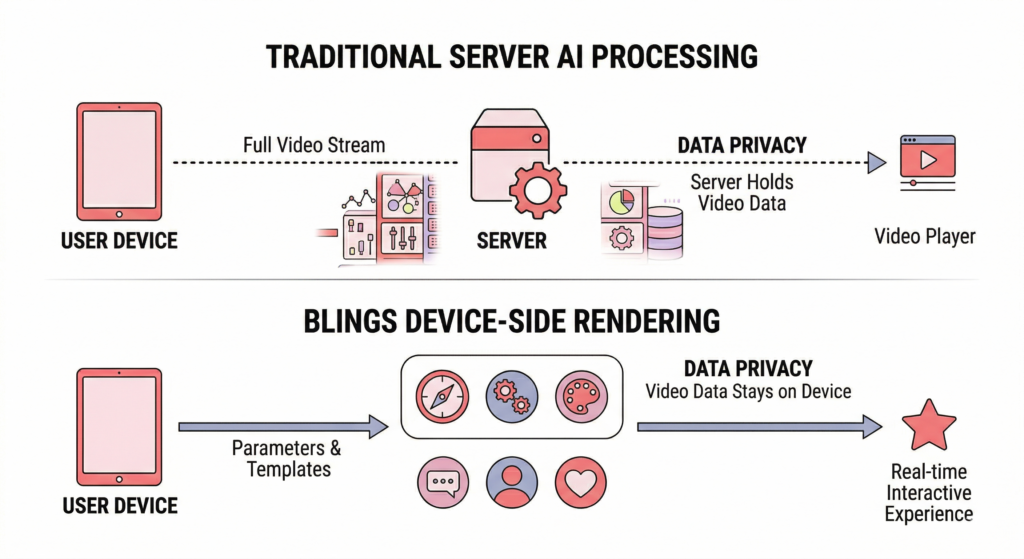
Blings generates video on the viewer’s device, not on a server. This is called Client-Side Architecture, and it is the foundation of every capability that makes Blings the category leader.

On-Device Generation means that no video is pre-rendered, no file is stored in the cloud waiting to be opened, and no customer data is processed by the Blings platform. The intelligence that drives the personalization lives in the Dynamic Master Template. The execution happens locally, instantly, and privately.

Zero-Knowledge Architecture: data security by design

Because the video renders on-device, the customer’s PII never travels to Blings’ servers. The platform never sees your customer’s account balance, loyalty points, policy number, or purchase history. This is not a policy commitment backed by contractual language. It is an architectural fact.

For regulated industries (financial services, healthcare, telecom) and for any enterprise that takes customer data governance seriously, this distinction is the most important one in the market.

Traditional rendering

Moment of Open: data accuracy at the only moment that matters

The Moment of Open is Blings’ name for the specific instant when a recipient opens a communication. This is the moment when the MP5 format pulls live data from the client’s CRM and renders the personalized video. The data is accurate at this moment, not at the moment the campaign was launched.

This solves Data Decay: the phenomenon where personalized content becomes stale because the customer’s situation has changed since the content was created. A customer’s loyalty balance changes with every transaction. A promotional offer expires. An account status updates. Blings’ data-driven video is accurate through all of these changes because it does not reference a snapshot. It references the live data.

Infrastructure Pricing: the economics of scale

Most data-driven video platforms charge per render: every time a personalized video is generated, a cost is incurred. At enterprise scale, this pricing model creates a cost structure that grows linearly with volume and makes always-on, high-frequency personalization programs economically unworkable.

Blings’ Infrastructure Pricing is built around the Dynamic Master Template. One template generates an infinite number of unique personalized versions without per-render fees. The marginal cost of the 10 millionth personalized video is the same as the first. This is what makes enterprise-scale data-driven video financially viable.

The proof: client results

The claim that Blings is the best platform for data-driven video in 2026 is supported by the outcomes it has generated for enterprise clients.

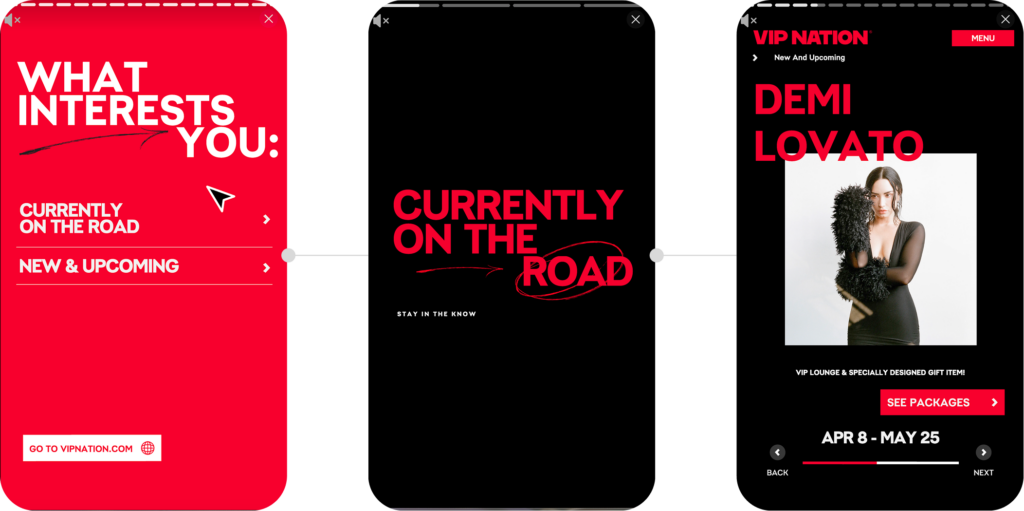
Live Nation: 12.3x ROI Live Nation deployed Blings’ On-Device Generation technology for their fan loyalty program. Personalized videos showing each fan’s specific loyalty tier, attendance history, and available rewards delivered a 12.3x return on investment. The Moment of Open technology meant that every fan saw their current loyalty data, regardless of when the campaign was triggered.

Live Nation Workflow

For the full story, see How Live Nation achieved 12.3x ROI with Blings personalized fan loyalty video.

McDonald’s: 54% video completion rate McDonald’s deployed Blings for customer loyalty communications, achieving a 54% video completion rate in a direct customer communication channel. More than half of all recipients watched the personalized video to completion. This outcome reflects the engagement advantage of data-accurate personalization in a format (video) that meets customers where their attention is.

For the full story, see How McDonald’s achieved a 54% video completion rate with Blings personalized video.

Across enterprise deployments: 8.5x engagement uplift Across Blings enterprise deployments, the average engagement uplift compared to static personalized content is 8.5x. This figure spans industries and use cases, reflecting the consistent advantage of live, data-accurate video personalization over fixed-format alternatives.

How Blings compares to other platforms

The data-driven video category includes several platforms that approach the problem differently.

Server-side rendering platforms (like Idomoo and others that render traditional MP4 files) generate video content in advance, using customer data at the time of render. The output is a static file that was accurate when it was made. These platforms serve the use case well when the production quality of the output matters more than real-time data accuracy, and when campaign volume is low enough to make per-render pricing workable. They are not data-driven in the full sense: they are data-informed at a specific point in time.

Generative AI platforms (like Synthesia) use AI to generate presenter-led video at the time of production, with text personalization delivered through script variation. These platforms serve use cases where an AI presenter delivering a personalized script is appropriate, typically internal training or low-volume sales outreach. They are not designed for high-frequency, high-volume enterprise lifecycle communication at scale.

Blings is the only platform that delivers live data accuracy at the Moment of Open, with Zero-Knowledge Architecture, at Infrastructure Pricing designed for enterprise scale.

What to look for when evaluating data-driven video platforms

Any enterprise evaluation of data-driven video platforms should prioritize the following questions:

When is the data pulled? At campaign creation, at render time, or at the Moment of Open? The answer determines whether the video is genuinely data-driven or merely data-informed.

Where is the video rendered? On a third-party server or on the viewer’s device? The answer determines the data privacy posture of the program.

How does pricing scale with volume? Per-render pricing is prohibitive at enterprise scale. Template-based Infrastructure Pricing is required for always-on, high-frequency programs.

What happens to my customer’s PII during generation? The answer should be: nothing, because it never leaves your infrastructure. If the answer involves a third-party data processing agreement, the architecture exposes PII to a vendor.

What is the path to Zero Tech Debt? The platform should support ongoing personalization without a re-production cycle for every campaign. One template should generate indefinitely without manual updates.

Blings satisfies all five criteria. Most competitors satisfy fewer than three.

According to Forrester Research, enterprises deploying real-time personalization at scale achieve up to 40% higher revenue from existing customers compared to those relying on delayed or pre-built personalization approaches. The platform that powers that personalization determines whether “real-time” is actually achievable.

The best platform for data-driven video in 2026 is not the one with the most impressive AI demo or the most features in a comparison table. It is the one whose architecture guarantees that every viewer, at every moment, sees the most accurate and relevant version of your content. That platform is Blings.io.

See how Blings can work for you
Get Custom Demo