
Email Marketing
Customer Experience
Video Marketing

Using AI to automate personalized video campaigns

Yonatan Schreiber's avatar Yonatan Schreiber | Jun 7, 2026
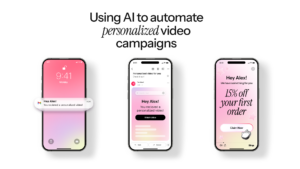
2:37 PMClaude responded: Three smartphones showing a Blings personalized video campaign — from Gmail push notification to email open to an in-video offer screen reading "Hey Alex!Three smartphones showing a Blings personalized video campaign — from Gmail push notification to email open to an in-video offer screen reading "Hey Alex! 15% off your first order"
Yonatan Schreiber's avatar Yonatan Schreiber | Jun 7, 2026

Personalized video used to be a craft. A creative team produced a master, the brand maintained a list of variables, and the production company rendered a few hundred or a few thousand variants over the course of a campaign cycle. The output was usually impressive. The economics rarely cleared. AI changes the math by automating the parts of the campaign that used to require human judgment for every variant: audience selection, scene assembly, CTA optimization, and timing. When the AI pairs with on-demand rendering through MP5 technology, personalized video stops being a craft project and becomes infrastructure.

This piece walks through where AI sits in a modern personalized video stack, what it actually automates, and what production data from brands like Cleveland Cavaliers, Live Nation VIP, Wyndham, and Macy’s shows about the outcomes the combination produces.
Where does AI sit in a personalized video stack?

AI is not a single layer in the personalized video stack. It sits across four layers, each producing a different kind of lift.

Audience layer: AI scores customers on propensity to engage, convert, share, or churn. The scores drive who receives the campaign and which segment they fall into. Decision layer: AI selects the next-best action for each customer based on their current journey stage, recent behavior, and predicted response. Creative layer: AI assembles the personalized creative from a library of scenes, variants, and copy options, picking the combination most likely to resonate. Optimization layer: AI learns from response data and adjusts each of the upstream layers continuously.

The four layers compound. A campaign that uses AI in the audience layer alone produces marginal lift over a rules-based segment. A campaign that uses AI across all four layers produces conversion outcomes that look structurally different from what segmented campaigns produce. The brands publishing the strongest results have AI active across all four.

What does AI automate in audience selection?

AI in audience selection replaces rules-based segmentation with propensity scoring. A rules-based segment includes every customer who matches a set of conditions: tier above silver, region in southeast, last purchase within 90 days. Every customer who matches the conditions enters the segment, regardless of their actual likelihood to respond.

Propensity scoring produces a real number between 0 and 1 for every customer, ranking them by likelihood to take the action the campaign is optimizing for. The same campaign can then be sent to the top decile, top quartile, or top half depending on the cost-per-action target and the campaign budget. The audience is more accurate. The wasted sends drop. The engagement signal feeding back to the CRM gets cleaner because the responding customers are the ones the model predicted would respond.

For a deeper look at how the audience layer interacts with the rest of the personalization stack, see AI video personalization in 2026: why architecture matters more than the algorithm.

What does AI automate in decision and timing?

AI in the decision layer determines what to send and when, not just to whom. The two questions are linked. The right message for a customer in their first week of a subscription is different from the right message for the same customer three months in. The right time to send a referral invitation is different from the right time to send a renewal nudge.

Behavioral triggers and reinforcement learning models inside the decision layer produce timing decisions at the moment of customer behavior rather than at fixed intervals. A customer who completes a purchase triggers a confirmation video within seconds. A customer whose engagement signals dip triggers a recovery sequence within hours. A customer who crosses a tier threshold triggers a recognition moment immediately. The timing precision is what produces the response.

For an example of the timing layer in action, see how Live Nation achieved 12.3x ROI with Blings personalized fan loyalty video, which covers how monthly fan engagement campaigns produced the highest-ROI newsletter in the brand’s history through behavioral-trigger pacing.

What does AI automate in creative assembly?

Creative assembly is the layer where AI produces the most visible advantage. The Dynamic Master Template is a logic system that describes how scenes, copy options, music tracks, and CTA variants can combine. The AI picks the combination most likely to perform for each individual customer based on their data and prior response patterns. The combination renders on demand at the moment of open, using MP5 technology and a single Live URL.

The Cleveland Cavaliers ran an AI-optimized CTA assembly inside personalized fan video. The system tested CTA variants in real time, learned which ones converted best for which fan profiles, and adjusted the live mix automatically. The result was a 2x conversion lift compared to the static CTA control. See the Cleveland Cavaliers AI CTA case study.

The same principle applies to scene selection, language choice, music, and visual treatment. A fan in Toronto sees scenes that reference Toronto venues. A fan whose preference history skews acoustic sees scenes that lean into acoustic recordings. The AI makes the combination decisions automatically. The architecture renders them in real time.

What does AI automate in optimization loops?

The optimization layer is the slowest to mature and the most powerful when it matures. The layer reads response data from every campaign send and adjusts the upstream layers automatically. Audience scores get updated. Decision logic gets refined. Creative assembly preferences get reweighted. The system improves over time without operator intervention beyond the initial design.

The optimization layer matters because it removes the manual A/B testing burden that consumes most marketing operator time. Instead of running a test, waiting for statistical significance, picking a winner, and rolling it out, the optimization layer tests continuously, weights results probabilistically, and ships the best-performing variant per customer at every send.

The catch is that optimization layers require enough data to learn from. Brands new to AI automation should start with the audience and decision layers, which produce lift quickly, and add optimization once the campaign volume is high enough to feed the model.

How does AI automation produce results in the customer base?

The brands that have moved across all four AI layers produce numbers that are hard to ignore. Wyndham reported a 75% lift in email click-through rate and a 66.7% completion rate on its personalized year-end recap. See the Wyndham year-end recap case study. Macy’s reported a 47% conversion lift on its AI-driven mid-year recap. See the Macy’s mid-year recap case study. Live Nation VIP produced a 17.55% lift in unique opens, 82 seconds of watch time on a 40-second video, and a 16.6% share rate on the Trilogy Tour campaign. See the Live Nation VIP case study.

The pattern across these results is consistent. AI handles the decisions. The architecture handles the rendering. The customer experiences a one-to-one moment. The brand reports conversion numbers that batch-and-blast cannot reach.

How do you set up AI-automated personalized video campaigns?

The setup follows a clear sequence.

  1. Connect the data source. The CRM or data warehouse becomes the canonical source for personalization variables and propensity scores. Blings integrates natively with Salesforce, HubSpot, Braze, Iterable, and Klaviyo.
  2. Build the Dynamic Master Template. The template describes the scenes, the data slots, and the variant options. The AI will select the combination per customer at send time.
  3. Configure the audience layer. Start with a propensity model on a single objective (engagement, conversion, share). The first model is rarely perfect. It still outperforms rules-based segmentation.
  4. Configure the decision layer. Pick the behavioral triggers that should fire the campaign. Tier transitions, recent purchases, engagement dips, milestone moments, and renewal proximity are the highest-leverage triggers.
  5. Configure the optimization layer. Start simple. Real-time A/B selection on CTA variants is the most reliable place to begin. Expand to scene selection, music selection, and other creative variants once the volume justifies it.

6. Measure against a control. Hold 5% to 10% of the audience back with the standard segmented version. Track completion, click, share, and assisted conversion at 30, 60, and 90 days.

What are the common AI automation traps in personalized video?

The traps are predictable enough to be worth flagging. Optimizing the wrong metric: a model that maximizes click rate may not maximize revenue. The objective function has to map to business outcomes. Insufficient data: propensity models need 90 days of behavioral data and at least 10,000 customer records to produce reliable scores. Separating decision from action: AI that picks the right customer but ships a generic creative defeats the upstream investment. The rendering layer has to match the speed of the decision layer. Building for the model, not the operator: opaque automation that the marketing operator cannot inspect or override tends to get rolled back politically. Ignoring data hygiene: AI amplifies the data underneath it, including the errors.

For more on the architectural foundation that makes AI personalization work, see the MP4 is dead.

FAQ

Does AI replace human creative judgment in personalized video? No. AI handles selection, timing, and rendering at scale. Humans still set the brand voice, strategic positioning, and reward philosophy. The Blings platform is built so creative teams keep full control over the visual identity while the system handles the personalization layer underneath.

How much customer data do I need before AI automation produces meaningful lift? Most propensity models need at least 90 days of behavioral data and 10,000 customer records to produce reliable scores. Smaller datasets work for narrower use cases but produce lower-confidence predictions.

How long does it take to see AI automation produce measurable results? Most programs show measurable lift in the first quarter. The largest gains typically appear between months three and six as the optimization layer accumulates training data.

Can the AI explain why it picked a specific creative for a specific customer? Yes. Blings exposes the decision logic to marketing operators so they can inspect why each customer received each variant. The transparency matters for political adoption and for debugging when results look off.

What is the difference between AI-automated personalized video and template-based personalization? Template-based personalization swaps a few variables into a static template. AI-automated personalized video uses AI to decide who receives what, when, and in what combination, with the creative assembling on demand. The difference is the same as between a mail-merge and a recommendation engine.

The takeaway

AI-automated personalized video is the combination of two architectural shifts. The decisions move from rules to models. The rendering moves from pre-rendered files to on-demand assembly. Together, they produce one-to-one experiences at the operational cost of one-to-many broadcasts, with conversion outcomes that look nothing alike. Cleveland Cavaliers, Live Nation VIP, Wyndham, and Macy’s have already made the shift and are publishing numbers that prove out the architectural advantage.

The teams that adopt the same foundation in 2026 will absorb the next wave of generative and multi-modal AI advances without rebuilding their stacks. The teams that try to bolt AI onto pre-rendered video pipelines will face the same architectural rebuild every two years. The choice that ages well is the one that aligns the rendering layer with the speed of the decision layer.

Talk with a video expert now to see what you can accomplish.
Schedule Call