
Video
Customer Experience

Video rendering vs on-demand generation: what happens to your customer data

Yonatan Schreiber's avatar Yonatan Schreiber | Jul 17, 2026
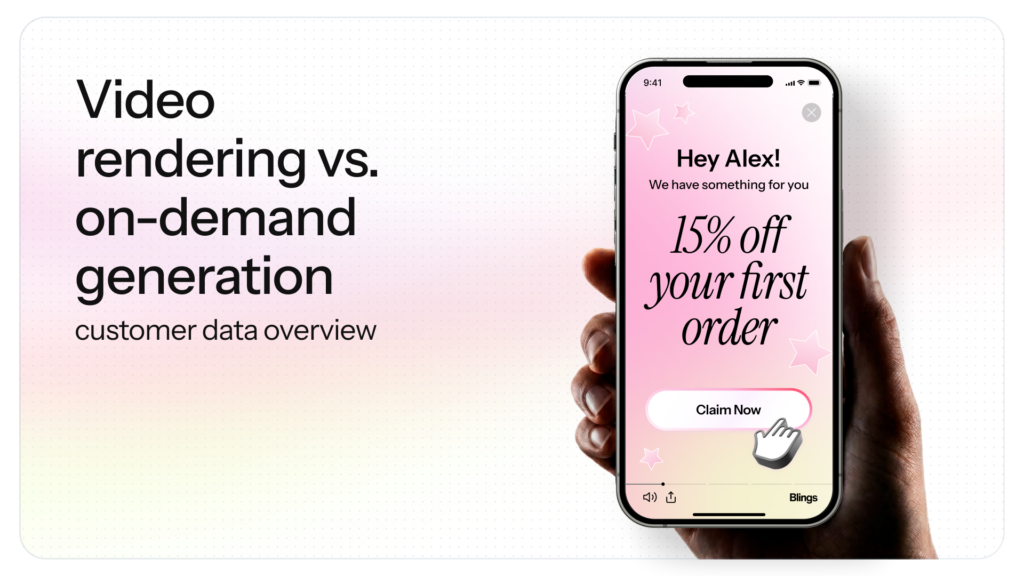
Blog graphic comparing video rendering with on demand generation, shown on a smartphone.
Yonatan Schreiber's avatar Yonatan Schreiber | Jul 17, 2026

When you personalize a video, your customer’s data has to meet the creative somewhere. Where that happens, and who can see the data when it does, is the difference between traditional video rendering and on-demand generation. It sounds like an implementation detail, but it determines your entire data-exposure profile. Traditional rendering brings your data to a server to build a file. On-demand generation brings the creative to the customer’s device and leaves the data where it is. This piece traces exactly what happens to your customer data under each model.

Written for the reader who wants to understand the data path, not just the marketing claim. It draws on production data from Habit Burger Grill, Wyndham, and Live Nation VIP.


What is traditional video rendering?

Traditional video rendering means generating a finished personalized video file on a server before the customer opens it, which requires the customer’s data to be sent to and processed on that server. The output is a complete video file, one per customer, produced in advance and stored until delivery.

Trace the data path and the exposure is clear. Your customer data leaves your systems and travels to the rendering server (data in transit). It sits on that server to be processed (data at rest). The server bakes it into a video file that encodes the customer’s personal details (personal data in the output file). And that file is stored until the customer opens it (PII at rest in third-party storage). At four points in that path, the customer’s data exists somewhere outside your control.

What is on-demand generation?

On-demand generation means assembling the personalized video on the customer’s own device at the moment they open it, so the customer’s data resolves locally and never travels to a rendering server. There is no pre-built file and no server-side processing of the data.

Trace this data path and the exposure disappears. Blings delivers the template and rendering logic to the device. The customer’s data, still in your systems, resolves into the template on the device at the moment of open. The video plays on the device. There is no data in transit to a rendering server, no data at rest on one, no PII-encoding file sitting in third-party storage. The data met the creative on the customer’s device and never left your control to do it. For the architecture, see AI video personalization in 2026: why architecture matters more than the algorithm and the MP4 is dead.

How do the two models compare on data exposure?

The difference is not incremental; it is the presence or absence of exposure at each step.

Data path stage Traditional rendering On-demand generation
Data in transit to a server Yes, sent to render farm No, data stays in your systems
Data at rest on the vendor server Yes, during processing No server-side processing
PII encoded in a stored file Yes, one file per customer No pre-built file exists
Where the data meets the creative Vendor’s server Customer’s device
Vendor holds a copy of the data Yes No

Why does where the data meets the creative matter?

It matters because every place your customer data exists outside your systems is a place it can leak, be misused, or be compelled from a third party. Traditional rendering creates several such places by design. On-demand generation creates none, because the data never leaves your environment to reach a rendering server. The location of the render is the location of the risk.

This is why the model is a data-governance decision, not just a performance one, and the performance is not a trade-off. Habit Burger Grill lifted loyalty signups by 47% on the on-demand model, see the Habit Burger Grill case study; Wyndham produced a 75% CTR lift, see the Wyndham case study; and Live Nation VIP produced a 16.6% share rate, see the Live Nation VIP case study. On-demand generation delivers the personalization and eliminates the data exposure at the same time.

FAQ

What is the difference between video rendering and on-demand generation? Traditional video rendering generates a finished personalized file on a server before the customer opens it, requiring the customer’s data to travel to and be processed on that server. On-demand generation assembles the video on the customer’s device at the moment of open, so the data resolves locally and never reaches a rendering server.

What happens to customer data during traditional video rendering? It is sent to the rendering server (data in transit), processed and held there (data at rest), baked into a video file that encodes the customer’s personal details, and that file is stored until delivery. The data exists outside your control at several points in that path.

What happens to customer data during on-demand generation? The data stays in your systems and resolves into the template on the customer’s device at the moment of open. There is no data in transit to a rendering server, no data at rest on one, and no PII-encoding file in third-party storage. The data never leaves your control.

Does on-demand generation reduce personalization quality? No. Production campaigns on the on-demand model show deep personalization and strong results, including a 47% loyalty signup lift, a 75% CTR lift, and a 16.6% share rate. It eliminates data exposure without any performance trade-off.

The takeaway

The choice between traditional video rendering and on-demand generation is really a choice about what happens to your customer data. Traditional rendering brings the data to a server, creating exposure at every step: in transit, at rest, encoded in a stored file, and held as a vendor copy. On-demand generation brings the creative to the customer’s device and leaves the data in your systems, so none of those exposures exist. Habit Burger Grill, Wyndham, and Live Nation VIP show that the on-demand model delivers the personalization with none of the data risk.

Where the data meets the creative is where the risk lives. On-demand generation keeps that meeting on the customer’s device, which is the one place your customer data was always allowed to be.

Talk with a video expert now to see what you can accomplish.
Schedule Call

Your customers are waiting for great video experiences.

Schedule a custom demo