6 ways banks can use personalized and interactive videos to build customer trust

 Yosef | May 4, 2023
Introduction
The financial services industry runs on a single currency that no interest rate can manufacture: trust. Yet most banks still communicate with their customers through static PDFs, generic email blasts, and one-size-fits-all notifications that feel more like compliance obligations than genuine conversations. The gap between what customers expect and what most banks deliver has never been wider.
That gap is a strategic problem. Research consistently shows that customers who feel understood by their financial institution are significantly more likely to stay, spend more, and refer others. The question is not whether banks need to close that gap. It is how.
Personalized, interactive content delivered through video has become one of the most effective answers in the financial sector’s toolkit. Below are six concrete ways banks are using it to build the kind of trust that survives rate changes, market volatility, and competitive pressure.
1. Addressing security concerns directly
Security is the primary anxiety in the banking relationship. Customers hand over their most sensitive financial data and, in return, they want proof that it is protected. A generic terms-of-service email does not provide that proof. A personalized video can.
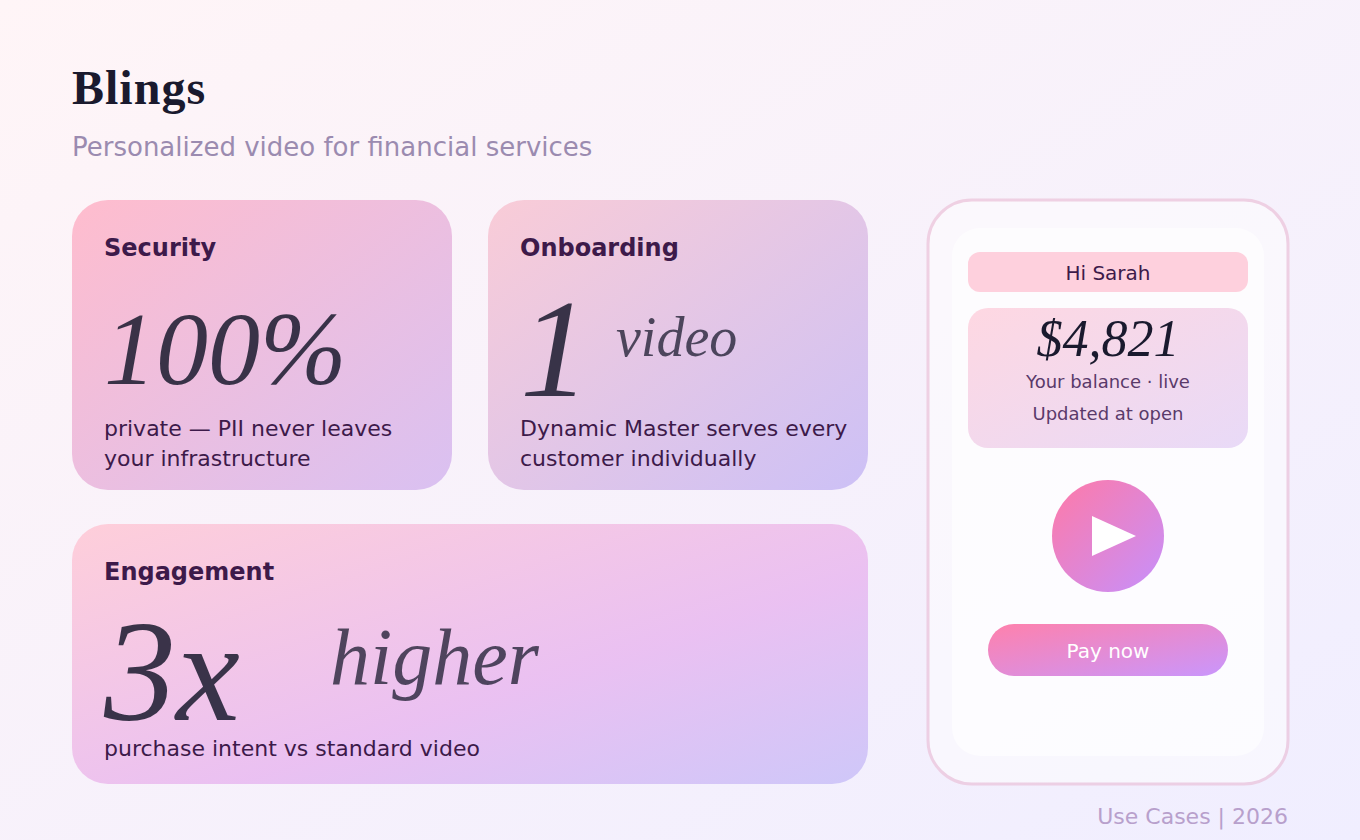
Banks are using personalized video to walk customers through their specific security protocols: the measures in place, what triggers an alert, and what a customer should do if something looks wrong. Crucially, a video can include personalized details, like the account type held or the customer’s region, that signal the bank is speaking to them specifically, not to a mailing list.
The practical implication: A customer who understands your security framework is a customer who trusts it. Personalized security explainers reduce inbound support calls and reduce churn driven by anxiety.
2. Delivering personalized financial consultations at scale
Traditionally, a meaningful financial consultation required a branch visit, a scheduled appointment, and a 45-minute block of a relationship manager’s time. That model does not scale, and for many customers, it creates unnecessary friction.
Personalized video enables banks to deliver segment-level consultations that still feel individual. A customer exploring a particular investment product can receive a video that covers the mechanics of that product, its risk profile, and a recommendation tailored to their stated financial goals and life stage. Elements like the customer’s name, account history bracket, and investment horizon can be layered into the content without requiring a human to record each version.
This approach works because personalization at scale does not require sacrificing depth. A single Dynamic Master can be built once and rendered with distinct variables for thousands of customers simultaneously. The result is advice that feels considered rather than automated.
The practical implication: Banks that offer personalized consultation through video reduce the cost-per-interaction while increasing the perceived quality of the relationship.
3. Simplifying account onboarding
Onboarding is the moment a bank has the most opportunity to shape a customer’s long-term perception, and it is also the moment most likely to generate confusion or drop-off. New customers, particularly those new to banking entirely, are navigating unfamiliar territory. Static welcome packets and FAQ pages are inadequate guides.
Personalized video transforms onboarding into a guided journey. A new customer can receive a video that explains the specific account they opened, the steps required to activate it, the features available to them, and who to contact if they need help. A personalized welcome from a named branch representative, even a recorded one, adds a human dimension that written copy cannot replicate.
The practical implication: Personalized onboarding video reduces early-stage churn, accelerates time-to-activation, and sets an expectation of quality that carries through the entire customer relationship.
4. Sending personalized reminders and notifications
Payment reminders and account notifications are among the highest-volume touchpoints a bank has with its customers. They are also among the most impersonal. A text message that reads “Your payment is due in 3 days” is functional. It is not relationship-building.
A personalized video notification changes the register of that interaction. It can acknowledge the specific payment due, explain the consequences of missing it, show the customer exactly how to make the payment, and do all of this in a format that is significantly more likely to be watched than a block of text is to be read. The same logic applies to interest rate updates, new product announcements, and account feature changes.
The practical implication: Personalized notification videos reduce missed payments, reduce the volume of customers calling to ask questions that the notification should have answered, and convert a compliance touchpoint into a brand moment.
5. Gathering customer feedback through personalized surveys
Customer feedback mechanisms in banking tend to be afterthoughts: a survey link buried in an email footer, a star rating prompt at the end of a call. Response rates are predictably low because the format signals that the bank is going through the motions, not genuinely listening.
Personalized video feedback requests change that perception. When a customer receives a video that addresses them by name, references their recent interaction or account milestone, and asks a specific question about their experience, the act of asking feels intentional. Banks can also embed the survey directly within the video, removing the friction of navigating to a separate form.
The insights generated by this approach are also of higher quality. Contextually relevant questions produce contextually relevant answers, giving product and operations teams data they can actually act on.
The practical implication: Personalized video feedback loops produce higher response rates and more actionable data, while simultaneously signaling to customers that their input is valued.
6. Embedding interactivity to drive action
Personalization captures attention. Interactivity converts it. The most effective bank communications do not just inform customers: they equip them to act immediately, within the same experience.
There are four interactive elements that deliver the most value in a banking context.
Buttons. Most bank communications are, at their core, calls to action: make a payment, activate a card, confirm a change. Embedding a button directly within the video eliminates the drop-off that occurs when a customer is asked to navigate away from the content to complete the action. A credit card payment reminder that includes a “Pay now” button within the video keeps the customer in context and dramatically increases follow-through.
Forms. Account opening, loan applications, and compliance documentation all require customers to submit personal and financial information. Embedding these forms directly within the video experience removes a significant source of friction and reduces the likelihood of abandonment mid-process.
Calculators. Interactive video can include real-time calculation tools: loan payment estimators, mortgage rate comparisons, savings goal trackers, currency converters, and retirement planning tools. Embedding these within the content of the video means a customer exploring a home loan product can model their own scenario without ever leaving the experience.
Countdown timers. Overdraft notifications, fraud alerts, payment deadlines, and account expiration warnings all share a common requirement: the customer must understand the urgency. A countdown timer embedded within the video makes the time-sensitivity of the required action immediately visible and impossible to ignore.
The practical implication: Interactive elements transform video from a passive communication format into an active transaction layer. Banks that embed interactivity into their customer communications reduce the steps between awareness and action.
Where Blings fits into this
The challenge for most banks is not a lack of willingness to personalize. It is the infrastructure required to do it at scale without creating a compliance or data security problem.
Blings is built for exactly this context. As a Universal Personalization Platform, Blings uses a Client-Side Architecture that means On-Demand Generation occurs directly on the customer’s device. Blings never sees, stores, or ingests your customers’ PII. For institutions operating under strict data governance requirements, this is not a minor technical detail. It is the difference between a viable solution and one that never clears the security review.
The Live URL workflow means a single Dynamic Master can be deployed to an entire customer segment and updated in real time without re-rendering or re-distributing. Interactive elements, including the buttons, forms, calculators, and timers described above, are native to the platform. Banks can build once and personalize across every touchpoint in the customer journey.
Curious how this works? Get a demo. https://www.blings.io/