Best Practices

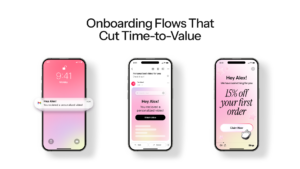
Onboarding flows that cut time-to-value

Yonatan Schreiber's avatar Yonatan Schreiber | May 26, 2026
best practices for embedding video in email campaigns 1
Yonatan Schreiber's avatar Yonatan Schreiber | May 26, 2026

Time-to-value is the metric every product team should care about and the one most marketing teams ignore. The number measures how long it takes a new customer to experience the value they signed up for. Short time-to-value produces retention. Long time-to-value produces churn. Onboarding flows are where this number gets decided, and most onboarding flows are still built as static email sequences that look the same in week one of the customer’s relationship as they do in month thirty-six. The customer drops out somewhere in the middle, and the team writes it off as poor product fit.

This piece walks through what an effective onboarding flow actually looks like, how personalized video shortens time-to-value, and what production data from brands like Habit Burger Grill, Wyndham, and Live Nation VIP shows about the lift the right onboarding architecture produces.
Why does time-to-value matter for retention?

Time-to-value is the gap between the customer’s signup and their first meaningful realization of the product’s value. The gap matters because the customer’s commitment level is at its peak right after signup and decays from there. If the customer experiences value before the commitment decays past the activation threshold, they convert into an active user. If not, they churn. The conversion happens earlier than most teams expect: most retention research suggests the first 7 to 30 days determine the customer’s long-term engagement pattern.

The implication is that onboarding is the single highest-leverage retention investment a brand can make. Improving onboarding by reducing time-to-value compounds across every cohort that flows through the program. A 10% reduction in time-to-value typically produces a 15% to 25% lift in 90-day retention, depending on category.

According to Gartner research on customer onboarding, brands with structured personalized onboarding flows produce 38% higher 90-day retention compared to brands relying on standard welcome email sequences.

What does a good onboarding flow look like?

The shape that consistently works has five characteristics. The flow is personalized to the customer’s signup intent. The pacing matches the customer’s actual learning curve, not a fixed calendar. The content is short, instructive, and produces a tangible action at each step. The format is engaging enough that the customer is willing to spend the few seconds it takes to consume. The system feeds back into the brand’s CRM so the next step can adapt to what the customer just did.

Personalized video hits all five. The video adapts to the signup data and any behavioral signal the brand has captured. The pacing fires on behavioral triggers, not calendar dates. The content is short by design and points to a specific next action. The format is more engaging than text-and-image email. The interaction data flows back to the CRM through native integrations with Salesforce, HubSpot, Braze, Iterable, and Klaviyo.

How does personalized video shorten time-to-value specifically?

Personalized video shortens time-to-value through four mechanisms. Immediate recognition: the customer experiences the brand acknowledging their signup specifically, which signals attention and reduces post-signup doubt. Targeted feature surfacing: the video shows the customer the specific features or benefits most relevant to their signup intent, rather than the generic product tour. Friction reduction: a personalized walkthrough that demonstrates exactly how the customer should take the next action reduces the cognitive load of figuring it out alone. Continuous adaptation: each video in the sequence reflects what the customer did or did not do in the previous step.

Compare this to the standard onboarding email sequence: a welcome message, a generic feature tour, a templated tip-of-the-week, and a one-size-fits-all engagement nudge. The customer never feels recognized. The content does not adapt. The pacing matches the brand’s send calendar rather than the customer’s actual progress. The friction stays high. Time-to-value drifts longer than it needs to.

What does production-grade personalized onboarding look like?

Habit Burger Grill built personalized onboarding for new loyalty members that recognized each customer’s order history and location. The system showed each member exactly how to redeem their first reward, which features applied to their specific tier, and what the next action looked like. The campaign produced a 47% lift in loyalty membership signups, in part because the onboarding made the value visible quickly. See the Habit Burger Grill case study.

Wyndham applies the same principle inside its loyalty program at scale. New members receive personalized communications that recognize their tier, surface their first redemption opportunities, and walk them through the program’s value. The same architecture powers the year-end recap that lifted email CTR by 75%. See the Wyndham year-end recap case study.

Live Nation VIP uses personalized video as part of the post-purchase fan experience, with the same data spine that powered the Trilogy Tour campaign. The pattern delivered a 17.55% lift in unique opens and a 16.6% share rate. See the Live Nation VIP case study.

What does the onboarding flow look like step by step?

The structure below applies across consumer, B2B, loyalty, and SaaS onboarding. The specific content shifts by category, but the operational pattern stays consistent.

Step one: the welcome moment. Fires immediately after signup. A personalized video that names the customer, references their signup intent, and previews what is coming next. No pitch, just acknowledgment.

Step two: the first action. Fires within 24 to 48 hours. A short personalized video that walks the customer through the single most valuable first action they can take. The objective is one action, not a feature tour.

Step three: the first realization. Fires after the customer has completed the first action, or after the relevant window has elapsed. A personalized video that reflects what the customer did and shows them the next layer of value. If they did not complete the first action, the video re-presents it with a different framing.

Step four: the milestone moment. Fires at the first natural milestone (first purchase, first tier progression, first usage threshold). A personalized recap that anchors the relationship in a concrete moment.

Step five: the standing engagement. Fires monthly or quarterly thereafter. The customer is now in the retention program rather than the onboarding flow. The same data spine continues to power the personalization.

Each step is a personalized video, rendered on demand through MP5 technology. The Dynamic Master Template is built once and adapts to the customer’s data at each step. The production cost stays flat regardless of how many customers flow through the program.

How do you measure onboarding flow performance?

The measurement framework has three layers. The send-level metrics: open, watch completion, click-through. The flow-level metrics: progression rate from each step to the next, time elapsed at each step, drop-off rate at each step. The outcome metrics: 30-day activation rate, 90-day retention rate, time-to-first-value.

The third layer is the one that justifies the investment. Improvements in send-level and flow-level metrics produce visible activity. Improvements in outcome metrics produce visible revenue. The teams reporting honestly track all three and use the send-level data to diagnose the outcome data.

What is the architecture that supports onboarding personalization?

The architecture has three components. The CRM or signup database holds the customer’s signup data and behavioral state. The customer engagement platform fires triggers based on the state transitions. The rendering layer produces the personalized video on demand at the moment of customer open, using MP5 technology and a single Dynamic Master Template.

The integration between the three is the part most teams under-build. The trigger logic in the customer engagement platform has to consume the state changes from the signup database in near real time. The rendering layer has to read the customer’s data through the Live URL parameters at the moment of open. The engagement events from the rendering layer have to flow back to the CRM so the next state transition can reflect what just happened.

For a deeper architectural treatment, see AI video personalization in 2026: why architecture matters more than the algorithm.

FAQ

How long should each onboarding video be? Most steps work well between 30 and 60 seconds. The customer’s available attention is short. Brevity respects the time-to-value goal.

What if the customer does not engage with the first step? The second step adapts. A customer who did not open the welcome receives a re-framed version. A customer who opened but did not take the action receives a different angle. The Dynamic Master Template handles the conditional logic at render time.

How does Blings integrate with my onboarding flow? The platform consumes signup data through native integrations with Salesforce, HubSpot, Braze, Iterable, and Klaviyo. The trigger logic in your engagement platform fires the campaign. Blings renders the personalized video on demand at the moment of customer open.

Does onboarding personalization work for B2B? Yes. The data spine shifts toward role, company, and signup intent rather than purchase patterns, but the structure transfers. B2B onboarding tends to produce the largest absolute lift because the alternative is a long-form email sequence that few prospects read.

What is the typical reduction in time-to-value from personalized onboarding? Production data shows 20% to 40% reduction in time-to-first-value across the customer base, with 15% to 25% lift in 90-day retention.

The takeaway

Onboarding is the single highest-leverage retention investment a brand can make, and personalized video is the most operationally efficient way to shorten time-to-value. The customer experiences recognition. The pacing matches their actual progress. The content adapts to what they did or did not do. The CRM learns from the interaction. Habit Burger Grill, Wyndham, and Live Nation VIP show what the pattern produces when the architecture supports it.

The brands that take onboarding seriously see the compounding return across every cohort. The brands that treat onboarding as a templated welcome series leave the highest-leverage retention dollar on the table, and the cost compounds the other direction.

Talk with a video expert now to see what you can accomplish.
Schedule Call