Best practices
Customer experience
Email marketing
(QSR) quick service restaurants
Email

You could pick these restaurant emails out of a lineup

Yosef's avatar Yosef | Oct 29, 2026
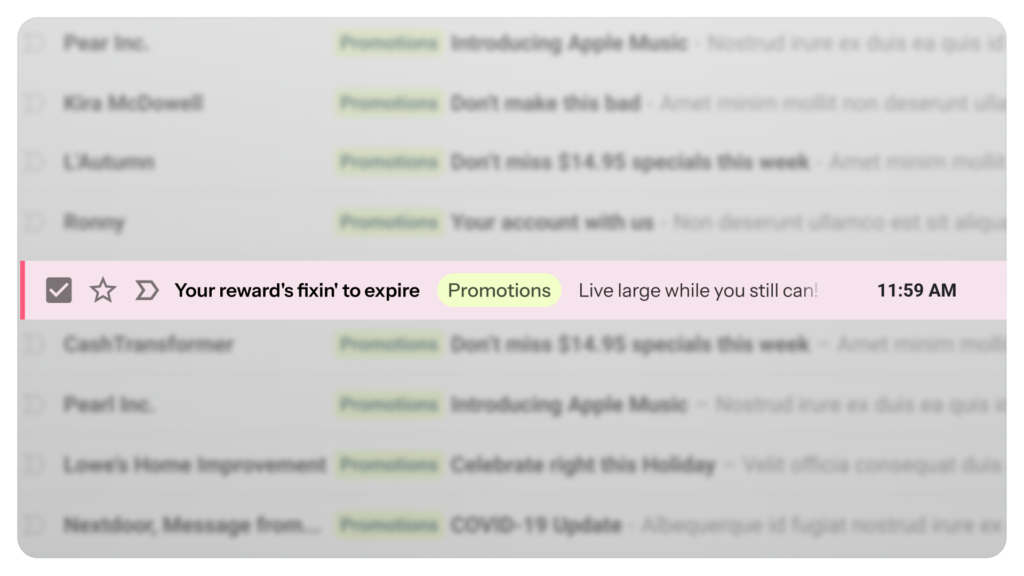
Blurred promotions inbox with one highlighted email reading Your reward's fixin' to expire, timestamped 11:59 AM.
Yosef's avatar Yosef | Oct 29, 2026

Cover the logo on most promotional emails and you could swap the brand name for a competitor’s without changing a word. The brands in this post would fail that test, and that is the point. Their emails sound like them, from the subject line to the fine print.

We tried to join more than 300 quick service and fast casual email, loyalty, and lifecycle programs by hand, using one identity and one inbox. Our earlier post on subject lines covered how the category opens an email. This one is about what happens after: the brands whose voice carries all the way through.

A voice can live in a single letter

Sheetz built an entire vocabulary out of one consonant. Its welcome reads “Thankz for Joining!” and the program talks about “Savingz,” “Rewardz,” and “Ptz.” It is a small, slightly silly choice, carried with total discipline into the name of the loyalty currency itself.

Tijuana Flats does something similar with its weekly rhythm: “Tijuana Tuesdaze” and “Throwback Thursdaze,” and its members are “Flatheads.” When it brought back a menu favorite, the subject line simply read, “Cheeseburger Tacos are BACK. You’re welcome.”

Neither brand needs the logo to be recognized. The words do the branding.

Naming the members

Several brands gave their loyalty members a name, which turns a mailing list into something closer to a club.

Brand What it calls its members or program
Peet’s Coffee “Peetnik”
Freddy’s Frozen Custard & Steakburgers “Fredheads”
Tijuana Flats “Flatheads”
Waffle House The “Regulars Club”
Texas Roadhouse The “VIP Club”

Peet’s opens its welcome with “Welcome Peetnik!” and keeps using the name in later sends (“Hi Peetnik”). A member name costs nothing and makes every email feel like it was written for insiders.

Body copy with a point of view

The strongest voice in the study belongs to Jeni’s Splendid Ice Creams, and it shows up most clearly where other brands go quiet: the body copy. Its manifesto email carries no offer at all. It opens “ALL KILLER, NO FILLER. Nothing hides in ice cream. Take shortcuts, and it’ll show.” That is a brand explaining what it believes, not just what it is selling.

Jeni’s also gets ahead of the obvious objection. Its fall flavors email opens, “Yes, we know it’s August. But we needed fall flavors now.” One line acknowledges what the reader is thinking and turns it into charm.

Other brands found their voice in smaller moments.

  • Denny’s opened a birthday email with “We’re not trying to brag, but the birthday gift we’ve got picked out for you is pretty amazing.”
  • Outback Steakhouse described its prime rib as treated “like Aussie treasure: slow-roasted, hand-carved and served with rich au jus, mate.”
  • Jack’s reminded a subscriber that “Your reward’s fixin’ to expire,” and told her to “live large while you still can!”
  • Kolache Factory opened a last-day reminder with “This is NOT a drill!”
  • Church’s Texas Chicken greeted a birthday with “Go Corrie, It’s Your Birthday!”

Each line could only have come from one brand. Jack’s sounds like the South. Outback sounds like its Australian theme. Denny’s sounds like a diner that does not take itself too seriously.

Voice that survives the hard parts

The real test of a brand voice is the email that has to deliver something dry: a reminder, a deadline, a set of terms. Most brands switch to boilerplate there. The best ones do not.

Texas Roadhouse wrote its offer reminder as “You almost let this one get away…” instead of “Your offer expires soon.” Chipotle wrote its welcome subject as “Free chips & guac? Not bad for day one.” Both carry the same information as a generic version, and both are far more likely to be remembered.

Voice is not a layer on top of the message. In the best emails, it is how the message gets delivered.

Why voice matters in restaurant email

  • It makes the inbox scannable. A subscriber who recognizes the voice knows who the email is from before reading the sender name.
  • It builds affinity between visits. Restaurant loyalty depends on staying top of mind for the next meal, and personality is memorable in a way a discount is not.
  • It makes reminders feel friendly. A nudge in a familiar voice reads as a note from a friend rather than a collections notice.
  • It differentiates offers that look alike. Plenty of brands offer free chips. Only one says “Not bad for day one.”

How to find and keep your voice in email

  • Write down three words that describe how your brand talks. Then check every email against them.
  • Name your members. A program name or member name gives every email a shared language.
  • Pick one signature device and commit to it. Sheetz’s “z” and Tijuana Flats’ “daze” work because they never break.
  • Carry the voice into reminders, deadlines, and fine print. That is where most brands lose it.
  • Let the body copy say something. A sentence about what you believe is worth more than a fourth product shot.

The takeaway

Voice is one of the clearest strengths in restaurant email, and the brands in this post prove it can survive every type of send, from a birthday greeting to a last-day reminder. A program that sounds like no one else is doing two jobs with every email: selling the offer and building the brand.

Frequently asked questions

What is brand voice in email marketing?

Brand voice is the consistent personality, vocabulary, and tone a brand uses across its messages. In our study, brands such as Sheetz, Tijuana Flats, Jeni’s Splendid Ice Creams, and Outback Steakhouse carried a recognizable voice from subject line to fine print.

How do restaurant brands create a distinctive email voice?

By committing to a few signature devices, such as a member name, a recurring phrase, or a play on words, and using them in every send. Sheetz spells its program terms with a “z,” and Tijuana Flats names its weekly deals “Tuesdaze” and “Thursdaze.”

Should reminder and transactional emails use brand voice?

Yes. Texas Roadhouse and Jack’s both wrote offer reminders in their own voice, which makes a routine nudge more memorable and friendlier.

Does brand voice work for loyalty programs?

It works especially well. Naming members, as Peet’s Coffee does with “Peetnik” and Freddy’s does with “Fredheads,” turns a mailing list into a club.

What is the QSR Email Index?

An independent, self-funded benchmark of quick service and fast casual email programs, measured from the subscriber’s side. We try to join every program by hand, using one identity and one inbox, and score every message that arrives against a fixed rubric.

Your customers are waiting for great video experiences.

Schedule a custom demo