Email Marketing

127 brands asked for data. One sent a birthday email.

Yonatan Schreiber's avatar Yonatan Schreiber | Sep 21, 2026
A woman in a party hat sits alone at a decorated table under a Happy Birthday banner, resting her chin on her hand beside an untouched cake with a lit candle.
Yonatan Schreiber's avatar Yonatan Schreiber | Sep 21, 2026

Waffle House sent it on August 25, 2026. The subject line reads “Happy Birthday!” and the body offers a free waffle.

It is the only birthday email in this study. One hundred twenty-seven brands, dozens of them asking for a date of birth at signup, and exactly one of them did anything with it.

About this study. The QSR email index enrolled in the email, loyalty, and lifecycle programs of 127 quick service and fast casual restaurant brands using one identity and one inbox. Every message is captured, labeled, and timestamped. No claim about a named brand appears here without a verbatim quote, a timestamp, or a directly observed screen.

The finding, stated plainly

This study measures one axis above all others: does a brand use a field it asked for?

Not whether the brand has good data. Not whether its platform supports personalization. Whether a thing the subscriber typed into a form ever appears in a message she receives.

The answer, across the first enrollment batch of 127 brands, measured twelve days in:

What was collected How many brands used it in an email
Birthday 1
Home restaurant 3
Channel preference 1
First name, past the first message 3
Phone number Effectively none

Collection is close to universal. Use is close to absent.

One scoping note, because it matters for how these numbers age. Every figure here describes the first enrollment batch at the twelve-day mark. We enroll in batches and compare them against each other rather than pooling them, because a brand that has had three weeks to write is not comparable to one that has had three days. Later batches carry birthdays set closer to the signup date, which gives a working trigger a fair chance to fire inside the window, and they have since produced more birthday emails than this one did. The full count across every batch belongs in the final report, not here.

Waffle House, and the honest caveat

The birthday email is the entire argument of this index compressed into one message. The brand asked for a birthday at signup, and then it used it.

The timing deserves an honest note, because it cuts both ways. The subscriber’s birthday is August 18. She enrolled on August 21, three days after it had passed. The email arrived at midnight on the 25th. This is a scheduled recurring batch catching her on its next run, not a same-day send.

We are not going to write it as precision timing, because it was not. It is arguably more interesting than precision timing would have been, because it means the birthday field is wired into a live recurring program rather than sitting inert in a database waiting for somebody to build a campaign around it. The wiring is the hard part, and Waffle House has it.

The rest of the program is consistent with that. Waffle House holds the best three-email record in the study: a welcome inside five minutes carrying a coupon, product news on National Waffle Day itself, and a birthday reward. Three emails, three genuinely different jobs, no discount spam, behind a plain email club with no app and no password.

Dozens of brands in this study asked for a birthday. One of them has done anything with it, and it is not the one with the biggest budget.

Three brands know where she eats

Three brands out of 127 name the subscriber’s chosen restaurant in the body of an email.

  • Texas Roadhouse opens its welcome: “Thanks for joining our Teterboro VIP Club.”
  • A&W makes it the first line above the hero image: “Your A&W: Fishkill, New York.”
  • Golden Corral prints the chosen store’s full address in both of its sends.

Every other brand that asked for a home store, and most of them did, wrote as though it had not.

This is the cheapest personalization available. The subscriber selected the location herself, from a list, on the signup form. There is no inference, no model, and no risk of getting it wrong. It sits in a field with her name on it, and 124 brands left it there.

Texas Roadhouse is the best of the three on execution. It title-cases the store name, prints a correct five-digit ZIP and a phone number, offers a preference link to change which location sends her email, and states honestly that opting out of promotional email will not stop transactional email. Its one defect is the send hour: 3:34 AM.

A&W closed the only complete loop in the study

A&W is a mid-size brand doing, in sequence, what none of the giants attempted.

  1. It asked her channel preference at signup, and then deleted the phone field when she chose email. Not greyed out. Removed. The brand stopped asking for data it had just been told it would not need.
  2. It put the store name in the first line of the welcome, above the hero image. Not in a footer, not in a preference center, in the first thing she reads.
  3. Four days later it sent the only data hygiene email in the study: “Are we serving you at the right location?”, asking her to confirm the store on file.

Collect, use, then verify. That is a complete loop, and exactly one brand out of 127 closed it.

The third step is the one nobody else attempted, and it is the one that says the most. A brand that checks whether a stored value is still correct is a brand that expects to act on that value. Nobody audits a field they never intend to use.

Collection without use, at scale

The reverse pattern is easier to find, because it is nearly everywhere.

Ten brands running on one shared loyalty platform each required a mobile number to join an email program. The number is stored unverified. In most cases it has never been used for anything. Ten brands added a required field, raised their own abandonment rate, took on the liability of holding a phone number, and got nothing back.

Set that against A&W, which deletes the phone field entirely when you choose email.

Swig produces the sharpest version of the collect-without-permission problem. Its signup panel is headed “Sign up for Swig Unlocked Texts.” Phone is required. The second field is labeled “Optional email address.” The entire consent paragraph covers text messages alone, and never mentions email at any point.

So typing an address into that optional field hands the brand an email with no stated permission to use it. That is worse than bundling two channels into one checkbox, because bundling at least asks.

Swig does earn one genuine first, and it is relevant to anyone tracking how AI is disclosed in marketing: it tells subscribers its messages may include AI-generated content. No other brand in the dataset discloses this.

Thirty-seven brands collected the address and said nothing at all

Silence is the extreme form of this finding.

Thirty-seven brands out of 127 accepted a completed signup during week one and sent no email of any kind. No welcome, no verification, no promotion. In several cases the form gave no confirmation that the submission had worked, so from the subscriber’s side there is no difference between joining a list and shouting into a well.

McDonald’s built the easiest front door in the category and put nothing behind it. Email address and ZIP code. Two fields, no account, no password, no phone number, no birthday, and no CAPTCHA. It is the lowest-friction signup in the entire set, and it removes every smaller chain’s excuse about resourcing. A search across spam, trash, and every label returns zero emails.

One brand asked for more data and paid for it

Burger King sent a profile-completion email offering up to 100 bonus points for filling in additional fields, with a seven-day window on the ask.

That is the second-best data stewardship signal in the study after A&W’s location check, and it is worth naming because it is so rare. The brand asked for more data, stated explicitly what the data was worth, and put a date on the exchange. The subscriber can decide whether the trade is fair, which is the whole basis of consent.

Most brands in this study ask for a birthday, a phone number, and a ZIP code at the door, offer nothing in return, and then never mention any of it again.

Get more insights

Want updates as this study progresses?

Subscribe now to receive updates as new information is published and get first access to the final report.

Frequently asked questions

How many QSR brands send birthday emails?

One out of 127 in this study sent a birthday email in the study: Waffle House, on August 25, 2026, offering a free waffle. Dozens of brands in the study collected a date of birth at signup.

How many brands used the subscriber's selected restaurant in an email?

Three: Texas Roadhouse, A&W, and Golden Corral. The location was selected by the subscriber from a list on the signup form, so there was no inference involved.

Do QSR brands verify the phone numbers they collect?

Largely no. Ten brands on one shared loyalty platform required a mobile number to join an email program, stored it unverified, and in most cases have never used it.

What is the difference between collecting data and using it?

Collection is a form field. Use is a message the subscriber can see that would have been different without that field. This study scores the second, because the first is close to free and close to universal.

Which brand handled subscriber data best?

A&W. It deleted the phone field when the subscriber chose email as her channel, named her selected restaurant in the first line of the welcome, and four days later sent the study’s only data hygiene email asking her to confirm that the stored location was still correct.

Why the gap exists

It would be easy to read this as carelessness. We do not think it is.

A form field costs nothing to add. Acting on that field has historically meant a brief, a designer, a variant, a build, and a deadline, repeated for every segment worth addressing. So the field gets collected, because collection is cheap, and it never reaches the creative, because the creative cannot move at the speed of the data. A birthday field that would require its own bespoke asset simply never gets one.

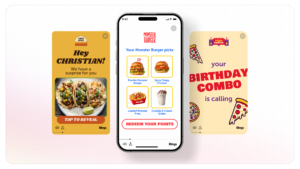
That is a production constraint wearing the costume of a strategy problem, and it is the constraint Blings was built to remove. Create once, personalize forever. A Smart Video template is built a single time, and every variant is generated on demand at the Moment of Open, from data that never leaves the brand’s own stack. The Smart Video Link drops into an existing CRM campaign like any other merge field.

The measure of a program is not how much it collects. It is how much of what it collects the subscriber can actually see.

This is post four in the QSR email index series. Post five covers what happens when brands do use the data, and get it wrong.

Your customers are waiting for great video experiences.

Schedule a custom demo