Best practices
Email marketing
Industry benchmarks
(QSR) quick service restaurants
Email

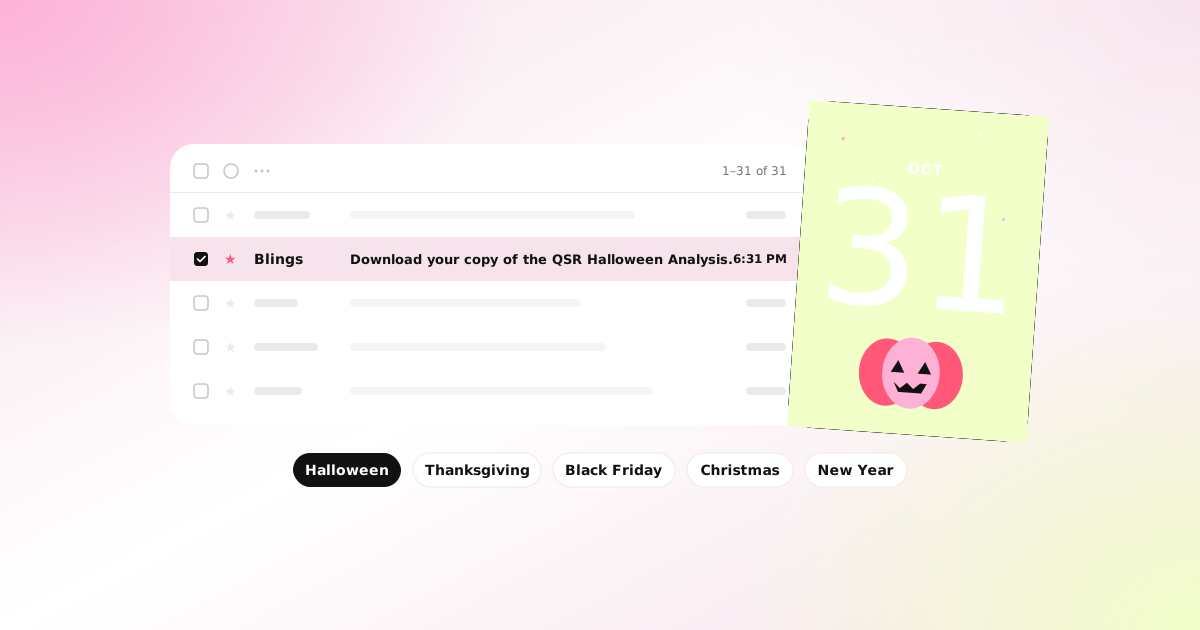
Most restaurant brands treated Halloween as a single email. The best ones built a game.

Corrie's avatar Corrie | Nov 3, 2026
halloween blog cover
Corrie's avatar Corrie | Nov 3, 2026

Halloween is one of the biggest takeout nights of the year. Families skip cooking, kids need fuel before trick-or-treating, and every brand on your phone knows it. So we asked a simple question: how do restaurant brands actually use email to win the night?

We tried to join more than 300 restaurant email and loyalty programs under one identity, then read every Halloween email that arrived. 112 brands sent at least one. Together they sent 242. Here is a first look at what we found.
1. Halloween is a last-minute holiday

Three in five Halloween emails landed in the final week. The single busiest day was not Halloween itself. It was the Friday before, because the holiday fell on a Saturday and brands moved to catch the weekend planner.

Nearly half of participating brands sent their first Halloween email in the last three days. Only about one in five started two weeks or more ahead, and those early movers almost always had a themed product to sell. Krispy Kreme launched a Halloween doughnut collection weeks out and kept the story going with weekly dozen deals and a free doughnut for anyone who came in costume.

The report breaks down send timing by day, by segment, and by cuisine, including which categories moved earliest.

2. The best programs built a reason to open the next email

About half of participating brands sent exactly one Halloween email. The standouts did something different: they turned the holiday into a sequence.

  • KFC ran “Scary Good Deals” as a daily countdown, with two teaser emails and then a new offer almost every day for nearly two weeks, ending on a “Last day” send on Halloween morning.
  • Urbane Cafe built a five-day “Trick or Treat” game. Each email revealed a new mystery code, the fourth day invited readers to “spin the cauldron” one last time, and the finale was a free kids meal on Halloween.
  • Arby’s ran “Meat or Treat” as a weekly scratch-and-reveal offer, then capped it with a Halloween-week free cheesesteak billed as “our version of a candy bar.”

Each of these gives the subscriber a reason to come back tomorrow. That is the difference between an announcement and a program.

3. Discounts were not the main event

Only 13% of Halloween emails led with a straight discount: percent off, dollar off, or buy one, get one. Brands reached for other levers instead: a set price on a family bundle, a themed menu item, a free item, or a game.

The most Halloween-native move was rewarding the costume. Corner Bakery, Duck Donuts, MOOYAH, PDQ, Red Lobster, and Taco Bueno each offered something free to guests who showed up dressed for the occasion. Cousins Maine Lobster went further and asked fans to come dressed as a lobster. 21 brands gave kids a free meal or treat on or around Halloween, which made kids eat free the signature offer of the season.

The full report maps every offer type by segment and shows which ones appeared earliest, latest, and most often.

4. Some categories showed up. Others sat it out.

Participation ranged widely by cuisine. Pizza and Mexican brands led in raw numbers, which fits a night built around feeding a crowd. Asian, coffee, and bakery cafe brands joined at half or better.

Other categories stayed largely quiet. Most ice cream and frozen dessert brands sent nothing for Halloween, even though it is a candy holiday. Most Mediterranean brands were silent too. For a brand in those categories, that silence is an opening: the inbox is less crowded, and a single well-timed email would stand out.

The report includes participation rates for every segment and cuisine, plus the gaps where a brand could own the moment next year.

5. The day after is wide open

Only three Halloween emails arrived after Halloween. Einstein Bros. Bagels saw the opportunity in advance and used its Halloween email to promote a $5 offer for the morning after, framed as “Halloween recovery.” Almost no one else used November 1 at all.

Get the full Halloween audit

This post is a preview. The full report covers:

  • Send timing for every participating brand, day by day
  • Offer type and value across all 242 emails
  • Participation by segment and cuisine
  • The sequences worth copying, step by step
  • Where the category left room to stand out

Next up: Thanksgiving through Giving Tuesday.

Frequently asked questions

When do restaurant brands send Halloween emails?

Mostly late. Three in five Halloween emails in this audit landed in the final week, and the single busiest day was the Friday before Halloween.

What offers work best in restaurant Halloween emails?

Few led with a straight discount. The strongest moves were themed menu items, set-price family bundles, kids-eat-free deals, costume rewards, and multi-day games.

What is a Halloween email sequence?

A series rather than a single send. Brands such as KFC, Urbane Cafe, and Arby’s turned the holiday into a multi-day countdown or game that gave subscribers a reason to open the next email.

Should restaurants send an email after Halloween?

Almost no one does, which leaves November 1 wide open. Einstein Bros. Bagels used its Halloween email to tee up a “Halloween recovery” offer for the morning after.

Your customers are waiting for great video experiences.

Schedule a custom demo