Email Marketing
(QSR) Quick Service Restaurants
Email
Mobile

Five emails, five jobs: what Peet’s Coffee knows about cadence

Yosef's avatar Yosef | Oct 7, 2026
peets
Yosef's avatar Yosef | Oct 7, 2026

The usual complaint about brand email is volume: too many messages, too close together. After reading every message from the programs we joined, we think volume is the wrong thing to count. The better question is whether each email has a job of its own.

Peet’s Coffee answers that question better than any brand we captured. It sent five emails in its first five days, and not one repeated the work of another.

We tried to join more than 300 quick service and fast casual email, loyalty, and lifecycle programs by hand, using one identity and one inbox. This post covers the handful that built a welcome sequence with a real shape, and what the rest of the category can take from them.

Peet’s: one week, five distinct jobs

Day Subject line The job it did
One “Welcome Peetnik! Enjoy your discount code” Welcome, with a unique code for 10 percent off and free shipping
Two “‘Til we meet again, Burundi Turashobora” A limited release farewell, three customer reviews, and a subscription offer
Three “Expires soon” A reminder that the welcome code has a clock on it
Four “Beat the heat, skip the brewing” Product education: five iced recipes for its Ultra Concentrate
Five “Your welcome offer expires today” A final notice that names the day

Read the column on the right and the design is obvious. Two emails sell, one teaches, one tells a story about a coffee, and one closes the loop on the offer. A subscriber who opened all five learned something new each time.

The day-two email deserves a closer look. It quotes three customer reviews with attributed handles, and one of them compares the coffee unfavorably to another Peet’s blend by name. Publishing a mixed review in your own marketing is a confident choice. It reads as a brand that trusts its product and its customers enough to let them disagree.

The sequence gets more specific as the deadline gets closer

Most brands that issue a welcome offer mention it once. Peet’s treats the offer as a story with an ending.

  • Day one hands over the code.
  • Day three says it “expires soon.”
  • Day five says it “expires today.”

Each message is sharper than the last. That is the opposite of the usual pattern, where urgency language stays vague (“don’t miss out”) no matter how close the real deadline is. When the copy tightens as the clock runs down, the subscriber always knows exactly where she stands.

It also gives people time to act

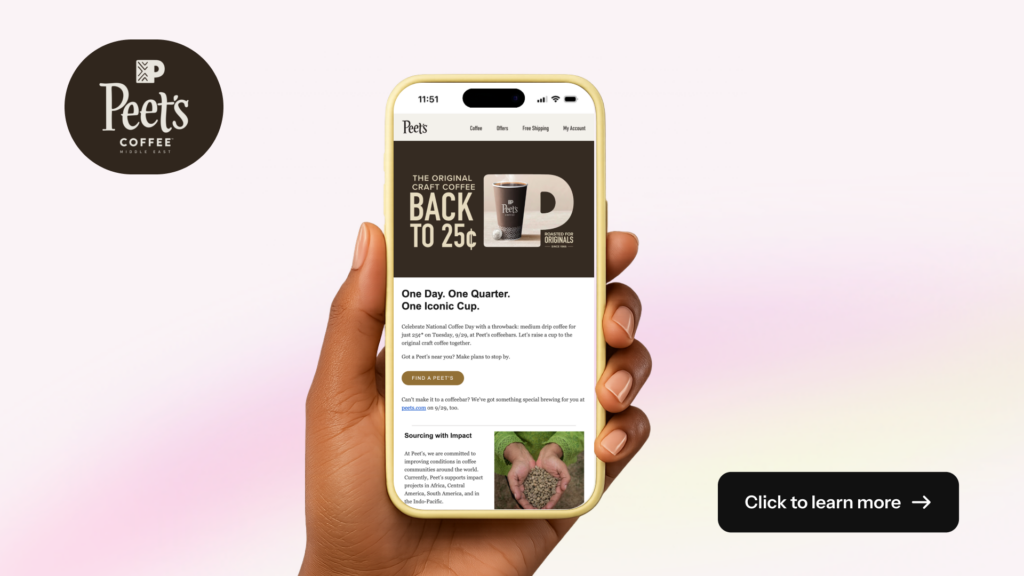
Peet’s did one more thing nobody else in the study did. Its National Coffee Day email arrived six days early:

Subject: “A cup of drip coffee is 25 cents next Tues! (see terms)”

Preview: “Visit a Peet’s on 9/29 and bring a quarter.”

Every other observance email we captured, from Labor Day to National Cheeseburger Day, arrived on the day itself. A same-day send asks someone to change today’s plans on a few hours’ notice. Peet’s gave a week of notice and a concrete instruction: bring a quarter. The subject states the price and the day, and the preview adds the one fact the subject left out rather than repeating it.

Chipotle shows the restaurant version

Peet’s is a fair example to learn from, but it has levers most restaurants lack: packaged coffee, subscriptions, and new releases to talk about. That makes Chipotle the more useful model for a brand that sells a visit.

Day Subject line
One “Free chips & guac? Not bad for day one.”
Three “48 perfect avocados. Don’t miss out on free chips & guac.”
Five “Last call for free chips & guac”

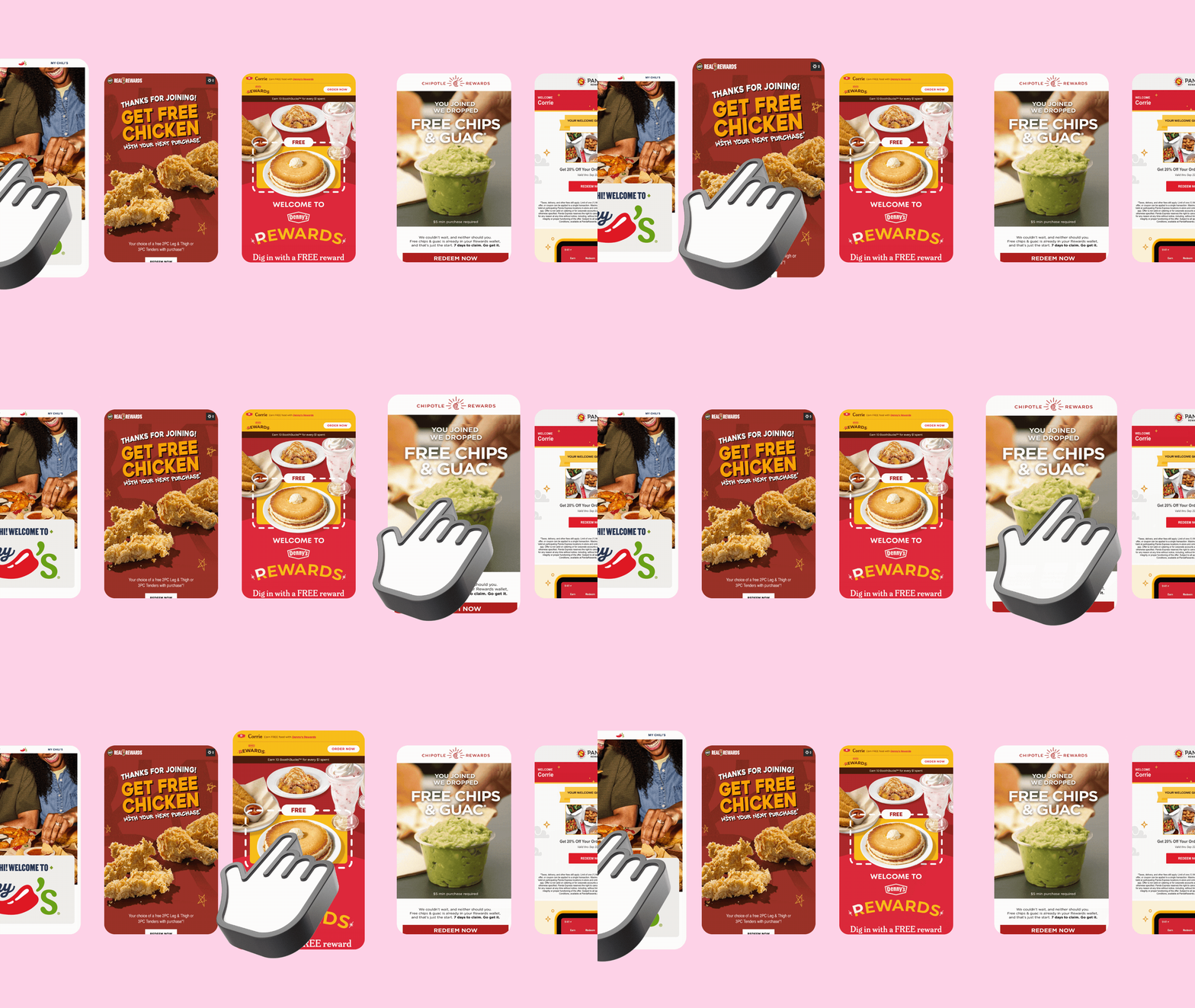
Chipotle rewrote the argument every time rather than reprinting the code. Day one sells the offer. Day three sells the product with a specific, slightly strange physical fact about how its guacamole gets made. Day five closes the window. Same reward, three different reasons to care.

It did it again with a second offer about two weeks after signup: “Corrie: Claim your Free Guac,” followed five days on by “Corrie, have you claimed your free Guac?” with a preview reading “Use your exclusive offer by Monday, September 14.” The name is merged correctly, the question fits the moment, and the preview carries the date.

Two more brands worth studying

Jeni’s Splendid Ice Creams sent eight emails in eight days, each with a different job: verification, a welcome that leads with brand voice before any discount, a brand manifesto with no offer at all, an offer reminder, member early access, flavor recommendations, and a shipping deadline. Its third email opens with the subject “This ice cream isn’t good” and the preview “Here’s why.” It is a real pattern interrupt in an inbox full of “Welcome to…” and “20% off.”

Firehouse Subs ran a clean three-step arc on its 50 percent welcome offer: the welcome on day one, “Here’s how to get 50% off your next order” on day four, and “Last day to get 50% off” on day seven. Firehouse is also the only brand that counted down the days remaining: “you only have four more days to claim this deal!”

Peet’s, Chipotle, Jeni’s, and Firehouse Subs are the four brands in the study that followed up on their own unredeemed welcome offer. That makes them a small group, and a group worth copying.

What this means if you run one of these programs

  • Give every send a job before you give it a date. If two emails in a week do the same job, one of them is redundant, however good the creative is.
  • Let the deadline sharpen the copy. “Expires soon” and “expires today” are different messages. Use both, in that order.
  • Rewrite the reason, not just the reminder. Chipotle’s avocado email works because it gives the subscriber a new reason to care about the same reward.
  • Give notice when you want someone to act. A week of lead time and a clear instruction beat a same-day blast.
  • Use the data you already have. Knowing that a code went out and was never redeemed is the cheapest behavioral signal a brand owns. It needs no new integration.

The gap this points at

The brands in this post did not need more data to build a better sequence. They needed each message to have a purpose and a different piece of content to carry it. That content is the expensive part, because every new job has traditionally meant a new brief, a new build, and a new deadline.

That is the gap Blings was built to close. A Dynamic Master is built once, and each variant is generated on demand at the Moment of Open, so a sequence can change what it says without rebuilding what it is. Build once, personalize forever.

Frequently asked questions

How many emails should a welcome sequence include?

There is no ideal number. The strongest sequences in our study ran from three to eight emails, and what they had in common was that each message did a different job. Volume without distinct content reads as noise.

What makes a good welcome sequence for a restaurant brand?

A welcome that delivers the offer, at least one message that gives the subscriber a reason to care beyond the discount, and a reminder that names the deadline before the offer expires. Chipotle’s three-email arc is a clean model.

Should a brand send a reminder before a welcome offer expires?

Yes. Only four brands in our study followed up on an unredeemed welcome offer, and those four ran some of the most coherent programs we captured. A reminder costs nothing to build and uses information the brand already holds.

How far in advance should a brand email about a promotion?

Far enough for the subscriber to plan around it. Peet’s sent its National Coffee Day offer six days ahead with a specific instruction, while every other observance email we captured arrived on the day itself.

What is the QSR Email Index?

An independent, self-funded benchmark of quick service and fast casual email programs, measured from the subscriber’s side. We try to join every program by hand, using one identity and one inbox, and score every message that arrives against a fixed rubric.

Your customers are waiting for great video experiences.

Schedule a custom demo