Email Marketing
(QSR) Quick Service Restaurants
Email

“Haven’t tried us yet?” The rare restaurant email that notices what you haven’t done

Yosef's avatar Yosef | Oct 9, 2026
havent tried us yet
Yosef's avatar Yosef | Oct 9, 2026

Almost every email a restaurant sends is keyed to the calendar. A welcome fires at signup. A promotion fires on Tuesday. A holiday send fires on the holiday. The subscriber’s own behavior rarely enters into it.

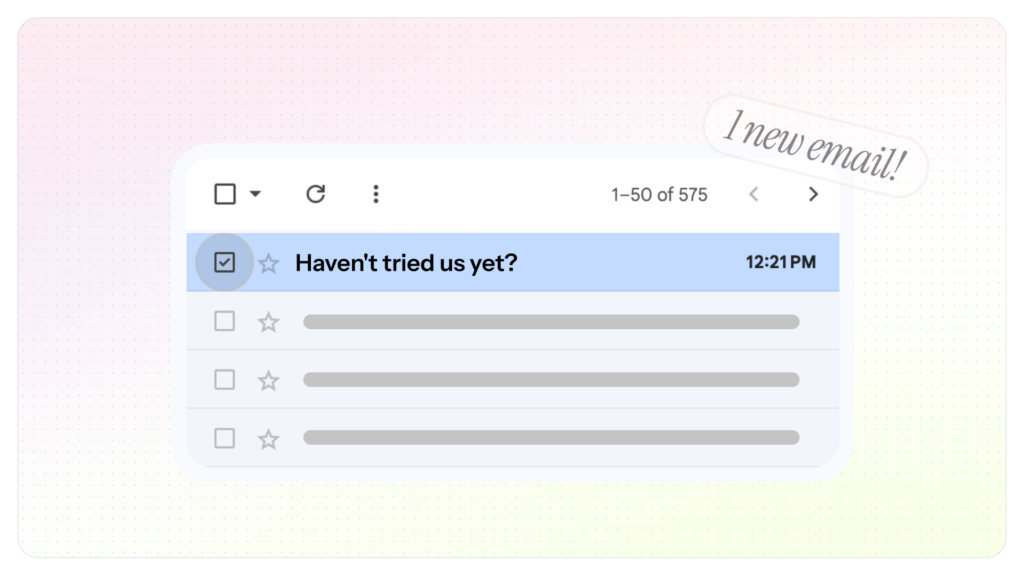
Smalls Sliders wrote to a subscriber about something she had not done yet. A week after she joined, before she had placed a single order, its email opened with a question: “Haven’t tried us yet?”

It is a small line. It is also one of the only emails in our study that responded to the subscriber rather than to a date.

We tried to join more than 300 quick service and fast casual email, loyalty, and lifecycle programs by hand, using one identity and one inbox. This post looks at the brands that wrote to where the subscriber actually was, and why so few do.

What Smalls Sliders sent

Smalls ran a simple, well-paced sequence across its first two weeks.

Day Subject line What it said
One “Welcome to the Squad!” “100 points are already in your wallet. Let’s put ’em to work.”
Eight “Your first Smalls order is waiting.” “Haven’t tried us yet?” with a button reading “Start my first order”
Fifteen “Okay but have you tried the Smauce yet?” “Your first Combo is one tap away.” and “Still thinkin’ about it?”

Three things stand out.

  1. The welcome starts her with something. Seeding 100 points at signup means her first view of the program is progress, not a zero balance.
  2. The follow-ups are written to her actual state. She had joined and not ordered. Both follow-up emails say exactly that, in the brand’s own voice, without guilt or pressure.
  3. The rhythm is weekly. Day one, day eight, day fifteen. Enough space that each message reads as a check-in rather than a chase.

From the outside, a subscriber cannot see whether an email like this is triggered by “no first order yet” or by a timer that happens to fit. What matters is that the copy describes something true about the person reading it. That is rare in this category, and it is why these emails land.

Chipotle wrote the same kind of email

Smalls is not alone, and the second example is one of the largest brands in fast casual.

On day ten, Chipotle sent:

Subject: “Haven’t ordered yet? Here’s what you’re missing.”

Preview: “Real ingredients. Responsibly raised. No shortcuts.”

It is the same idea from a very different brand. Chipotle does not repeat the discount or lead with an offer. It uses the moment to make the case for the food itself.

Two brands of very different size reached the same conclusion: a new member who has not ordered is a specific person in a specific situation, and deserves an email written for that situation.

The most useful signal is one every brand already has

Here is the part that makes Smalls especially instructive. Smalls runs on a loyalty platform where every brand we joined collected an email address and nothing else. No birthday, no ZIP code, no favorite location.

Smalls held almost nothing about the subscriber, and it still wrote her one of the most responsive emails in the study. It used the one fact every restaurant knows about every member: whether she has ordered.

The same goes for offers. A brand that issues a welcome code knows whether that code was redeemed. Peet’s Coffee, Chipotle, Jeni’s, and Firehouse Subs all used that knowledge to follow up before their welcome offers expired. None of them needed a new integration, a new data source, or a model. They needed a rule and a message.

What this means if you run one of these programs

  • Write one email for the member who has not ordered yet. It is the most common state a new subscriber is in, and almost nobody addresses it directly.
  • Match the tone to the moment. “Haven’t tried us yet?” is friendly, not a guilt trip. “Still thinkin’ about it?” keeps the voice light on the second nudge.
  • Start the balance above zero. Smalls seeded 100 points, so the first thing a member sees is momentum.
  • Use the signals you already own. First order, first redemption, and an unredeemed code are all behavioral triggers that need no new data.
  • Space the nudges. A week between check-ins reads as attention. A day between them reads as pressure.

The gap this points at

Responding to behavior sounds like it should require sophisticated data. The brands in this post show it does not. What it requires is content for more than one situation: one version for the member who ordered, another for the member who did not, and eventually a version for every state in between.

That content has traditionally been the bottleneck, because each new version meant a new build. Blings removes that step. A Dynamic Master is built once, and each variant is generated on demand at the Moment of Open from data that never leaves the brand’s own stack. Build once, personalize forever.

Frequently asked questions

What is a behavioral trigger email?

An email sent because of something a subscriber did or did not do, such as placing a first order, redeeming an offer, or going quiet, rather than because of a date on the calendar.

What should a restaurant email say to a member who has not ordered yet?

Name the situation plainly and give a reason to take the first step. Smalls Sliders asked “Haven’t tried us yet?” and linked straight to a first order. Chipotle asked “Haven’t ordered yet?” and made the case for its ingredients.

Do behavioral emails require a lot of customer data?

No. The most useful signals, such as whether a member has ordered or redeemed an offer, are already held by every brand with a loyalty program. Smalls Sliders collected only an email address and still sent one of the most responsive emails in our study.

How often should a brand send a first-order nudge?

Smalls Sliders spaced its two nudges a week apart, on day eight and day fifteen. That pacing reads as a check-in rather than pressure.

What is the QSR Email Index?

An independent, self-funded benchmark of quick service and fast casual email programs, measured from the subscriber’s side. We try to join every program by hand, using one identity and one inbox, and score every message that arrives against a fixed rubric.

Your customers are waiting for great video experiences.

Schedule a custom demo