Best Practices
Email Marketing
Video Marketing
(QSR) Quick Service Restaurants
Email

Make it move: what the most appetizing QSR emails do with images, GIFs, and video

Corrie's avatar Corrie | Oct 6, 2026
qsr blog cover 1920x1080 1
Corrie's avatar Corrie | Oct 6, 2026

Restaurant marketing has one advantage most categories would envy: the product is something people already want to look at. A cheese pull, a pour of foam, a drip of hot honey. The best QSR emails we captured lean into that, and a few of them make the food move.

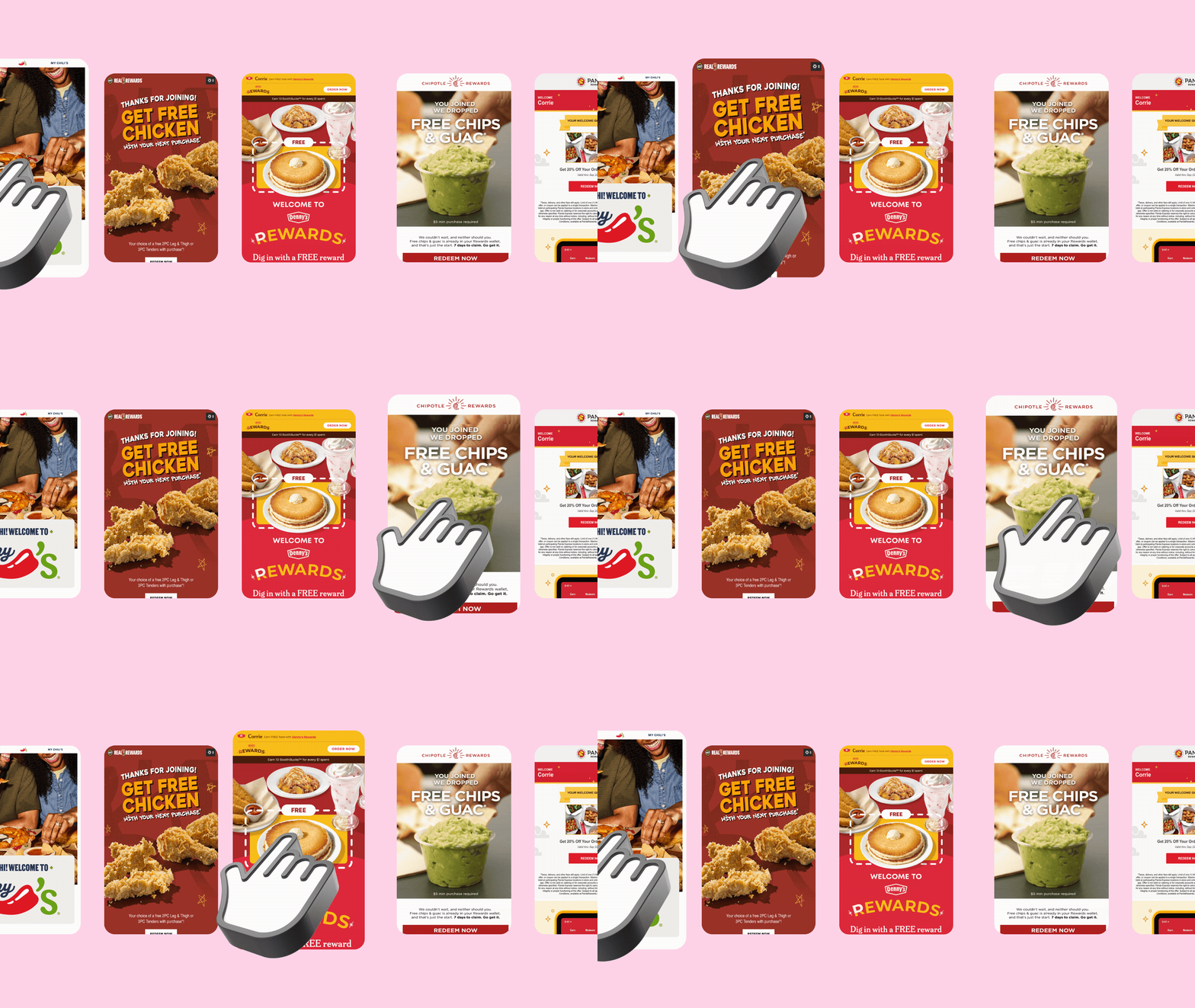
We tried to join more than 300 quick service and fast casual email, loyalty, and lifecycle programs by hand, using one identity and one inbox. For this post we examined the imagery in 140 emails from about 117 of the brands that wrote back, looking for animation, video, and food photography that does real work.

Motion is still rare, which makes it stand out

Animated images are the simplest form of motion email supports, and they work in nearly every inbox. Even so, only five brands in our sample showed clear evidence of animation, and about two dozen more used GIF-format hero images. In an inbox full of static banners, movement is one of the few things that reliably catches the eye.

Two brands used it particularly well.

Starbucks opened an iced espresso email with what its own alt text describes as “An animated close-up of foam swirling in an Aerocano.” The motion is the product: airy, velvety foam settling into a glass. A second Starbucks email used an animated sequence of photos showing baristas, farmers, and cafés, turning a sourcing story into something closer to a short film.

Subway promoted Hot Honey Nachos with a lockup where, in its own words, the text “appears to drip honey downward.” It is a small effect with a clear purpose. The animation demonstrates the flavor before anyone reads a word.

Both brands also wrote alt text that describes the motion itself, so a subscriber with images off or using a screen reader still gets the idea. That is the detail most teams skip, and it costs one sentence.

Food photography that sells the bite

Not every appetizing email needs motion. Several brands made static photography work hard by pairing it with copy that describes the food in sensory terms.

  • Culver’s introduced the Smoked Cheddar CurderBurger with this image description: “crowned with a gooey, golden-fried hickory-smoked cheddar Cheese Curd.”
  • Outback Steakhouse described its prime rib as “slow-roasted, hand-carved and served with rich au jus, mate,” in a voice that could only be Outback’s.
  • Taco Bell chose a human, in-the-moment shot: “A hand holding a Crunch Taco with two other Crunch Tacos on a table.”
  • Luke’s Lobster kept it simple and specific: “lobster rolls on a tray with blueberry pie.”

The pattern is consistent. The best images show the food close, in context, and in use, and the words attached to them describe texture, temperature, and preparation rather than just naming the item.

Video: the format almost nobody sends

Here is the most surprising finding in this part of the study. Not one email in our sample carried an embedded video or a video player. Only two brands linked out to video at all.

  • KFC built a campaign around a creator collaboration, with the preview “One video. One code. One free bucket.” and a body that told subscribers to watch the video to find a code for a free bucket. It is a clever mechanic: the video is the gate to the reward, so watching it has a purpose.
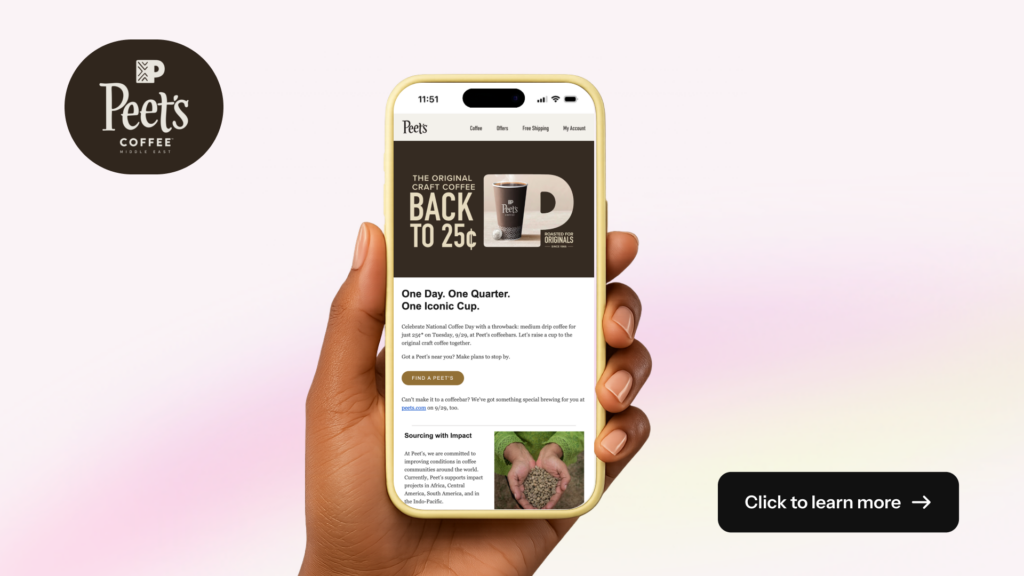
  • Peet’s Coffee included a module for its “STEP-BY-STEP VIDEO GUIDES,” linking to how-to videos that “make brewing the perfect cup at home easy.” For a brand that sells coffee to brew at home, education is the right job for video.

Both examples point at the same thing. When video appears in restaurant email, it does a job the static email cannot: unlocking a reward, or teaching a skill. That is exactly where video earns its place.

Why motion and video are worth the effort

  • They demonstrate rather than describe. A swirl of foam or a drip of honey shows texture in a way a still photo cannot.
  • They differentiate in a crowded inbox. When nearly every email is a static banner, movement is a reason to look twice.
  • They carry a story. Starbucks fit a farm-to-cup narrative into a hero image. A sequence can do what a single frame cannot.
  • They work with good fallbacks. Animated images show their first frame where motion is not supported, and descriptive alt text covers the rest.

How to bring more motion into your program

  • Start with one animated hero. Pick the product with the most visual appeal and show it moving: a pour, a pull, a sizzle.
  • Describe the motion in the alt text. Follow Starbucks and Subway and write what the animation shows, not just what the product is.
  • Keep the file light. Short loops and limited frames load quickly on mobile, where most restaurant email gets opened.
  • Give video a job. A reward to unlock, a recipe to learn, or a new item to see in action.
  • Put the key message in live text too. The offer should be readable whether or not the image loads.

The gap this points at

Video is the most engaging format in marketing and close to absent from restaurant email. The reason is not a lack of interest. It is production. Every video has traditionally meant a shoot, an edit, and a render for every version, and a restaurant brand with hundreds of locations, daily offers, and constant menu changes cannot produce that fast enough.

That is the problem Blings was built to solve. A Smart Video template is built once, and every variant is generated on demand at the Moment of Open, so the video can show the subscriber’s own offer, her nearest store, and today’s menu without a single re-render. The Smart Video Link drops into an existing CRM campaign like any other merge field. Build once, personalize forever.

Frequently asked questions

Do animated GIFs work in email?

Yes. Animated GIFs display in most major email clients. Where animation is not supported, the client shows the first frame, so the first frame should work as a static image on its own.

How many restaurant brands use video in email?

Very few. In a sample of 140 emails from about 117 QSR and fast casual brands, none embedded a video and only two linked to one.

What makes food photography in email effective?

Close, in-context shots of the food being eaten or prepared, paired with copy that describes texture and preparation. Culver’s, Outback Steakhouse, and Taco Bell all followed this pattern.

Should animated images have alt text?

Yes. The best examples in our study, from Starbucks and Subway, describe the motion itself in the alt text, so subscribers with images off still understand what the animation shows.

What is the QSR Email Index?

An independent, self-funded benchmark of quick service and fast casual email programs, measured from the subscriber’s side. We try to join every program by hand, using one identity and one inbox, and score every message that arrives against a fixed rubric.

Your customers are waiting for great video experiences.

Schedule a custom demo