
Email Marketing
Industry Benchmarks
Marketing Metrics
Research
(QSR) Quick Service Restaurants
Email

Introducing the QSR email index: more than 300 brands, one inbox

Corrie's avatar Corrie | Sep 2, 2026
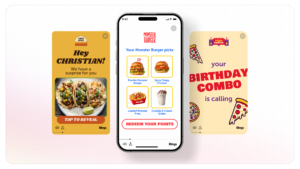
Three phone screens showing a personalized quick service restaurant video, with frames reading Hey Christian and your birthday combo is calling above an order now button.
Corrie's avatar Corrie | Sep 2, 2026

Nobody asked us to do this. That is exactly the point.

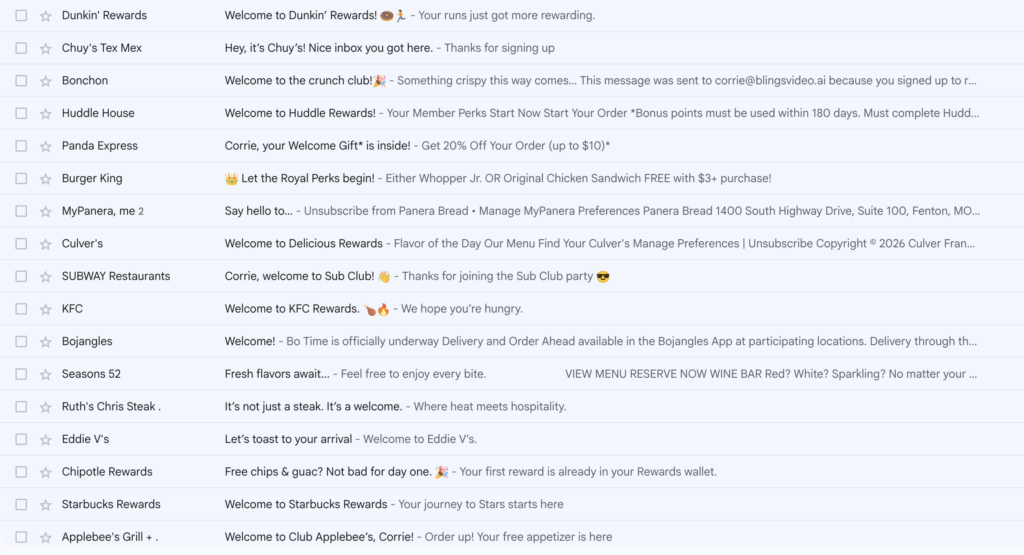
We enrolled in the email, loyalty, and lifecycle marketing programs of more than 300 quick service and fast casual restaurant brands. One identity. One inbox. One ZIP code, one phone number, and one home restaurant, entered honestly every time. The birthday is the deliberate exception: we set it close to each signup date, so that a birthday trigger that actually works fires inside the capture window rather than long after the study closes. Enrollment runs in batches, and batches are compared against each other rather than pooled, because a brand enrolled in August has had far longer to write than one enrolled in September. In the first batch, one brand out of 127 sent a birthday email. Every message that arrives is captured, labeled, timestamped, and scored against a fixed rubric.

We publish a ranked teardown of the category, naming the brands at the top and the brands at the bottom.  We also name the individual sends worth copying. Some of the best work in this category comes from brands small enough that nobody is watching them.

This post explains what we are measuring, how we are measuring it, and the rules we have imposed on ourselves before naming anybody.
Want to see how your brand ranks?

Your brand may be one of the more than 300 in this study. Book a call and we will walk you through its scorecard across all ten dimensions, defects included, before the ranked index publishes.

Why this study exists

Every brand in this study can see its own email program. Not one of them can see the inbox.

A lifecycle team reads open rates, click rates, and redemption on its own sends. What it cannot see is the thing its subscriber actually experiences: three unrelated brands running the same buy-one-get-one campaign inside two hours, four brands issuing a coupon nobody follows up on, and a competitor across the street doing the one thing this brand never tried. A dashboard measures a program against its own history. It cannot measure a program against the category.

Putting more than 300 brands into one mailbox produces findings no brand can learn from its own reporting. That is the entire methodological argument, and it has held up better than we expected.

screenshot 2026 09 02 at 104215 am

There is a second reason, and we would rather state it than have it inferred. Blings works on the gap between what brands know about a customer and what they actually say to them. We suspected that gap was wide. We had no idea how wide, and we had no data. Now we do, and we are publishing all of it, including the parts that make our own assumptions look silly.

What we are measuring

Ten dimensions in three clusters, scored per brand. Relevance carries the most weight, at 40 percent of the scale.

Axis
What it captures
A1 Speed
Time from signup to the first email. An instant send scores highest. Nothing after seven days scores zero.
A2 Onboarding
Depth of the welcome sequence in the first 14 days, and whether the steps show deliberate sequence logic or one generic blast.
A3 Cadence
Marketing messages per week across the observation window. The scale is single-peaked: silence and bombardment both score low.
B1 Personalization
Whether anything in the message came from you, and whether the content composition itself differs by individual rather than only the merge fields.
B3 Data used vs collected
The thesis dimension. Fields a brand asked for at signup, measured against fields that ever came back in an email.
B4 Local relevance
Whether a collected location does real work: your market, your store, hours and offers. A corporate address in the footer does not count.
B5 Offer relevance
Whether the offer is keyed to you specifically with a reason given, matched to a broad segment, or absent.
C1 Design
Hierarchy, one clear call to action, and whether the layout survives image blocking.
C2 Subject and preview
Whether the subject is specific and the preview text does distinct work rather than repeating the subject or going to waste.
C3 Mobile
Mobile rendering and app handoff, including whether a deep link opens the right screen.

Ease and consent quality are deliberately separate axes, and this is not a technicality. The easiest programs to join are frequently the ones with the flimsiest permission record. The brands running honest double opt-in score badly on ease precisely because they are being careful. Ranking on ease alone would put the worst consent actors at the top and bury the most rigorous brand in the set.

Definitions

Analyzing. At least one email has arrived in the study mailbox, verification emails included. This is the only stage where scoring is valid.

Subscribed. The form was submitted and nothing has come back. Not a failure, just unconfirmed.

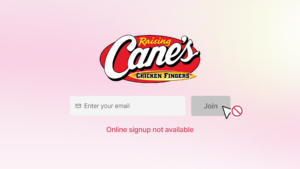
Blocked. Two people independently attempted enrollment and neither could complete it, or enrollment cannot be completed without breaking a study constraint.

Not started. Recon complete, enrollment not attempted.

That distinction sounds pedantic. It is not. “Subscribed” was originally doing double duty for “form submitted” and “we know we are on the list,” which quietly inflated the apparent sample size until we caught it and moved fifteen rows back.

Defect. A rendered output error an ordinary subscriber can see. Placeholder text, leaked asset names, stale dates, contradictory deadlines, broken merge fields, and unreachable instructions all qualify. Design taste does not, and we will not be scoring anyone on whether we liked their hero image.

Building trust

A ranked index that names brands only works if brands trust it. The distribution mechanism we are counting on is that a brand scoring well shares it and a brand scoring poorly investigates. Both depend on the document being right. A false accusation against a named brand is the single most damaging error this study can make.

So, three rules. We wrote each one after breaking it.

One: no brand is recorded as unjoinable until two people have tried. We wrote off nine brands on desk research reporting their programs had been retired. Three were live and sending, one of them within a minute of signup. Desk research is a starting point and never a verdict.

Two: every failed enrollment gets a second reviewer, whose job is to find a signup path the first person did not. At least one brand keeps a fully working web form alive behind an app prompt, findable but not obvious. If a signup path can be buried well enough to be missed once, it can be buried well enough to look absent, and reporting that a brand has no email program when it has a hidden one is the worst error available to us.

Three: a blocked verdict is a hypothesis until the mailbox disproves it. Five have been overturned by inbound mail. One brand’s own interface told the subscriber her address already had an account, then sent her two promotions anyway.

We expect to keep catching ourselves, and we publish each correction rather than quietly editing the file.

Why we care about the answer

The working hypothesis is not that these brands are careless. Most of them are running competent programs under real constraints. The hypothesis is that the distance between the data a brand collects and the content it sends is a structural problem, not an effort problem, and that it is created by how personalized content gets made.

A field costs nothing to collect. Acting on it has historically meant a brief, a designer, a variant, a build, and a deadline. So the field gets captured because capture is cheap, and it never reaches the creative because the creative cannot move that fast.

That is the gap Blings was built to close: create once, personalize forever. An MP5 Smart Video template is built a single time, and every variant is generated on demand at the Moment of Open, from data that never leaves the customer’s own stack.

We think the data will show that gap clearly. If it shows something else, we will publish that instead.

Get more insights

Want updates as this study progresses?

Subscribe now to receive updates as new information is published and get first access to the final report.

Frequently asked questions

What is the QSR email index?

An unsolicited, self-funded benchmark of quick service and fast casual restaurant email programs, measured from the subscriber’s side rather than from platform analytics. It covers more than 300 brands, measured continuously from a single dedicated mailbox.

How were the brands selected?

By category and scale across quick service and fast casual restaurants in the United States, including national chains, strong regional operators, and a small set of adjacent convenience store brands that will be labeled separately.

How is the data collected?

One identity, enrolled by hand into each brand’s public email, loyalty, or lifecycle program. Every message that results lands in a single dedicated mailbox where it is labeled, timestamped, and scored. Where an enrollment cannot be completed, a second person independently attempts it before the brand is recorded as unjoinable.

Are brands told they are being measured?

Not in advance. The study measures the experience an ordinary subscriber receives, and announcing it beforehand would change the thing being measured.

Can a brand correct the record?

Yes. Every claim is anchored to a verbatim quote, a timestamp, or a directly observed screen, so any brand can check it against its own send logs. Where a claim does not hold, we correct it and say what changed. We have already withdrawn and inverted one finding on exactly that basis. A brand that has since fixed a defect can also ask to be re-scored, because a ranking that punishes a team for something they repaired months ago measures history rather than practice.

How often is the index updated?

The index is republished annually. Between editions we correct any finding a brand successfully disputes, and we re-score a brand that has changed its program and asks us to.

How can I include my brand?

Email Blings

This is post one in the QSR email index series.

Your customers are waiting for great video experiences.

Schedule a custom demo