6 creative ideas to make personalized videos to grow your brand
 Yosef | Mar 7, 2023
Most brands know they should be producing video. The harder question is why so few of those videos actually do anything.
The gap between “we have a video strategy” and “our videos drive measurable results” almost always comes down to one variable: relevance. A video that speaks to everyone, in practice, speaks to no one. The brands closing that gap are the ones treating video not as broadcast content but as a direct, personal conversation with each individual viewer.
What follows are six approaches to building that kind of connection through personalized video content, along with the practical thinking behind each one.

1. Build for the platform, not the campaign
Social algorithms now prioritize video over static images and text. That is not a trend. It is the current default behavior of every major platform, and it creates a structural advantage for any brand willing to commit to the format.
The mistake most teams make is treating a single video asset as a cross-platform solution. LinkedIn audiences are not Instagram audiences. According to available data, 59% of executives prefer consuming video on LinkedIn , making it one of the most underused channels for B2B personalization. On Twitter, video posts receive roughly three times the engagement of text-only posts . On Instagram and Facebook, video is the primary lever for paid visibility.
The practical takeaway is straightforward: before you produce anything, identify where your specific audience spends time. Then build for that environment first. A video optimized for LinkedIn decision-makers looks and sounds different from one designed to stop a scroll on Instagram. Producing both from a single Blings Dynamic Master overview is how you scale that without doubling your workload.
2. Use explainer content to earn attention before you ask for it

Explainer videos work because they lead with value. Rather than presenting a product, they solve a problem the viewer already has, and then connect that solution to what the brand offers. That sequence matters.
Short, well-structured explainer content consistently outperforms promotional video on several metrics that marketers actually care about:
– Engagement duration: Visual storytelling keeps viewers on the page longer, which reduces bounce rates and signals content quality to search engines.
– Brand recall: Explaining a concept through narrative and illustration makes the brand’s perspective more memorable than a feature list ever will.
– Conversion: Viewers who understand a product convert at higher rates than those who were simply exposed to it.
The SEO benefit is real but secondary. The primary value of an explainer is that it reframes the brand relationship. You become a source of clarity in a category that is probably already noisy.
3. Let your customers carry the message
No copy your marketing team writes will be as persuasive as a satisfied customer describing a real outcome. This is not a new insight, but it is one that brands consistently underinvest in.
Video testimonials extend the logic of customer reviews into a format that is significantly harder to ignore. A written review is easy to scroll past. A person speaking directly to camera about a specific, recognizable problem they solved is not.
The production does not need to be elaborate. The credibility comes from authenticity, not production value. What matters is specificity: the customer should describe a concrete situation, not deliver a vague endorsement. Collect these, deploy them at the right moments in the funnel, and share them across channels.
Done well, this is one of the highest-return activities in a video content program.
4. Use gratitude as a retention tool
Acquisition-focused video content gets most of the attention and most of the budget. Post-purchase communication is where most brands go quiet, which is precisely why it is an opportunity.
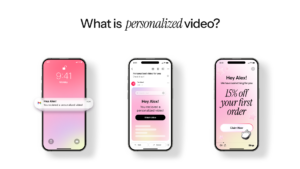
A personalized thank-you video, delivered after a significant purchase or milestone, signals something that generic email automation cannot: that the customer is seen as an individual, not a transaction. That signal drives the behaviors retention teams care about most: repeat purchases, referrals, and long-term loyalty.
The mechanics are simple. Record or generate a personalized video and embed or link it directly within your existing thank-you email workflow. For high-value customers or loyalty milestones, a video built specifically around their history with the brand will outperform any static message. Personalization for post-purchase email workflows
5. Repurpose content that has already proven itself
If a blog post has generated meaningful traffic or engagement, the argument it makes has already been validated by your audience. That is not a reason to leave it as text.
Converting a high-performing post into a video does two things. First, it extends the reach of content you know resonates into a format consumed by a different segment of your audience. Second, it reinforces the message for people who encountered it the first time as text.
Use the original post as your script outline. The structure is already there. Focus your production energy on translating the argument into visual terms, whether through motion graphics, on-camera explanation, or illustrated scenes. The goal is not a reading of the post. It is a version of the same idea that works in a different medium.
6. Whiteboard and scribing formats still hold attention
Whiteboard-style video, sometimes called video scribing, has maintained its effectiveness because it works on a simple cognitive principle: people follow the hand. The act of drawing out an idea in real time creates a sense of discovery that keeps viewers engaged longer than a static slide deck or a talking head.
The production requirements are modest. A camera, a tripod, good lighting, and someone who can draw clearly are sufficient to produce a compelling whiteboard video. The more important variable is content selection. The format works best for explaining processes, illustrating cause and effect, or walking through a decision framework. It is less effective for pure product demos.
Varying playback speed strategically, slowing down to emphasize a key concept, speeding up transitions, can add rhythm and emphasis without requiring additional production resources.

Building a personalized video program that scales
The six approaches above each have value individually. The brands generating the most return from personalized video are not doing one of them well. They are connecting them into a coherent system where content flows between formats, channels, and audiences without requiring a full production cycle each time.
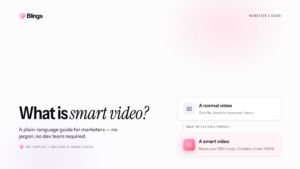
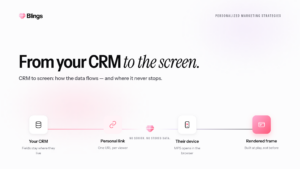
That is where Blings fits into the stack. As a Universal Personalization Platform, Blings uses a client-side architecture that generates each video on demand, directly on the viewer’s device. Your team builds a single Dynamic Master. Blings handles On-Demand Generation at the individual level, pulling live data to personalize each version in real time. The Live URL means each viewer receives a current, relevant experience without a new export or upload.
Because generation happens client-side, Blings never sees or stores your PII. For teams managing personalized video at scale, that is not a minor detail. It is the architecture that makes the whole approach viable.
Book a demo to try Blings today.