10 personalization benefits every loyalty program needs
 Yosef | Dec 3, 2024
Loyalty programs are everywhere. The average consumer belongs to more than sixteen of them, yet is only active in just over half. That gap is not a coincidence. It is a signal. Programs that fail to stay relevant to the individual customer get deprioritized, ignored, and eventually forgotten.
The fix is not a better points system or a shinier app. It is personalization: communications, rewards, and experiences that reflect what each customer actually wants. Done well, personalization transforms a loyalty program from a passive perk into an active driver of engagement, retention, and revenue.
This post breaks down ten specific personalization capabilities your loyalty program needs, along with the strategic rationale for each.
Why personalization is non-negotiable for loyalty programs
65% of a company’s revenue comes from repeat business. A loyalty program is one of the most direct levers for protecting and growing that share. But a program customers do not actively use is not protecting anything.
Personalization addresses the core reasons programs lose momentum:
– Engagement: Customers who receive content and offers aligned with their actual interests have a reason to keep opening messages and logging in. Generic promotions do not clear that bar.
– Retention: A program that demonstrates real understanding of a customer makes it harder for competitors to pull them away. Personalization raises the switching cost without raising the price.
– Satisfaction: Relevant offers and experiences make customers feel recognized. When personalization extends to addressing specific feedback or requests, the effect compounds.

Three challenges that hold personalization back
Before exploring what great personalization looks like, it is worth naming the real obstacles. Most teams are not failing for lack of ambition. They are failing because the infrastructure is not keeping up.
- Scaling
Traditional personalized content production follows a predictable sequence: ingest customer data, integrate it with a content template, produce a distributable output, and deliver it at the right moment. That workflow breaks down at enterprise scale. Teams managing millions of customers cannot realistically execute that process for each individual without automation purpose-built for volume.
- Real-time data
Timing determines relevance. Content that is not surfaced at the right moment loses most of its impact. Waiting for a customer to log in and discover an offer on their own is a passive strategy. Pushing content requires both the right channel selection and the assurance that the content will render correctly when it arrives.
- Engagement quality
Personalization built on stale or inaccurate data does not just underperform. It erodes trust. Customers who receive recommendations that miss the mark are less likely to engage next time. Real-time data access is not a nice-to-have. It is a prerequisite for personalization that actually works
10 personalization benefits every loyalty program needs
1. Onboarding
The moment a customer enrolls is when their intent is highest. A personalized onboarding experience capitalizes on that moment by delivering information that is immediately relevant to them, not a generic walkthrough. [INTERNAL LINK: personalized onboarding content overview]
Video is a particularly effective format for onboarding because it conveys instructions clearly and efficiently. Personalized video raises that ceiling further: a new member who sees their name, their chosen preferences, and guidance specific to their situation is far more likely to absorb the information and act on it.
2. Hyper-Personalization
Hyper-personalization uses advanced data analytics, often AI-powered, to tailor content to real-time customer behavior. Digital browsing patterns, in-store activity, and contextual signals all feed into a picture of what a customer needs right now.
The operational requirements are significant: live data monitoring and software capable of acting on it in real time. But when the infrastructure is in place, hyper-personalization enables the kind of precisely timed messaging that drives purchase decisions. [INTERNAL LINK: hyper-personalization capabilities page]

3. Gamification
Awarding points for specific behaviors, milestones, or challenges gives customers a reason to interact with your brand beyond the transactional. Personalized communications tied to gamified features make that invitation feel relevant rather than generic.
A customer who is close to a tier threshold responds differently to a progress nudge than a customer who just enrolled. Personalization ensures each message lands with the right context.
4. Personalized Ways to Earn Rewards
Reward structures that are anchored to purchase categories a customer never engages with are invisible to that customer. Personalizing the paths to earning rewards, connecting them to a customer’s actual purchase history and stated preferences, ensures the program is always presenting a visible and attainable incentive.
Intent data adds another layer. If behavioral signals indicate a customer is considering a specific purchase, adjusting the reward structure to nudge them across the finish line is a direct application of that data. Similarly, if gamification is part of the program, the activities that earn points should reflect what each customer is most likely to do.
5. Personalized Offers and Rewards
There is no strategic reason to present every customer with the same menu of rewards when the data exists to tailor it. Unique offers based on individual preferences and purchase history make each customer feel that the program is designed for them specifically.
Some programs go further by allowing customers to provide direct feedback on desired benefits or to configure their own reward preferences. The key constraint is choice architecture: too many options introduces friction and degrades the experience. Real-time personalization can address this by calibrating the degree of customization offered based on each customer’s demonstrated preferences.

6. Customer Hubs or Dashboards
Customers should never have to hunt for information about where they stand. A well-designed hub or dashboard surfaces point totals, active offers, and approaching expiration dates without requiring the customer to go looking. [INTERNAL LINK: loyalty program dashboard or customer experience page]
The personalization opportunity here is in connecting the dots. If a customer has enough points to redeem a reward they are likely to want, and that reward is expiring soon, the dashboard should make that connection explicit. A short personalized video within the dashboard experience is a high-impact way to surface exactly that kind of timely, actionable information.
7. Loyalty Tiers
Segmenting customers by participation level serves two purposes. It simplifies offer management by allowing teams to target communications by tier rather than attempting to segment by every individual variable. It also creates a visible progression that motivates higher engagement: customers who can see a path to better benefits have a concrete reason to increase their activity.
Personalized communications at each tier level reinforce the relevance of the program to where each customer actually is, not where the average customer is.
8. Great Recommendations
Purchase-history-based recommendations have been a retail standard for years. AI has expanded what is possible, enabling product discovery experiences that draw on a much broader set of behavioral and contextual signals.
Data-driven recommendations become significantly more effective when delivered through loyalty program content, where the customer is already in a relationship context with the brand. The combination of relevant product suggestions and a channel built on earned trust is a reliable driver of incremental sales.
9. Personalized Video
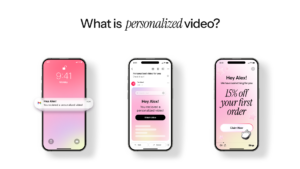
Video is the preferred content format for the majority of consumers. Personalized video raises the stakes further: content that addresses a viewer by name, references their specific history, and presents offers calibrated to their behavior is materially more likely to prompt a click and a conversion.
Historically, the barrier was production cost and complexity. Creating individualized video at scale required resources that most organizations could not justify. That constraint has changed. Platforms built on on-demand generation now make it possible to produce personalized video at enterprise scale without proportional increases in time or cost. [INTERNAL LINK: personalized video capabilities or MP5 technology page]

10. Reward and Savings Recaps
Periodic recaps that show customers the concrete value they have received from the loyalty program serve as a recurring reminder of why the program is worth their attention. Spotify Wrapped is the clearest example of this mechanic at scale: a personalized summary of a customer’s year that generates significant organic engagement.
Applied to a loyalty program, a recap that surfaces a customer’s most relevant rewards, savings, and experiences, while drawing attention to benefits they have not yet used, reinforces the program’s value without requiring any new offer. The content already exists. Personalization determines how it is framed for each individual.
Putting it into practice
The ten capabilities above are not independent features. They are a compounding system. Personalized onboarding builds initial engagement. Better engagement generates better data. Better data enables more precise offers, recommendations, and timing. The result is a loyalty program that gets more relevant over time, not less.
The infrastructure requirement is real. Scaling personalized content, particularly dynamic video, across a large customer base demands a platform built specifically for that purpose. Blings operates as a Universal Personalization Platform designed to meet exactly that challenge.
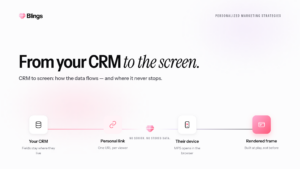
Using a single Dynamic Master, Blings generates personalized video on demand, directly on the customer’s device. The on-demand generation approach means every asset reflects real-time data at the moment of viewing, with no server-side rendering bottleneck and no PII exposure. The Live URL workflow means content can be pushed across any distribution channel, including SMS and email, and update itself without requiring a new production cycle. For loyalty teams managing campaigns at scale, that eliminates the manual render-and-upload cycle that creates the most operational drag. [INTERNAL LINK: Blings platform overview or how it works page]