Personalization

What is personalized video? The complete 2026 guide

Yonatan Schreiber's avatar Yonatan Schreiber | Aug 3, 2026
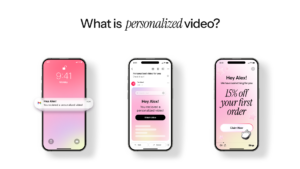
A graphic with phone mockups asking What is personalized video, used for a blog post on embedding video in email campaigns.
Yonatan Schreiber's avatar Yonatan Schreiber | Aug 3, 2026

Personalized video is one of the most significant developments in enterprise marketing of the past decade. Yet the term covers a wide range of technologies, architectures, and use cases, and the differences between implementations have enormous consequences for cost, data privacy, content accuracy, and scale.

This guide covers everything a marketing, CRM, or customer experience professional needs to understand about personalized video in 2026: how it works technically, what the different types are, when to use it, how to measure its impact, and how to choose a platform that fits your enterprise requirements.

What is personalized video?

Personalized video is video content that dynamically incorporates data specific to each individual viewer. Rather than producing a single video that every recipient sees identically, personalized video uses customer data to make each viewing experience unique to that person.

At its most basic, personalization might include the recipient’s name overlaid on a branded visual. At its most sophisticated, personalized video can incorporate a customer’s specific account balance, loyalty tier, recent transaction history, local weather, renewal date, and behavioral triggers, all rendered in real time at the moment the video is viewed.

The critical distinction that separates the most powerful personalized video implementations from basic personalization is when and where the personalization happens. This distinction has major implications for data accuracy, data privacy, and cost.

How personalized video works

There are two fundamentally different approaches to generating personalized video content.

Server-side rendering

In the server-side model, a batch process runs before the campaign is distributed. The platform pulls customer data, renders a unique video file for each recipient, stores those files in cloud infrastructure, and distributes links to individual recipients. By the time a customer clicks and watches, they are watching a pre-existing video file.

This approach gives creative teams high control over cinematic output, and it is well-suited to one-time campaign productions. Its limitations become significant at scale: the cost of rendering grows linearly with volume, every video file contains data that was accurate at render time (not at view time), and the customer’s PII is processed on a third-party server.

Client-side generation (On-Device Generation)

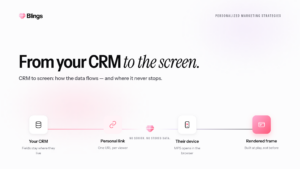
In the client-side model, no video is rendered in advance. The platform stores a Dynamic Master Template: the visual design, animation logic, and data schema for the personalized content. When a recipient opens the communication, the template pulls live data from the client’s own CRM or CDP and generates the personalized video directly on the viewer’s device, at the Moment of Open.

This is the architecture that Blings pioneered with its MP5 Format. An MP5 file is not a traditional video file. It functions like live code: always current, always connected to the live data source, and never stored as a static asset in a third-party environment.

The consequences of this approach are significant:

  • Data accuracy at the Moment of Open: A loyalty email opened three weeks after send shows the customer’s current points balance, not the balance from three weeks ago. This eliminates Data Decay.
  • Zero-Knowledge Architecture: Because the video renders on the viewer’s device using a live connection to the client’s own infrastructure, the personalization platform never sees or stores the customer’s PII.
  • Scale economics: One Dynamic Master Template generates millions of unique versions without proportional cost increases. Infrastructure Pricing replaces per-render fees.

Types of personalized video

Personalized video spans a wide range of use cases across the customer lifecycle.

  • Onboarding and welcome videos. When a new customer joins, a personalized onboarding video that uses their name, their specific product or plan, and their account details increases the probability they complete key activation steps. Welcome videos with personalized next-step recommendations have demonstrated measurably higher onboarding completion rates than static emails.
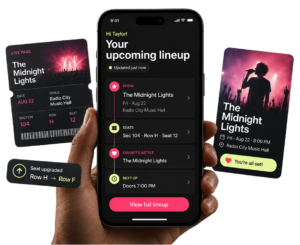
  • Loyalty and rewards communications. Loyalty program members respond to content that reflects their actual status: their specific points balance, their tier level, the exact rewards available to them today, and a clear path to the next tier. Blings’ work with Live Nation demonstrated the power of this use case directly, achieving a 12.3x return on investment through personalized fan loyalty videos.
  • Billing and account statement videos. Financial services companies, telecom providers, and utilities have traditionally communicated complex account information through dense PDF statements. A personalized video summary that walks a customer through their statement, highlights anomalies, and presents relevant offers significantly increases comprehension and reduces inbound customer service volume.
  • Renewal and retention communications. As a renewal date approaches, a personalized video that references the customer’s specific contract, their usage over the period, the value they received, and the consequences of lapsing is more effective than a text-based renewal reminder. The specificity signals that the brand is paying attention.
  • Re-engagement and win-back campaigns. Customers who have gone quiet respond better to content that acknowledges their history with the brand than to generic promotional messages. Personalized re-engagement videos that reference the customer’s last interaction, what has changed since then, and a specific offer relevant to their profile demonstrate relevance.
  • Behavioral trigger communications. When a customer takes a specific action (viewing a product, hitting a savings milestone, completing a purchase), a real-time personalized video triggered by that action reinforces the behavior and drives the next step in the journey. This use case requires the on-demand generation architecture to work effectively: the video must be current at the moment of the trigger.
  • Annual and milestone recap videos. “Year in review” style videos that summarize a customer’s history with a brand, their usage, their achievements, and their top moments are among the highest-engagement personalized video formats. These tend to work best as high-production-value annual campaigns.

Why personalized video outperforms static content

The performance advantage of personalized video over static or generic content is well-documented across industries and use cases.

  • Engagement: Blings clients consistently see 8.5x engagement boosts when personalized video replaces static personalization in lifecycle communications. The combination of motion, visual identity, and data-accurate personalization captures and holds attention in ways that text and static imagery cannot.
  • Completion rates: McDonald’s achieved a 54% video completion rate using Blings-powered personalized content, a figure that reflects genuine customer interest rather than passive delivery. Average video completion rates for non-personalized marketing video are typically far lower.
  • Conversion: Across deployment types, Blings clients see up to 4x conversion uplift. When a customer sees content that is accurate, relevant, and specific to their situation, the probability of the desired action increases.
  • Customer retention: Personalized video that makes customers feel understood and valued at key moments in the lifecycle – renewal, account review, loyalty milestones – reduces churn by creating emotional connection alongside transactional communication.

According to Wyzowl’s Video Marketing Statistics report, 91% of businesses use video as a marketing tool, but far fewer deploy it at true personalization scale. The gap between “using video” and “using personalized video as infrastructure” represents a significant competitive opportunity.

When to use personalized video: the right use cases

Not every communication benefits equally from personalized video. The moments where it creates the most value share common characteristics.

Personalized video delivers the highest return when the communication involves data the customer cares about (their specific account, their specific history, their specific offer), when the moment is emotionally significant (a loyalty milestone, a welcome, a renewal), when complexity needs to be simplified (a billing statement, a portfolio review, a policy summary), or when re-engagement requires a demonstration of relevance.

Standard promotional broadcast is typically not the right application. If the message is the same for every recipient and the personalization would be limited to a name in a subject line, the investment in personalized video infrastructure is not justified.

The highest-ROI deployments combine data richness, lifecycle relevance, and high frequency.

How to measure personalized video ROI

Measuring the return on personalized video investment requires selecting the right metrics for your specific use case. The most relevant measurement framework depends on what action the video is designed to drive.

  • Engagement metrics: Video open rate, play rate, and completion rate establish baseline engagement. Completion rate above 50% indicates strong relevance and content quality.
  • Conversion metrics: Click-through rate from video to the desired action (account renewal, offer acceptance, purchase, support ticket avoidance) connects engagement to business outcomes.
  • Retention metrics: Churn rate in the period following a personalized video campaign compared to a control group that received a static communication. This is the most direct measure of loyalty and retention impact.
  • Customer service deflection: For billing, statement, and account summary videos, measuring the reduction in inbound service inquiries provides a direct cost-saving calculation.
  • Revenue per communication: The incremental revenue generated per personalized video send compared to the baseline of a static communication. For loyalty and upsell programs, this is often the most compelling metric.

The denominator in these calculations should account for the platform’s cost model. With Infrastructure Pricing, the cost per communication decreases as volume increases, which improves ROI dramatically compared to per-render pricing models where cost grows with volume.

How to choose a personalized video platform

The right platform depends on your use case, your data infrastructure, your regulatory environment, and your scale.

  • Architecture: Ask how and where the video is generated. Server-side rendering means pre-built files and data decay. On-Device Generation means real-time accuracy and Zero-Knowledge Architecture. For regulated industries or high-volume always-on programs, the architecture question is the most important one.
  • Data integration: The platform must integrate directly with your CRM or CDP. The depth and flexibility of that integration determines the richness of personalization you can deliver. Ask specifically about which data fields are accessible, how the connection is authenticated, and what happens when data changes after a campaign is sent.
  • Pricing model: Per-render pricing is appropriate for low-volume, high-production-value campaigns. Infrastructure Pricing is required for high-frequency, always-on lifecycle programs. Model the cost at your anticipated annual volume before committing.
  • Data privacy: For any enterprise handling PII, ask directly: does the vendor’s platform ever see, process, or store your customer data? Understand the data residency and processing terms in the contract. For an overview of how different platforms handle this, see Idomoo vs SundaySky: why 2026’s best personalized video is neither.
  • Creative and technical support: Evaluate what it takes to go from a brief to a live campaign. Platforms that require significant development work for each new template create ongoing Technical Debt. Platforms that support a Zero Tech Debt model – where one template generates indefinitely without re-production – are better suited to enterprise operations.

For a direct comparison of Blings against the most commonly evaluated alternatives, see Blings vs Plainly: the best enterprise video automation choice 2026.

Getting started with personalized video

The most effective way to begin a personalized video program is to identify the one highest-value communication in your customer lifecycle: the moment that is highest in emotional relevance, richest in customer-specific data, and most closely tied to a retention or conversion outcome.

For most enterprises, this is either a loyalty milestone communication, an annual statement or recap, or a renewal trigger. Start there. Measure the impact against a control. Use the results to build the business case for expanding to additional use cases across the lifecycle.

The infrastructure investment in a Universal Personalization Platform pays the highest dividends when the initial deployment proves the model and creates organizational confidence to scale. Blings works with enterprises across financial services, telecom, retail, and entertainment to build and scale these programs, and the platform’s In-House Studio and Hybrid Model service options mean your team does not need to start from scratch.

FAQ

What is the difference between personalized video and dynamic video?

These terms are often used interchangeably, but there is a useful distinction. Dynamic video refers to any video content that changes based on variables, including simple A/B tests or basic name insertions. Personalized video typically refers to content that incorporates rich, individual customer data, such as account details, behavioral history, and real-time status information, to create a genuinely unique experience for each viewer.

Is personalized video the same as interactive video?

Not necessarily, though the two often overlap. Interactive video allows viewers to make choices that affect what they see next. Personalized video adapts to the viewer’s specific data. Some platforms, including Blings, support both within the same MP5 asset: the video is personalized with the viewer’s data and interactive in that it responds to their choices.

How much does personalized video cost?

Costs vary significantly depending on the platform architecture and pricing model. Per-render pricing is common in server-side platforms and scales linearly with volume. Infrastructure Pricing, used by Blings, is template-based and does not increase proportionally with the number of personalized versions generated. For enterprise programs reaching millions of customers, the pricing model is often more important than the per-unit cost.

How long does it take to deploy a personalized video program?

With a platform that supports a Hybrid Model or In-House Studio service, enterprises typically move from brief to live campaign in three to six weeks. The complexity of the data integration and the creative scope are the primary determinants of timeline.

Is personalized video compliant with GDPR and CCPA?

It depends entirely on the platform’s architecture. Server-side rendering means customer PII is processed on a third-party server, which creates compliance obligations. Blings’ Zero-Knowledge Architecture means the platform never sees or stores customer PII, because the video renders on the viewer’s device using a live connection to the client’s own infrastructure. This is the most straightforward path to regulatory compliance for personalized video in regulated industries.

What industries use personalized video most effectively?

Financial services, telecom, retail, entertainment and sports, travel and hospitality, and insurance are among the most active deployments. Any industry with a significant ongoing customer relationship and rich customer data has a strong use case for personalized video.

What is the Moment of Open?

The Moment of Open is the specific instant when a recipient opens a communication and the personalized content is generated. Blings’ On-Device Generation technology means the data displayed in the video reflects the customer’s live account data at that exact millisecond, not the data that existed when the campaign was sent. This is the solution to Data Decay.

Your customers are waiting for great video experiences.

Schedule a custom demo