Best Practices
Email Marketing

Optimizing your email marketing for better conversions

Corrie's avatar Corrie | Apr 29, 2026
Blog post cover image for Optimizing Email Marketing for Better Conversions 2026 by Blings, featuring bold typography on a warm pink-to-yellow gradient background with a decorative four-pointed star graphic
Corrie's avatar Corrie | Apr 29, 2026

Introduction

Most email programs leave real money on the table. Open rates tell you who noticed. Click rates tell you who was interested. Conversions tell you what the program is actually worth. If your campaigns are hitting inbox benchmarks on opens and clicks but still underperforming on revenue per send, the gap is almost always in segmentation, personalization, and timing, not in subject lines. This post walks through how to close that gap step by step.

We will cover what good looks like in 2026, why the same email converts differently for different segments, how to personalize in a way that actually moves the numbers, and a five-step playbook you can run this quarter.

What is a good email conversion rate in 2026?

A good email conversion rate in 2026 is between 2 and 5 percent across most industries, with top-performing programs routinely clearing 7 percent on targeted flows. For benchmarks to be useful, break the question into three numbers:

  • Open rate: who noticed
  • Click-through rate: who was interested
  • Conversion rate: who took the action you cared about

According to Klaviyo’s 2026 email marketing benchmarks, the average click-through rate across industries hovers around 2.4 percent, with flow-based automations (welcome, abandoned cart, post-purchase) clicking at roughly three times the rate of broadcast campaigns. Industry matters: retail and consumer goods run hotter on opens than B2B software, for example.

The number that matters most is not the average. It is your delta from baseline. If your welcome flow converts at 8 percent and your broadcasts at 1 percent, you do not have a conversion problem overall. You have a broadcast problem.

Why does the same email convert differently for different people?

Because the email is the same, but the reader is not. Intent, context, lifecycle stage, and product affinity all change what a given message is worth to a recipient. A 15 percent off code is valuable to a price-sensitive browser. It is irrelevant to a loyalty member who already gets 20 percent off. The same email in both inboxes will convert at wildly different rates, and the average hides the range.

This is the first principle of conversion optimization: an email that is right for the sender and wrong for the recipient is an email that does not convert. Fix the match between the message and the segment before you fix the message itself.

How do you segment for higher conversion?

Start with the four segmentation dimensions that drive the biggest conversion deltas, in order of payoff:

  1. Lifecycle stage. New subscribers, active buyers, at-risk, and win-back each need a different ask. According to research cited by Campaign Monitor, segmented campaigns generate roughly 30 percent more opens and 50 percent more clicks than unsegmented ones, and the biggest gains come from lifecycle splits.
  2. Engagement recency. Someone who opened yesterday is a different audience than someone who has not opened in 90 days. Treat them that way. Re-engagement flows should look and sound different from active-subscriber flows.
  3. Purchase history and product affinity. Recommend what the recipient has already shown interest in, not what the catalog team is trying to move this week.
  4. Behavioral triggers. Cart abandonment, page views, quiz completions, and tier changes. These are the signals that give email its advantage over paid channels: real intent, captured in real time.

A practical rule: if you are sending the same campaign to more than 30 percent of your list, you are probably under-segmented. If you are sending to less than 3 percent, you are probably over-segmented and starving the model of data. The sweet spot is somewhere in between, and you find it by testing.

How do you personalize beyond the first name?

Merge tags in the subject line used to be a competitive edge. In 2026 they are table stakes. The programs that win on conversion personalize along three dimensions that most senders still ignore:

  • Offer personalization. Show each recipient the discount, bundle, or reward that is relevant to their tier, balance, or history. A 10 dollar off code for someone who averages 15 dollar orders is a conversion. The same code for a 250 dollar order is a gift.
  • Creative personalization. The hero image, the product grid, and the video can all change per recipient. Brands that drop a single hero creative into a mass send are leaving the biggest visual real estate in the inbox untouched.
  • Moment personalization. The content that is accurate when the email is sent is not always accurate when it is opened. Loyalty balances change, inventory shifts, offers expire. Personalization that reads live data at the Moment of Open keeps the email accurate regardless of the send-to-open gap. See Blings’ piece on personalized video emails for a deeper look at this pattern.

Personalization works when the recipient feels like the email was written for them. It stops working when the personalization is obviously shallow (the first name pasted into a generic sentence) or visibly broken (the loyalty balance is six months stale).

How does live content and timing change the economics?

Two levers often get underused: live content that updates after send, and timing that adapts to the recipient.

Live content matters because most senders design a campaign assuming the data at send time will be the data at open time. It will not. A customer whose balance changes between Monday morning and Monday afternoon opens an email that is already wrong. With traditional creative, the only fix is a re-send. With live content, the email self-corrects at the Moment of Open.

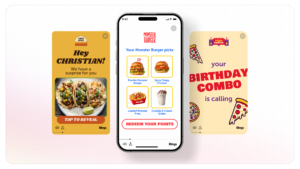
Blings’ MP5 technology is built for this case: a code-based video format that generates on the recipient’s device at the moment they open the email, pulling live data from the CRM. That eliminates the Data Decay problem without adding a re-send to the calendar. For a working example, Habit Burger Grill ran a loyalty email campaign with personalized video tied to each member’s current balance; the published case study reports a 47 percent lift in loyalty signups and a share rate roughly 13 times the industry benchmark.

Timing matters because inbox attention is not evenly distributed. Send-time optimization (letting the ESP pick the best time per recipient based on past behavior) consistently outperforms a single batch send. The lift is smaller than segmentation (usually single-digit percent on opens), but it compounds across every campaign.

What should you test and measure week over week?

The point of testing is to change decisions, not to generate reports. Pick tests that will change what you ship.

  • Subject line and preheader. The cheapest test you can run. A/B test one variable at a time, hold a meaningful sample size, and promote the winner to the main send.
  • Hero creative or video. The biggest pixel in the email. Static image versus personalized video, one product versus a grid, face versus no face. These are high-leverage tests.
  • Offer structure. Percent off versus dollar off, single product versus bundle, scarcity versus no scarcity. Most programs test creative obsessively and offer rarely. Flip that ratio.
  • CTA placement and count. Single CTA versus multiple, above the fold versus below, text versus button. Small changes, measurable wins.

Track three tiers of metrics:

  1. Inbox metrics: delivery rate, open rate, CTR, unsubscribe rate.
  2. Behavior metrics: time on site from email, add-to-cart rate, video completion if applicable.
  3. Revenue metrics: conversion rate, average order value, revenue per send, customer lifetime value of email-acquired customers.

The metric that drives budget conversations is revenue per send, not open rate. Build the dashboard around that number and let the rest support it.

A five-step playbook to improve conversions this quarter

If you only do five things, do these.

  1. Audit your current segmentation. How many segments do you actually send to? If the answer is “two or three,” that is your fastest win. Split by lifecycle stage first.
  2. Kill one broadcast, replace it with a flow. Broadcast campaigns generally convert at one-third the rate of behavioral flows. Pick the worst-performing broadcast on your calendar and replace it with a triggered flow.
  3. Add one live data point to your top two campaigns. Loyalty balance, next-best-offer, inventory, or recent activity. Live data at the Moment of Open is the single fastest way to lift conversion on existing creative.
  4. Install send-time optimization. Most modern ESPs (Klaviyo, Braze, Salesforce, HubSpot) support this natively. Turn it on and let it run for four weeks before judging.
  5. Build a weekly revenue-per-send dashboard. Track five campaigns or flows by that single metric. Move them up or down based on what the dashboard shows, not on what the creative team likes.

For a tactical walkthrough of adding personalized video to an email flow, see Blings’ guide on using email marketing videos correctly.

Frequently asked questions

What is a good conversion rate for email marketing?

Across most industries, a good conversion rate is 2 to 5 percent, with top flows clearing 7 percent. The better comparison is not your number against the industry average; it is your flows against your broadcasts. If flows convert three times higher, that is your opportunity to shift volume.

Does email segmentation really improve conversion?

Yes. Campaign Monitor research shows segmented campaigns generate roughly 30 percent more opens and 50 percent more clicks than unsegmented ones, and the conversion delta is usually larger still because intent matters more than reach.

How much does personalization lift conversion?

The lift depends on the depth. First-name personalization gives a small bump (a few percent on opens). Offer and creative personalization tied to live CRM data can lift conversion by 20 to 60 percent on targeted flows.

Is video in email worth it?

For most programs, yes. Video in email drives higher watch time and longer session lengths post-click. Personalized video (where the video adapts to the recipient) outperforms generic video embeds on conversion. Blings’ personalized video email case data shows meaningful lifts over static sends. Habit Burger Grill‘s case study reports a 47 percent signup lift on a loyalty email using MP5 video.

How often should I re-test my email program?

Audit segmentation and creative quarterly. Test subject lines and CTAs continuously. Review the revenue-per-send dashboard weekly. The cadence matters more than any single test.

See how Blings can work for you
Get Custom Demo