Best practices
Email marketing
Industry benchmarks
(QSR) quick service restaurants
Email

The best QSR emails arrive before you need them

Yosef's avatar Yosef | Oct 28, 2026
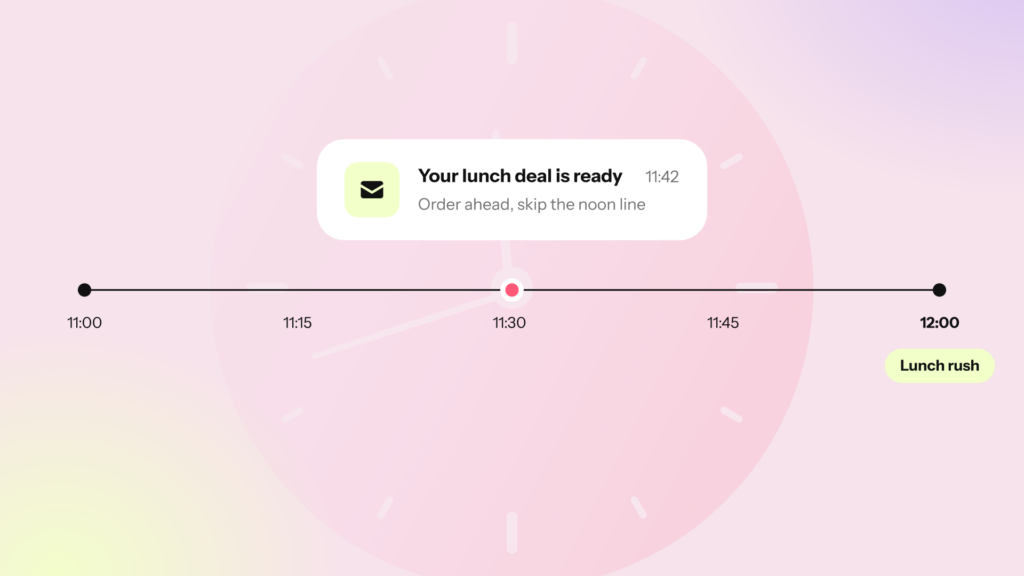
Horizontal timeline with a notification card reading Your lunch deal is ready, on a pastel pink and purple gradient.
Yosef's avatar Yosef | Oct 28, 2026

Most conversations about email timing start and end with the welcome: how fast does it land after someone signs up? The quick service and fast casual category has largely solved that. The brands that stood out in our study solved the harder problem: sending the right message early enough for a person to act on it.

We tried to join more than 300 quick service and fast casual email, loyalty, and lifecycle programs by hand, using one identity and one inbox. This post covers what the category does well on timing, and the brands that treat the send time as part of the offer.
Speed is the category’s solved problem

Start with the good news, because it is genuinely good.

Time from signup to first email Share of brands
Within 5 minutes 52%
Within 1 hour 70%
Within 24 hours 77%

The median brand sent its first email two minutes after signup. More than half replied inside five minutes, and seven in ten replied inside the hour. For a category that runs on thin teams and franchise systems, that is a strong baseline.

Taco Bell is a good example of how fast a modern program can move. Once we found its web signup form, the welcome arrived in sixty-six seconds. That is the standard the best of the category sets: the confirmation lands while the subscriber still has the brand’s site open in another tab.

Lead time turns an offer into a plan

Speed matters for a welcome. For everything after it, lead time matters more. A same-day email asks someone to rearrange today. An email with notice lets them plan around it.

Three brands handled this especially well.

  • Peet’s Coffee sent its National Coffee Day offer six days early, with a subject line that named the price and the day and a preview that added the one instruction the subject left out: “Visit a Peet’s on 9/29 and bring a quarter.”
  • Tijuana Flats emailed a catering offer for National Taco Day about two weeks ahead, valid “from 9/21/2026 – 10/26/2026.” Catering is the purchase that most needs lead time, because someone has to plan a party, an office lunch, or a game day around it. Tijuana Flats gave them the room.
  • Texas Roadhouse sent a Labor Day email the evening before the holiday, announcing that its New Rochelle restaurant would open early “Monday, September 7 at 11AM” and closing with “We’ll see you here tomorrow.” One email, one store, one specific hour, and a full night’s notice.

The common thread is that the subscriber could act on the email the moment she read it, rather than discovering it after the window had closed.

Day-part timing that matches the meal

Some of the best-timed emails in the study were simply aligned with when people eat.

Tijuana Flats sends its “Lunch for $8.99” emails late in the morning, before noon Eastern. A lunch deal that lands at 11:30 is a suggestion for the next hour. The same email at 3 PM is a suggestion for tomorrow, and most people will have forgotten it by then.

Krispy Kreme ran an evening offer on its Original Glazed dozens, with a preview that told subscribers exactly where to be between 5 and 7 PM, and sent it in the early afternoon. The email arrived with a few hours of runway before the window opened, which is exactly enough time for an after-work plan.

Texas Roadhouse gave a two-day window on a free appetizer offer, “today, September 14 or Tuesday, September 15,” so a subscriber who could not make it on a Monday still had a second chance.

Timing around the subscriber’s own dates

The most personal timing in the study came from birthday programs. Church’s Texas Chicken sent its birthday email the day before the date on file, so the reward was already waiting on the day itself. Denny’s sent two birthday emails a few days apart, and the second spelled out a hard deadline, “be sure to claim your gift by 10/6/2026,” along with step-by-step redemption instructions.

Both brands treated the birthday as a window rather than a single moment, which gives the subscriber time to actually show up.

What this means if you run one of these programs

  • Keep the welcome fast. The category median is two minutes. If yours takes longer than an hour, it is behind most of its peers.
  • Send offers with notice. Give people a day or more for anything that requires a visit, and a week or more for catering and group orders.
  • Match the send to the meal. Lunch deals before lunch. Dinner deals in the afternoon. Breakfast deals the night before.
  • State the window plainly. A specific day and hour, like “Monday, September 7 at 11AM,” removes every question a subscriber might have.
  • Treat dates as windows. A birthday, an anniversary, or a holiday lasts long enough to send ahead of it and again before it closes.

The gap this points at

On speed, the category is in good shape. The opportunity is everywhere after the welcome. Roughly 15 percent of the brands we timed took more than 72 hours to send a first email, and the distribution was split rather than spread: brands tended to be nearly instant or days late, with little in between. The brands in this post show that the same discipline that makes a welcome fast can make every later send arrive at the moment it is most useful.

Frequently asked questions

How fast should a restaurant welcome email arrive?

Within minutes. In our study, the median QSR brand sent its first email two minutes after signup, more than half arrived within five minutes, and seven in ten arrived within the hour.

What is the best time to send a restaurant promotional email?

Ahead of the meal or the window it promotes. Lunch offers work best late in the morning, and evening offers work best in the early afternoon, so the subscriber has time to plan.

How far in advance should a restaurant email about a holiday or observance?

Far enough for the subscriber to plan. Peet’s Coffee sent its National Coffee Day offer six days early, and Tijuana Flats sent a National Taco Day catering offer about two weeks early.

Should birthday emails arrive on the birthday?

On or before it. Church’s Texas Chicken sent its birthday email a day ahead, and Denny’s followed up with a clear claim-by date, which gives the subscriber time to redeem.

What is the QSR Email Index?

An independent, self-funded benchmark of quick service and fast casual email programs, measured from the subscriber’s side. We try to join every program by hand, using one identity and one inbox, and score every message that arrives against a fixed rubric.

Your customers are waiting for great video experiences.

Schedule a custom demo