Personalization
Customer experience
Email marketing
(QSR) quick service restaurants
Email

Your restaurant, not just your brand: the QSR emails that use location well

Yosef's avatar Yosef | Nov 12, 2026
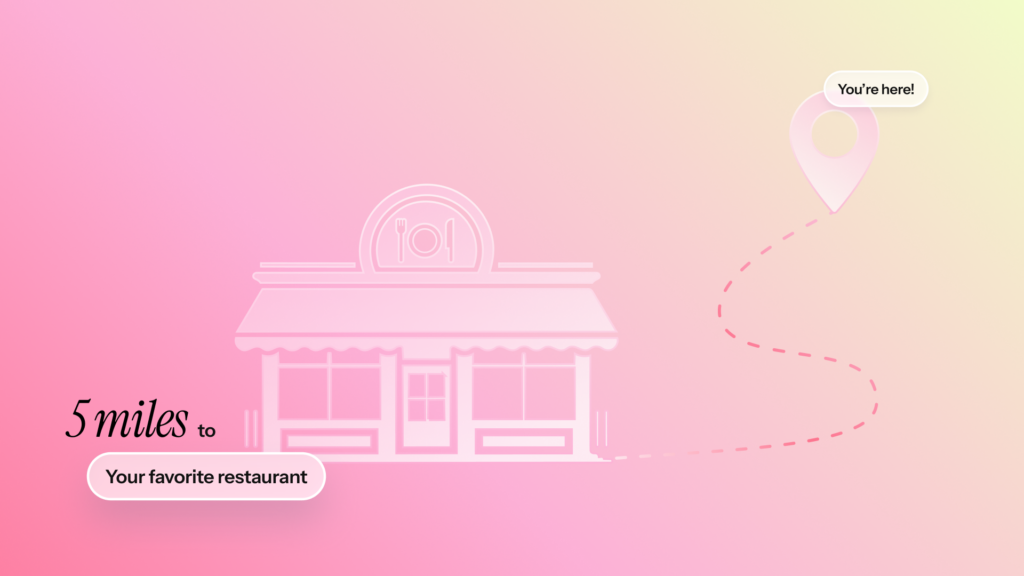
Illustration of a restaurant storefront on a pink gradient, with a dashed path to a map pin labeled You're here and a caption reading 5 miles to your favorite restaurant.
Yosef's avatar Yosef | Nov 12, 2026

Quick service is a local business wearing a national logo. Every restaurant has its own hours, its own address, its own waitlist, and sometimes its own menu. Most email programs know which location a subscriber chose. Very few put it to work. The ones that do send some of the most useful email in the category.

We tried to join more than 300 quick service and fast casual email, loyalty, and lifecycle programs by hand, using one identity and one inbox. About one in ten of the brands we scored sent store-specific content: not just a store name, but hours, offers, or actions tied to a particular restaurant. This post is about how they did it.
Texas Roadhouse: one restaurant, one email

Texas Roadhouse builds its email around a single restaurant rather than the national brand, and it is the clearest example of location done well in the study.

Its Labor Day email was written for one store. It named “Texas Roadhouse in New Rochelle, NY,” announced that the restaurant would open early “Monday, September 7 at 11AM,” and offered $5 off with a barcode “Valid at the listed location only.” It printed the store’s street address and phone number, linked to that restaurant’s own Facebook page, and sent every button, from the digital menu to the waitlist, to that location’s pages.

Later emails followed the same pattern, from a dinner-for-two special at the same restaurant to a free appetizer valid on two named days. The subscriber always knows where the offer applies, when the doors open, and how to get a table.

Texas Roadhouse also handles the obvious follow-up question in its footer. Subscribers can update their preferences, “including which location you receive emails from.” Location is not just merged in. It is something the subscriber can control.

A&W: name the store, then confirm it

A&W did two things almost no one else did. First, it named the subscriber’s store right at the top of the welcome: “Your A&W: Fishkill, New York.” Soon after, it sent an email with a subject line that asked the question directly: “Are we serving you at the right location?”

That second email is the one to study. It is a data hygiene email disguised as a friendly check-in, and it is the only one of its kind we captured. A brand that asks whether it has the right store is a brand planning to use that store in every email that follows. It also reminds the subscriber that she has a local A&W, which is a marketing message in itself.

What store-specific content looks like

Store-specific email goes well beyond printing a location in the footer. The strongest examples in the study used location in at least one of these ways.

Location detail What it does for the subscriber
Store name in the opening line Confirms the email is about her restaurant
Hours or a special opening time Tells her when she can actually go
Street address and phone number Removes the step of looking it up
Store-scoped offer Makes clear exactly where the deal applies
Waitlist, order, or menu link for that store Turns interest into a visit in one tap
A way to change the location Keeps the data accurate over time

Texas Roadhouse used nearly every row in this table. Most of the work is in the template, not the individual send, which is why one brand can do it consistently across every email.

Why location matters more in restaurants than almost anywhere else

  • The visit is physical. A national offer still has to be redeemed at a specific counter, and the closest one is the only one that matters.
  • Restaurants differ. Hours, menus, delivery zones, and local events vary by location, and a generic email cannot reflect them.
  • The data is already there. Many signup forms ask for a ZIP code or a favorite store. Using it requires no new collection.
  • Local feels personal. A subscriber who sees her own neighborhood restaurant reads the email as a message from a place she knows, not a corporation.

How to use the location you already collect

  • Name the store in the first line. Follow A&W and Texas Roadhouse and lead with the restaurant, not the brand.
  • Link every action to that store. Menus, waitlists, ordering, and directions should open the right location.
  • Include hours and contact details. Especially for holidays, early openings, and special events.
  • Scope offers clearly. If a deal is valid at one location, say which one.
  • Ask subscribers to confirm their store. A short check-in email keeps the data accurate.
  • Let subscribers change it. Put the location in the preference center.

The gap this points at

Location is the widest gap we measured. Nine in ten brands never referenced where the subscriber was, even though many of them asked for a ZIP code or a home store at signup. The brands in this post show that the gap is not a data problem. The data is collected and stored. It is a content problem, because building a different version of every email for every restaurant has traditionally meant more creative than any team can produce.

That is the gap Blings was built to close. A Smart Video template is built once, and every variant is generated on demand at the Moment of Open, so each customer can see her own restaurant, its hours, and its offer in the same send. The Smart Video Link drops into an existing CRM campaign like any other merge field. Build once, personalize forever.

Frequently asked questions

How do restaurant brands personalize email by location?

The strongest examples in our study named the subscriber’s restaurant, included its hours and contact details, scoped offers to that location, and linked every action to that store’s own pages. Texas Roadhouse did all of these.

How many QSR brands use location in email?

About one in ten of the brands we scored sent store-specific content. Nine in ten never referenced the subscriber’s location.

What is a location confirmation email?

A short email asking the subscriber to confirm her preferred restaurant. A&W sent one with the subject “Are we serving you at the right location?” It keeps location data accurate and signals that the brand plans to use it.

Should a restaurant let subscribers change their location in email preferences?

Yes. Texas Roadhouse lets subscribers choose “which location you receive emails from,” which keeps the data current as people move or change routines.

What is the QSR Email Index?

An independent, self-funded benchmark of quick service and fast casual email programs, measured from the subscriber’s side. We try to join every program by hand, using one identity and one inbox, and score every message that arrives against a fixed rubric.

Your customers are waiting for great video experiences.

Schedule a custom demo