
Ask three vendors how long personalized video takes to implement and you will get three answers, because they are measuring different things. Implementation time is not one number. It is the sum of a few independent tasks, and the architecture you choose decides how big each one is. Here is an honest breakdown, plus how Blings compresses the timeline to days, and in some cases to a single day.
Best practices
Personalization
Email
How long does personalized video implementation actually take?
 Yonatan Schreiber | Nov 16, 2026
The four tasks that make up implementation
Every personalized video project, on any platform, moves through the same four tasks. The timeline is just how long each one takes for your situation.
- Getting access. A self-serve signup is instant. An enterprise contract runs through procurement, security, and legal first.
- Building the creative. Adapting a template is hours. A custom production is weeks.
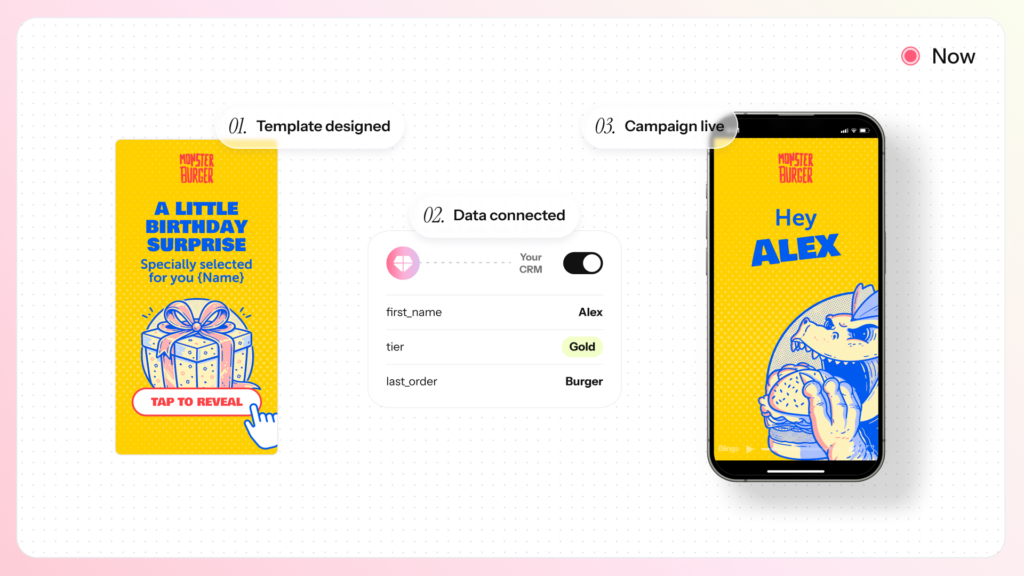
- Connecting the data. Merge tags in a link are minutes. A custom API or data pipeline is a sprint.
- Testing and launch. One real test send and a QA pass, which is short once the first three are done.
Where the time usually goes
For most teams, the clock is dominated by two tasks: access and creative. The data connection is faster than people expect, especially when the platform uses merge tags rather than an API build, and testing is rarely the bottleneck. So if you want to shorten implementation, the highest-leverage moves are starting from a template and choosing a platform that does not require an engineering project to pass data.
How architecture changes the math
The rendering model quietly adds or removes a whole task. A server-side platform renders and stores a file for every version, which adds production and storage time up front and a re-render every time the data changes. On-device generation removes that step: the video is generated on the viewer’s device at the Moment of Open, so there is nothing to render in advance and nothing to re-render later.
This is why two projects with the same creative can have very different timelines. The one that has to produce and manage files carries work that the on-device one simply does not.
How fast Blings goes live
Blings is built for speed. Because Blings uses on-demand generation on the viewer’s device, there is no render queue, no file storage, and no re-render cycle to plan around. Teams adapt a Dynamic Master instead of starting from a blank canvas, and they connect existing CRM fields through merge tags in the Live URL rather than commissioning a new data pipeline.
The result: most Blings campaigns go live in days, and some have launched within 24 hours of kickoff. When the creative is ready and the data already lives in your CRM, the only thing left is a test send and a QA pass.
A realistic range
| Scenario | Typical time to first live campaign | With Blings | Why |
|---|---|---|---|
| Template adapted, merge-tag data, self-serve | Days | As little as 24 hours | No procurement, no API build, no render step |
| Custom creative, merge-tag data | A week or two | A few days | Creative production is the long pole; Blings removes render and re-render time |
| Enterprise procurement, managed production | Several weeks | Days once contracts are signed | Contracts set the pace; the build itself stays short |
How to shorten your own timeline
- Start from a template. Inherit scenes and data fields instead of building from scratch.
- Use the data you already have. Map existing CRM fields with merge tags rather than commissioning a new data flow.
- Pick an architecture without a render step. On-device generation removes production and re-render time.
- Scope the first campaign small. Ship one program, then reuse the template for the next.
Frequently asked questions
How long does personalized video take to implement?
It ranges from days to several weeks on most platforms. The drivers are getting access, building the creative, connecting the data, and testing. With Blings, most campaigns go live in days, and some have launched within 24 hours.
What takes the most time in a personalized video project?
Usually getting access, which for enterprise contracts means procurement, and building the creative. The data connection is faster than expected when the platform uses merge tags.
Does the platform's architecture affect implementation time?
Yes. Server-side rendering adds production, storage, and re-render steps. On-device generation removes them, which shortens both launch and ongoing updates.
Can I implement personalized video without a developer?
For standard campaigns, yes. Merge tags in a link are a marketer’s task. A developer is only needed for backend or CDP-driven data.
How do I make my implementation faster?
Start from a template, use existing CRM fields with merge tags, choose an architecture without a render step, and scope the first campaign small.
You may also be interested in
Best practices
Email marketing
Most restaurant brands treated Halloween as a single email. The best ones built a game.
Learn more
Best practices
Personalization
Copy, paste, personalize: how Blings CRM integration works in HubSpot
Learn more
Best practices
Personalization