Industry Benchmarks

Raising Cane’s runs a $5 billion chicken chain. You cannot join its email list without driving to one.

Yosef's avatar Yosef | Sep 16, 2026
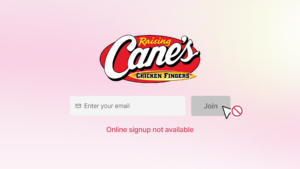
Raising Cane's Chicken Fingers logo on a pink gradient above an email field and a greyed out Join button, with a blocked cursor and the line, Online signup not available.
Yosef's avatar Yosef | Sep 16, 2026

Every email program starts with a front door: whatever a brand asks for before it will write to you. We have spent sixty days walking through more than 700 of them by hand, across 200+ brands, using one identity and one inbox.

Most brands in this category will take your email address in two fields and four seconds. Raising Cane’s asks you to get in a car.

To join the Caniac Club, the brand’s own page gives three steps, and the first one is not online:

  1. Head to your local participating Raising Cane’s location and ask a Crewmember for a Caniac Club card.
  2. Come right back to this page and click Register Your Card below.
  3. Enter your contact info and verify your email address.

There is no alternate path on that page. No “sign up online instead,” no email-only option, no web form hiding behind the card flow. The membership starts with a physical object that a person hands you inside a restaurant.

Raising Cane’s is the only one in the study that cannot be completed online at all.

Here is that page, captured on September 8, 2026.


Screenshot of the Raising Cane's Caniac Club signup page. The how to join list begins with: head to your local participating Raising Cane's location and ask a Crewmember for a Caniac Club card.

The Caniac Club signup page. Step one is not online, and there is no alternate path anywhere on the page.

Cane’s chose this door

It would be easy to file this as a small brand that never got around to building a web form. Raising Cane’s is not that.

Measure Raising Cane’s
US system sales $4.96 billion
US locations 828
Average unit volume $6.56 million
Units added in a year 101
Rank among US chicken chains Third, ahead of KFC

Those figures come from the QSR 50, and one of them deserves a second look. An average unit volume of $6.56 million is the second highest of any brand in the entire QSR 50, behind only Chick-fil-A. Cane’s does more business per restaurant than almost anyone in American fast food, from a menu with one item on it.

A company operating at that level has web developers. It has a mobile app, online ordering, and a working registration portal that the card flow sends you to anyway. The in-store requirement is not a missing feature. Somebody chose it, and kept choosing it.

The front door: Everything a brand makes you do before it will write to you: the fields it requires, the account it insists on, the codes it sends, and in one case the drive to a restaurant.

Every front door in the category, ranked

Across the programs we tried to join, the front door varies more than anything else we measure. Two things vary independently: how much a brand asks for, and how hard it makes you work to hand it over. These are examples from across that range, not the full list, ordered by the second.

Two fields, no friction. McDonald’s asks for an email address and a ZIP code, on its email list rather than its loyalty program. Waffle House asks for a name and an email address, and offers a birthday field it does not require. Neither brand makes you create an account, set a password, or clear a verification step.

Four fields, still no friction. A&W asks for a name, a contact preference, an email address, and a date of birth, then deletes the phone field entirely when you choose email. It puts your chosen restaurant in the first line of the welcome. It asks for twice what McDonald’s does and makes you work no harder to give it.

Verification first, then more fields. Pizza Hut and Firehouse Subs both email a code before they will send you marketing, and both keep asking after the code clears. Pizza Hut ends at three fields, Firehouse at four including a birthday. A code proves mailbox control, which is a stronger consent record than a checkbox.

A password and a phone number, both mandatory. Ten brands running on one common loyalty platform each required both to join what is functionally an email list. None of them verified the phone number, and most never used it.

Phone first, email second. Swig collects a phone number under consent language that covers text messages only, and treats the email address as secondary. Crumbl built one of the fastest-growing dessert chains in the country on social and SMS, and still arrives at four fields: name, phone number, email address, and birthday.

Two-factor authentication. The Great Greek required an emailed verification code and a texted verification code, neither optional, behind a panel advertising “Join Our Email List.” Four fields wait on the other side: name, email, phone, and a favorite location.

A card, in person. Raising Cane’s, and five fields once you are through, including the number printed on the card itself. There is no browser path to any of them.

The door does not predict the program

The obvious conclusion is that a hard front door signals a serious program behind it. Our data says the opposite at both ends.

McDonald’s asked for the least and did the least with it. Two fields, the easiest signup in the category, and then eight days of silence. No welcome email ever arrived. When the first message finally came, it used neither field it had collected: no store, no local offer, nothing tied to the ZIP code it had asked for. The address was a delivery pipe.

Waffle House asked for two fields and ran the best small program we captured. A welcome inside five minutes carrying a real coupon, product news on the day it was relevant, and a birthday reward that actually arrived. Three emails, three genuinely different jobs, behind a form with no account and no password.

So the front door tells you what a brand is willing to ask for. It tells you nothing about what the brand will do with the answer. Every extra field is a promise, and most of the promises in this category go unkept.

The clearest measure of that, among the brands in this comparison: four made a birthday mandatory, and not one of them used it. The single birthday email came from Waffle House, the one brand here that offers the field without requiring it, and it acted on the date almost immediately.

every front door in the category 1 scaled

What Cane’s door buys, and what it costs

Take the in-store requirement seriously for a moment, because there is a real argument for it.

A card handed over by a crew member guarantees the member has been inside a restaurant. It makes membership a physical object rather than a row in a database, and physical objects get kept in wallets. It creates a human moment at the counter. It also filters hard: nobody joins the Caniac Club by accident, on a whim, from a competitor’s parking lot, or because a discount site told them to. Every member is, by construction, someone who already showed up.

For a brand doing $6.56 million per restaurant, a list of confirmed visitors may genuinely be worth more than a bigger list of strangers. That is a defensible trade, and brands that make it deliberately deserve to have it described accurately rather than mocked.

Chick-fil-A is the useful comparison, because it is the only brand in the QSR 50 with a higher average unit volume than Cane’s. Its rewards program is app-first, and it is widely assumed to be app-only. It is not. The web door works, and no download is required to walk through it. The largest app-centric loyalty program in the category still lets a stranger join from a browser, which makes the in-store card a choice rather than a constraint of operating at scale.

Here is what the trade costs.

The people who want in the most are the ones who cannot act. Somebody reading about Cane’s, watching a location get built near them, or landing on that page from a search has to hold the intention until their next visit. Intent does not survive a car journey. Every other brand in this study captures that person in the moment.

It excludes anyone without a nearby location. Cane’s added 101 restaurants in a year and is expanding hard. The people in markets it has not reached yet, who are exactly the audience worth warming up before a location opens, cannot join at all.

The promise on the page requires the data it makes hard to collect. The Caniac Club page advertises “special surprises for your birthday, member anniversary and more.” Both of those are date-triggered programs. Both need a field. The brand has built a door that guarantees the member visited, then used the space behind it to promise the two most personalization-dependent rewards in the category.

That last one is the interesting tension, and it is not a criticism of the offer. It is a question about sequencing. If birthday and anniversary rewards are the pitch, the address is worth capturing before the visit, not only after it.

What we are seeing in 2026

Sixty days and more than 300 programs in, three patterns hold across the category.

The front door is getting harder while the program behind it is not getting better. Password and phone requirements are now the default on the major loyalty platforms, and none of the brands running them verified the phone number they insisted on. The extra fields get collected because the platform offers them, not because a campaign needs them.

Verification is the one piece of added friction that pays. Pizza Hut and Firehouse Subs both email a code before they send marketing. A code proves mailbox control, which is a stronger consent record than a checkbox and a cleaner list at the end of the year. It is the only added field in the study that reliably earns its place.

Date-triggered rewards are promised far more often than they are sent. A birthday or an anniversary is the most common thing a signup page advertises, and it is the rarest thing the inbox receives.

Three things worth taking from the comparison.

  • Audit your own front door as a stranger. Open your signup page in a private window, on a phone, on a network you do not control, and try to complete it. Several brands in this study have working web forms that are effectively invisible, and at least one keeps a fully functional form alive behind an app prompt. Nobody inside those companies knows, because nobody inside those companies signs up.
  • Count the fields against the sends. Every field you require is a commitment to use it. If you collect a birthday, a ZIP code, or a home restaurant and none of them ever appear in a message, you have added friction and bought nothing with it.
  • Decide what the door is for. Cane’s door is filtering for visitors, and that is coherent. A door that collects a password and an unverified phone number to send a weekly discount email is not filtering for anything. It is just a door.

Why the fields go unused

None of this is an effort problem. Every brand here is running a competent program under real constraints.

The pattern underneath is structural. A field costs nothing to collect, so it gets collected. Acting on it has historically meant a brief, a designer, a variant, a build, and a deadline, so it does not get used. The distance between what a brand knows about a customer and what it actually says to them is created by how personalized content gets made, not by how much anyone cares.

That is the gap Blings was built to close. A Smart Video template is built once, and every variant is generated on demand at the Moment of Open, from data that never leaves the customer’s own stack. Create once, personalize forever.

A birthday field is only worth asking for if something happens on the birthday.

Get more insights

Want updates as this study progresses?

Subscribe now to receive updates as new information is published and get first access to the final report.

Frequently asked questions

Can you join the Raising Cane's Caniac Club online?

Not entirely. The brand’s own instructions require you to visit a participating restaurant and ask a crew member for a physical Caniac Club card first. Registration and email verification happen online afterward, and members can later link the account to the app to go cardless, but the first step cannot be completed from a browser.

Why would a restaurant require an in-store signup?

It guarantees every member has visited at least once, it makes membership a physical object rather than a database row, and it creates a human interaction at the counter. The trade is that it cannot capture anyone at the moment they decide they are interested, and it excludes people in markets without a location.

Which QSR email program is easiest to join?

McDonald’s asks for the least of any brand we tried: an email address and a ZIP code, with no account, password, phone number, or CAPTCHA.

Does a harder signup mean a better email program?

No. The relationship does not hold in either direction. The easiest front door in our study was followed by eight days of silence and no welcome email, while one of the best programs we captured sits behind a two-field form with no account and no password.

What is the QSR email index?

An unsolicited, self-funded benchmark of quick service and fast casual email programs, measured from the subscriber’s side rather than from platform analytics. We try to join every program by hand, using one identity and one inbox, and score every message that arrives against a fixed rubric.

Your customers are waiting for great video experiences.

Schedule a custom demo