Personalization
Entertainment
Health
Email
SMS
Website

How data drives personalized marketing campaigns

Yonatan Schreiber's avatar Yonatan Schreiber | Aug 1, 2026
Blings blog cover with the headline How data drives personalized marketing campaigns, featuring a pink geometric graphic.
Yonatan Schreiber's avatar Yonatan Schreiber | Aug 1, 2026

Data-driven personalization uses live customer data to tailor the content, offer, and creative each individual sees at the moment they engage. The strongest marketing campaigns do not guess. They read from the CRM, react to the last interaction, and reflect the customer’s current status, balance, or behavior in every touchpoint. According to McKinsey’s Next in Personalization report, personalization drives a 10 to 15 percent revenue lift on average, with some companies reaching 25 percent.

This post covers what data-driven personalization actually means, which customer data powers it, how to deliver it at scale without sacrificing accuracy, and what the performance looks like when the data, creative, and delivery layers stay in sync.

What is data-driven personalization in marketing?

Data-driven personalization is a marketing approach that uses customer data (identity, behavior, CRM attributes, purchase history, or real-time triggers) to tailor the content, offer, or creative a customer sees in every channel. Instead of pushing one message to everyone, marketers build a single Dynamic Master Template and let the data decide what each person receives.

The goal is one-to-one communication at one-to-many scale. Strong programs share three traits:

  • A unified view of the customer, usually through a CRM or CDP
  • A content system that can vary at runtime, not just at send time
  • A measurement loop that feeds engagement data back into the data layer

Why is customer data the backbone of personalized marketing?

Customer data is the backbone because without it, personalization is a guess. With it, every asset speaks to a specific person’s context, preferences, and lifecycle stage.

Consumer research reinforces the point. McKinsey found that 71 percent of consumers expect personalized interactions, and 76 percent feel frustrated when they do not get them. Companies that grow faster than their peers drive roughly 40 percent more of their revenue from personalization.

The takeaway is clear: data is no longer a marketing advantage. It is the baseline.

What types of data power personalized marketing campaigns?

Personalized marketing campaigns draw from four data categories:

  • Identity data: name, email, account ID, and loyalty number
  • Descriptive data: demographics, segment, tier, and region
  • Behavioral data: purchase history, click patterns, product usage, and in-app activity
  • Contextual data: device, location, time of day, current offer, and live loyalty balance

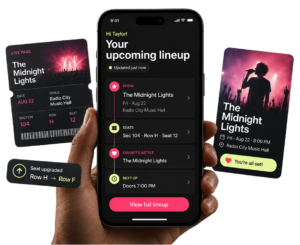
The more data sources connect to the creative layer, the more relevant the communication. A welcome email that shows a customer’s name is table stakes. A welcome video that shows the customer’s name, the products they browsed last week, and the loyalty balance at the instant they open is the frontier.

How does personalization at scale actually work?

Personalization at scale works when the creative is a template that reads from live data rather than a static file that has to be re-rendered for every variant. This is why Blings built its architecture around MP5 technology, a code-based video format that generates On-Demand, on the recipient’s device, at the Moment of Open.

The difference is structural:

Legacy approach Data-driven approach
Pre-render thousands of MP4 variants One Dynamic Master Template
Data frozen at send time Data read live at the Moment of Open
Storage and compute scale with audience Compute handled by the client device
New offer requires a new render Swap the data source, the video updates

For a practical walkthrough of how this plays out across channels, see Blings’ guide on enhancing the customer journey with personalized video.

What is data decay, and why does it undermine campaigns?

Data decay is the gap between the moment a marketer sends a campaign and the moment the customer opens it. In that window, loyalty balances change, inventory shifts, offers expire, and the content becomes inaccurate.

This is the Moment of Truth Gap, and it is where most personalization efforts fail. An email sent with the perfect data at 10:00 AM can be stale by the time it is opened at 6:00 PM. If the content is baked into an image or a pre-rendered video, the stale data ships with it.

Blings’ Zero-Knowledge Architecture solves this by generating the content on the recipient’s device at the Moment of Open. The data is never stored on a Blings server. It is pulled live from the customer’s CRM at the moment the asset is viewed, ensuring Moments-of-Truth Accuracy at every touchpoint.

How can marketers close the insight-to-action gap?

Marketers close the Insight-to-Action Gap by connecting the analytics layer directly to the creative layer so a data insight triggers a content change without a manual production cycle.

Three practices help:

  • Build around the CRM, not around assets. Treat data as the source of truth. The creative should read from the CRM, not the other way around.
  • Use template-based infrastructure. One Dynamic Master Template can power millions of variants. Template-based Infrastructure Pricing replaces pay-per-render pricing and eliminates re-rendering cycles.
  • Close the loop with analytics. Engagement data (completions, clicks, and drop-offs) should flow back into the CRM to refine segmentation and improve the next campaign.

Teams that build this way turn personalization into Strategic Content Deployment. The outcome is fewer manual cycles, faster creative iterations, and Zero Tech Debt.

How do data-driven personalized campaigns perform?

Data-driven campaigns consistently outperform generic ones on engagement, conversion, and revenue. According to Twilio Segment’s 2023 State of Personalization Report, 62 percent of business leaders cite customer retention as a top benefit of personalization, and 56 percent of consumers say a personalized experience makes them more likely to become repeat customers.

Blings’ own customer data tells a similar story. McDonald’s used Blings’ MP5 technology to power its McCoins loyalty campaigns with direct integration to the loyalty database. The results, published in the case study:

  • 4.2x sales lift over benchmark
  • 5x app opens
  • 8.3x ROI
  • 54 percent video completion rate
  • 26 percent CTA click rate

Since 2021, McDonald’s has sent nearly 100 million MP5 videos through Blings. That volume is only possible because the data, creative, and delivery layers operate as one system.

How do you build a data-driven personalization workflow?

A working data-driven personalization workflow has five steps:

  1. Connect your data source. Integrate the CRM or CDP (Salesforce, HubSpot, Braze, Klaviyo, or a custom warehouse) with the creative platform.
  2. Define the variables. Map each data field (name, loyalty balance, next-best-offer, or any custom attribute) to a placeholder in the Dynamic Master Template.
  3. Build the template once. Design one asset that can variate across every scenario the data describes.
  4. Deploy the Live URL. Instead of distributing files, distribute a URL that reads from the live data source.
  5. Measure and refine. Pipe engagement analytics back into the CRM, update segmentation, and ship the next iteration without re-rendering.

This workflow reduces the Insight-to-Action Gap from weeks to minutes.

Frequently asked questions

What is data-driven personalization?

Data-driven personalization is the practice of using customer data to tailor the content, offer, or creative each individual sees, rather than sending the same generic message to everyone.

Why does data accuracy matter in personalized marketing?

Because customer data changes constantly. If the data is stale when the asset is viewed, the personalization becomes inaccurate. Blings solves this by generating content at the Moment of Open so the data is always live.

What data sources power personalized video?

CRM and CDP systems are the primary sources, including Salesforce, HubSpot, Braze, Klaviyo, and custom data warehouses. Real-time triggers such as loyalty balances, inventory, or current offers can also feed the creative at the Moment of Open.

How does personalization affect revenue?

McKinsey found that personalization drives a 10 to 15 percent average revenue lift, with some companies reaching 25 percent.

What is the difference between personalization and data-driven personalization?

Personalization can be as simple as inserting a first name. Data-driven personalization is structurally different: the creative reads live data at runtime and adapts to every viewer without re-rendering.

Your customers are waiting for great video experiences.

Schedule a custom demo